Retail Robotics Enters the Scale Era
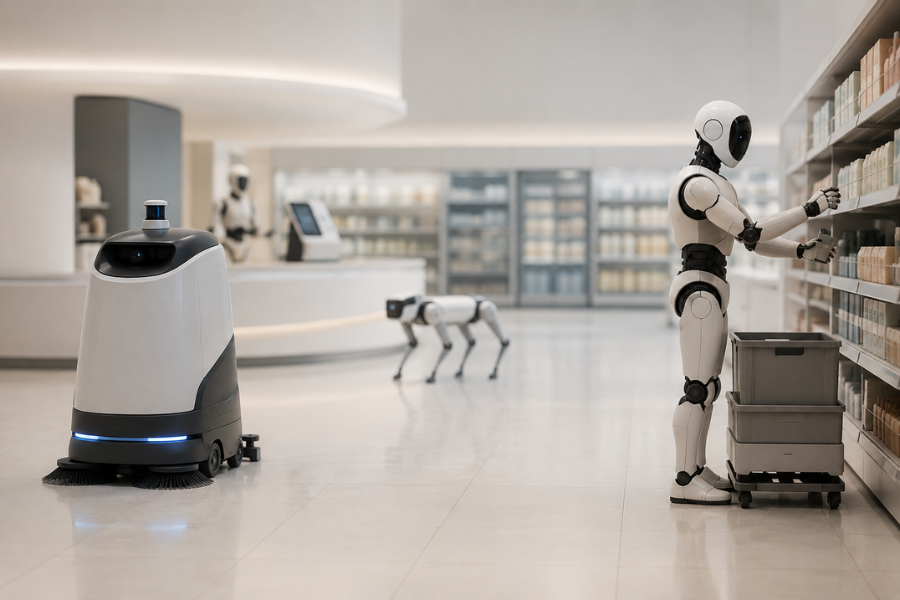
Promising pilots and dazzling trade show demonstrations have long characterised the retail robotics industry. In June 2026, that dynamic has fundamentally shifted. Across Europe and Asia, robots are moving out of controlled test environments and into daily store operations at scale, marking a transition from novelty to necessity.
What distinguishes the current wave of deployments is not the technology itself, but the scale and permanence of the commitment. Retailers are no longer running three-month trials in a handful of stores. They are rolling out hundreds of robots across national networks and integrating them into the fabric of daily operations. The narrative has shifted from what robots might do to what they are already doing.
The European Cleaning Robot Wave
The most visible evidence of this shift is unfolding in European supermarkets, where autonomous cleaning robots have become the unlikely vanguard of the robot workforce. In June 2026, two major retailers announced significant deployments on the same day, underscoring the momentum gathering behind retail automation.
In Switzerland, a discount supermarket chain formalised a partnership to deploy 200 cleaning robots across its store network. The deployment had already commenced in the autumn of 2025, scaling from an initial pilot in just four stores. The pilot had proven convincing enough to justify a full national rollout, demonstrating that the robots could reliably handle routine floor maintenance while remaining clearly visible to shoppers during store hours.
The driving force behind the decision was operational necessity. The supermarket had been expanding its fresh produce offerings, which significantly increased the daily cleaning workload across stores. Their Head of Sales emphasised the importance of hygiene in food retail: “We’re delighted to introduce smart helpers into our stores because hygiene and cleanliness remain top priorities in the supermarket environment”. Crucially, their leadership stressed that the robots are intended to relieve employees, not replace them. As he framed it, the machines are assistants: “Ideally, we can use the time saved for other tasks,” allowing staff to dedicate more time to high-value activities like customer service and detailed product range maintenance.
On the same day, a British grocery giant announced a partnership to roll out autonomous cleaning robots across 600 Express convenience stores. The machines are designed as “co-bots” to work alongside store colleagues, taking over routine floor cleaning to free up time for customer-facing service. The pair are laying claim to the first deployment of this scale in the UK convenience sector.
The Chinese Retail Robot Ecosystem
In China, the deployment of robots in retail has taken a more diverse and ambitious form. At a chain of large-format electronics and lifestyle stores, multiple types of intelligent robots have officially entered service as “intern employees” across several locations. The robots are assigned to a range of roles spanning both customer-facing and back-end operations.
A humanoid robot serves at the welcome desk, providing navigation to restrooms, service counters and brand areas, while also engaging customers with interactive performances. A four-legged robot dog provides guided tours, leading shoppers to specific product categories and adjusting its route in real time based on customer requests. In the back aisles, other robots handle standardised operational tasks: restocking shelves, tidying merchandise, organising storage areas and even making beds in display sections. The robots have achieved a single-item shelving success rate exceeding 90 percent.
The deployment represents what the company describes as the first example of a replicable commercial path for robot retail applications. The retailer is not merely testing robots but operating them as a normalised part of the workforce. The robots effectively alleviate peak-time customer service pressure, optimise the shopping experience and improve store traffic and service quality.
The deployment is supported by significant infrastructure investment. The retailer has built what it claims is the world’s largest and most comprehensive embodied AI data collection centre, with a plan to accumulate 5 million hours of real-world video data within a year and 10 million hours within two. The company has also launched an “Intelligent Robot Industry Acceleration Plan 2.0,” backed by tens of billions of yuan in resources, aimed at lowering the barriers to robot adoption and fostering an ecosystem of robotics solutions.
Humanoid Robots Enter the Retail Mainstream
The integration of humanoid robots into retail environments is accelerating across China. In Beijing, an embodied AI startup has opened autonomous retail stores known as “galaxy capsules” across the city and deployed humanoid robots in some of the city’s convenience stores. Inside these silver, spacecraft-like capsule stores, humanoid robots prepare coffee, retrieve drinks and serve customers without human assistance. The pace of improvement has been remarkable: when the startup opened its first capsule store in August 2025, a robot took 46 seconds to pick up and deliver a cup of coffee; less than a year later, that time had been cut to 18 seconds.
Hong Kong is set to receive its first humanoid robot-operated convenience store, located at the Hung Hom waterfront. The 9-square-metre capsule store will be managed by a humanoid robot model standing 173 centimetres tall with a 190-centimetre arm span engineered to restock shelves, select inventory items and manage customer checkouts.
The Human-Assisted Alternative
Not every retailer is pursuing fully autonomous robots. A startup in Utah is developing a different model: human-assisted robotic pickers that combine low-cost hardware with remote human supervision. The prototype, a basket on wheels with a single arm, can pick about 120 items per hour from grocery store shelves, managed by a remote human operator.
The company’s vision is less about replacing humans with robots and more about outsourcing difficult-to-fill entry-level jobs to remote workers willing to take on the work. The co-founders argue that if grocery stores in the United States struggle to stay fully staffed, it makes sense to open those jobs to remote workers in other countries. Their pitch is that lower overseas wages combined with increased worker efficiency will make the robots cost-effective. The goal is to eventually have one person manage multiple robots at a time as the software and hardware improve.
The Policy Backdrop
The commercial momentum is being reinforced by government policy. In June 2026, China’s Ministry of Industry and Information Technology and the State-owned Assets Supervision and Administration Commission launched a nationwide initiative to accelerate humanoid robot adoption across manufacturing, logistics, retail, healthcare and other sectors. The initiative aims to create more than 100 high-value application scenarios by the end of 2026 and drive large-scale deployment of more than 10,000 humanoid robots.
The policy reflects a broader ambition to turn humanoid robots into a new pillar of industrial growth. As one researcher put it, “What’s happening now is a transition from laboratory validation to large-scale commercial deployment. The key breakthrough is not that the robots can move. It’s that they can operate autonomously in complex, dynamic environments as part of everyday business operations”.
From Novelty to Necessity
The shift from pilot to scale represents a fundamental change in how retailers think about robotics. The machines are no longer curiosities or marketing attractions. They are operational tools addressing real business problems: labour shortages, rising costs and the need for consistent service quality.
The retailers leading this charge are not treating robots as replacements for human workers but as complements to them. As retailer leadership emphasised, the robots are intended to relieve employees, not replace them, freeing up staff for higher-value activities.
The retail robot workforce is no longer a vision of the future. It is a present reality, operating in supermarkets, convenience stores and department stores across Europe and Asia. The only question that remains is how quickly and how widely this model will scale.
Sources:

You may also like
Why Every Online Order May Soon Get a Made to Measure Box

AI Agents Step Into the Store Manager’s Office