The Rise of Autonomous Voice Agents in Retail
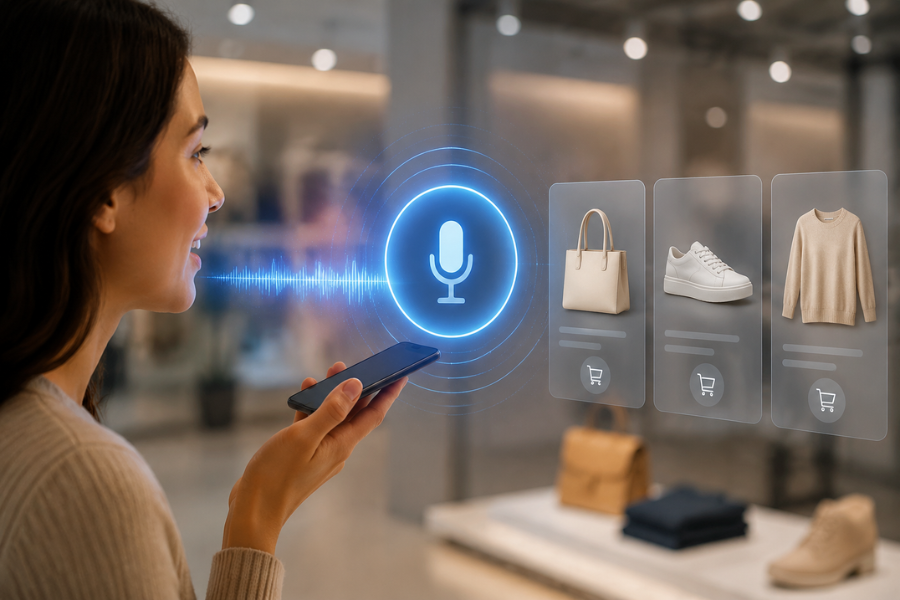
For years, retail chatbots followed a predictable pattern: they waited for a shopper to type a specific keyword and then offered a pre-programmed response. They could answer questions but rarely closed a sale. In 2026, a new generation of voice AI agents is changing that dynamic. Built on advanced real-time AI models, these systems can hold actual sales conversations, asking probing questions, adapting to shifting shopper needs and guiding customers toward a purchase, all without human intervention.
From Chatbots to Conversational Sales Agents
The distinction between a conventional chatbot and a modern voice AI agent is structural. A traditional chatbot waits for the shopper to type a specific keyword before it can respond usefully. A voice agent, by contrast, listens for context and asks follow-up questions to uncover what a customer actually needs, the way a trained sales associate would.
As one AI executive put it: “Customers do not want a chatbot. They want intelligence. ‘I need a refrigerator for a family of four, but my kitchen is small. Which one should I choose?’ Real customer service means being able to answer that question”.
The technology behind these agents typically combines several components. A retrieval-augmented generation system grounds the agent’s answers in real product data. The underlying AI model handles voice, text and image understanding within a single low-latency conversation, letting the agent stay responsive even as a shopper changes requirements mid-conversation.
Two Models of Deployment
Voice AI agents are being deployed in two primary configurations in retail.
1. In-store staff augmentation
One model equips floor staff with voice AI tools that provide real-time informational prompts during live customer conversations. The AI analyses intent and context, delivering instant data-driven recommendations, from product upgrades and bundles to cross-sell opportunities, directly to a tablet or any device with a microphone and screen.
This approach is designed for fast-paced retail environments. Instead of having customers wait while associates log into multiple systems, search through pricing plans or manually calculate options, the AI surfaces the right offer instantly, within the natural flow of conversation. The technology is purpose-built for noisy retail settings with minimal latency, orchestrating multiple specialised AI agents that securely access customer relationship management systems, billing, promotions, product databases and coverage tools.
As one industry executive observed: “Voice assistants and chatbots have been around for years, but truly effective, enterprise-grade voice interaction is only now becoming possible”.
2. Direct-to-consumer voice shopping
The second model involves voice AI agents that interact directly with customers, enabling them to discover products, ask follow-up questions and complete purchases using natural language. These systems target users who find typing, filters and structured keyword searches unintuitive, mimicking an offline shopping experience.
A generative AI-powered voice shopping assistant launched in February 2026 reached over 1.5 million users in its first phase of rollout, resulting in a 22 per cent higher conversion rate, alongside lower returns and cancellations. The assistant is designed for consumers who are comfortable with basic apps but find traditional e-commerce interfaces challenging, a demographic that exists across smaller towns, villages and even pockets of major cities.
Early Results
One of the most detailed deployments of a voice AI sales agent occurred at a Japanese home-appliance retailer in 2026. The retailer turned its sales associates’ expertise into a 24/7 multilingual voice agent built on real-time AI technology.
During a two-week public campaign on the retailer’s online store, approximately 30,000 people used the agent and 92 per cent of post-conversation survey responses were positive.
Customers described the agent as “easier to talk to than an actual sales associate” and appreciated being able to ask questions again without feeling stressed. The format also let shoppers speak candidly about budgets or uncertainty without feeling sales pressure, particularly after stores had closed for the day.
The technology developer described the deployment as “the beginning of an ‘interface revolution’ in retail”.
Consumer Readiness
The shift toward voice AI in retail aligns with broader consumer behaviour trends. Nearly half of online shoppers used AI to research their most recent purchase, according to PYMNTS Intelligence research conducted across the United States, Brazil and the United Arab Emirates.
That trust extends beyond research. 45 per cent of consumers say they would be comfortable letting an AI agent complete a purchase on their behalf, a figure that rises to 54 per cent among Gen Z.
Retailers are responding. 43 per cent of retailers are actively piloting autonomous AI shopping agents and 81 per cent of retailers say they already trust AI to operate autonomously once the right guardrails are in place.
However, significant trust gaps remain. Industry research found that one in four consumers say they will never delegate purchases to AI and 27 per cent trust no organisation to operate an AI shopping agent. 59 per cent of consumers say they would not trust any organisation to manage AI-powered shopping and payments.
Potential Benefits and Limitations
Documented benefits include higher conversion rates, as seen in the 22 per cent conversion uplift from the Indian deployment, faster response times, 24/7 availability across time zones and languages, and the ability to handle routine sales conversations while freeing human staff for more complex interactions.
The technology also appears to reduce customer anxiety. In the Japanese deployment, shoppers reported feeling more comfortable discussing budgets and uncertainties with the AI than with a human sales associate.
Documented limitations and challenges include persistent consumer trust concerns. A survey of more than 2,000 UK adults found that just 19 per cent of consumers trust AI assistants to follow rules for everyday purchasing decisions, compared with 55 per cent who trust a human expert or adviser. 68 per cent of consumers believe AI shopping agents may not act in their best interests.
Accuracy and reliability remain concerns. While AI models have improved significantly, they can still produce errors or hallucinations. One deployment acknowledged the need for “strong guardrails and evaluation metrics” to address these risks.
Data privacy is another consideration. Voice agents process personal information, shopping preferences and potentially payment details. How this data is stored, used and protected varies across implementations and remains a concern for consumers.
Market Context
The voice commerce market reflects the broader growth of voice AI in retail. The global voice commerce market is estimated at $150.34 billion in 2025 and is projected to grow to $194.03 billion in 2026, a compound annual growth rate of 29.1 per cent. The voice-activated shopping assistants market, a related category, grew from $6.84 billion in 2025 to $8.01 billion in 2026 and is expected to reach $22.45 billion by 2032.
By 2026, 53 per cent of all retail customer service interactions are expected to involve some form of voice AI, driven by consumer comfort, especially among millennials, 68 per cent of whom prefer voice-first shopping.
Conclusion
Voice AI agents are moving from experimental chatbots to functional sales associates capable of holding real conversations and closing transactions. The early evidence suggests they can deliver measurable improvements in conversion rates and customer satisfaction while operating 24/7 across languages and time zones.
However, widespread adoption faces significant hurdles. Consumer trust remains incomplete, with a substantial minority expressing reluctance to delegate purchasing decisions to AI. Accuracy, privacy and the potential for errors are legitimate concerns that retailers must address.
The technology is evolving rapidly and its trajectory will depend on whether it can earn the trust it requires. As one observer noted: “The things which sound and feel unfamiliar will within five to 10 years be totally normal”. Whether voice AI sales associates achieve that level of normalcy will depend on demonstrated reliability, transparent data practices and tangible value for both retailers and consumers.
Sources:

You may also like
Why Every Online Order May Soon Get a Made to Measure Box

AI Agents Step Into the Store Manager’s Office