Smart Glasses Move Into the Last Few Metres of Parcel Delivery
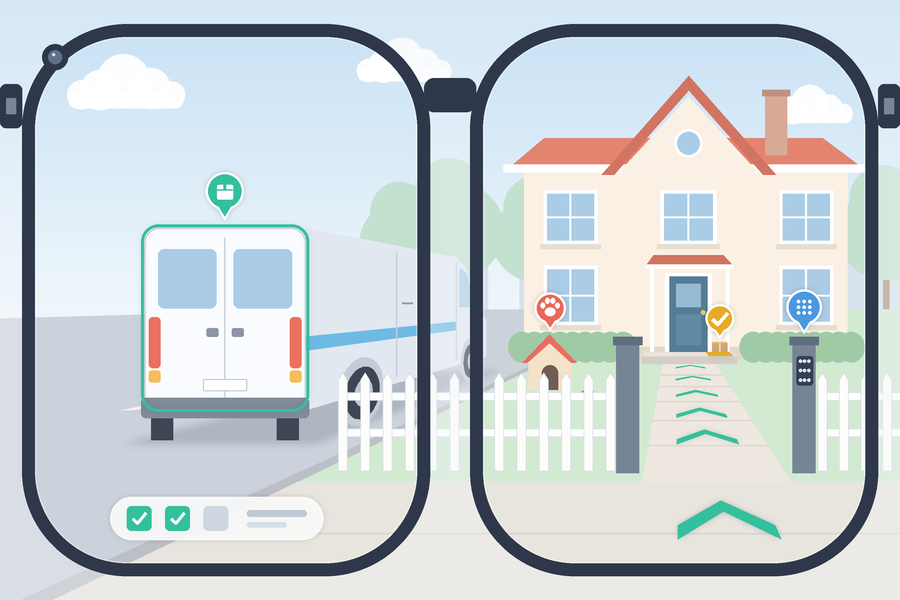
A delivery driver parks on a suburban street and the lenses in front of her eyes light up. Green highlights pick out the three parcels for this stop in the back of the van. A path appears on the pavement ahead, leading to a side gate whose code floats in view. A small paw print warns that a dog may be waiting in the garden. A major US online retailer now plans to put this kind of display on 5,000 drivers this year and more than 20,000 by the end of 2027. It is a large scale test of whether wearable screens can speed up the final steps of retail delivery, and of whether customers will accept cameras on every doorstep.
What is being rolled out
The retailer first showed its delivery glasses in October 2025 at an event in the San Francisco Bay Area. At that point they were an early prototype in testing with hundreds of drivers in North America. In an update on 23 October 2026 the company said drivers working for more than 300 of its delivery service partners have used the glasses since then. These partners are independent firms that employ the drivers and run routes under contract.
Supply chain trade publications reported the scale up in early November. The company plans 5,000 devices in 2026 and more than 20,000 by the end of 2027. Wearing them is optional for partners and for drivers. According to a technology news site summarising a newspaper column, the company has said the pilot supported more than 275,000 deliveries.
The move matters well beyond one network. Every online retailer pays for the final walk from kerb to door, and every failed or misplaced delivery adds cost and frustrates the customer.
From warehouse aisles to the front door
Workers in logistics have worn smart glasses for more than a decade, but almost always indoors. In 2015 a logistics provider ran a three week pilot in a warehouse at Bergen op Zoom in the Netherlands. Ten order pickers wore glasses that showed the aisle, the shelf location and the quantity for each task. They picked more than 20,000 items across 9,000 orders. The trial showed a 25 per cent efficiency gain over picking with handheld terminals.
The same provider later took the idea to Asia Pacific. In 2017 it began a proof of concept at a warehouse in Australia, comparing vision picking with manual, voice and radio frequency scanning. An earlier trial in Japan with a major retail customer had run into latency problems that were later solved. The provider then estimated a productivity gain of about 10 per cent.
Those systems worked because a warehouse is a controlled space with fixed shelves and known locations. A delivery round is the opposite. Every stop has a different layout, a different entrance and different hazards. Until now drivers have relied on a handheld scanner or a phone. They look down at the screen to find the parcel, read the notes, follow a map and take a photo, then look up again to walk. What has changed is that computer vision and artificial intelligence can now recognise parcels, read the scene around the driver and guide each step outdoors.
How the glasses work on a delivery round
The glasses switch on only when the driver parks. The display turns off while the van is moving, and the company says no images are captured between stops. Once parked, the display highlights the parcels that belong to the stop. The driver confirms each one by scanning its barcode in the van, and a virtual checklist updates as items are scanned.
On the walk, the glasses show navigation and delivery instructions. These include gate codes and the customer’s preferred drop off spot. A digital path is drawn on the ground towards the door. When delivery data suggests a pet is present, a paw print icon appears with an audio alert. The glasses also warn the driver when a parcel is about to be left at a location that does not match the address. A photo for proof of delivery is captured automatically.
The hardware has changed since the first prototype. After feedback from drivers, the computing parts and the battery moved out of the frame and into a small controller worn on the delivery vest. That controller has a swappable battery for a full shift and a dedicated emergency button. The glasses accept prescription lenses and lenses that darken in sunlight. Drivers can turn the camera off with a privacy switch.
What the glasses offer
The first gain is attention. A driver who no longer looks down at a phone can watch the path, the traffic and the steps ahead. A tester for one delivery partner in Omaha, Nebraska said he felt safer because the information was in his field of view.
The second gain is time. A news agency report cited by a Gulf newspaper said the aim is to shave seconds off each drop off. Across a full round, those seconds add up to extra capacity.
The third gain is accuracy. The wrong address alert targets misdelivered parcels, which add cost and hurt customer loyalty. The pet warning and the stored gate codes target familiar causes of delay at the door. Automatic photos also create a consistent record of where each parcel was left.
For the retailer, this sits inside a wider push to cut the cost of fast delivery. The same company is investing about $4 billion to extend same day and next day delivery into smaller towns and rural areas, according to a payments and commerce publication. Glasses that make each driver a little faster help that network reach further at the same cost.
The privacy question at the doorstep
The camera that makes the glasses useful is also their biggest challenge. The company says the camera takes still images only, with no video or audio. It says faces and number plates are detected and blurred, and that the images are encrypted and seen only by a limited number of people.
The volume of images is large. In a newspaper column summarised by a technology news site in September, a manager at the company said that a still image “every few seconds at least” was a good guess. A single shift could produce several thousand images, including pictures of private homes. Customers cannot opt out, view their images or ask for them to be deleted. The images also feed an artificial intelligence system that maps neighbourhoods. One driver who attended training called the glasses “definitely a dystopian move”. According to that driver, trainers tell drivers to switch on privacy mode during bathroom breaks and near schools or military sites.
Europe is already testing the limits of camera glasses in public. In September 2026 prosecutors in Paris opened a criminal investigation into suspected sexual harassment after women were filmed in the street without consent. France’s data protection authority said it had received fewer than 10 complaints about smart glasses used in workplaces. It added that businesses increasingly ask whether they can ban them. Under French law, recording a person’s image in a private place without consent can bring up to one year in prison or a €45,000 fine. Wearables that use artificial intelligence also fall under the European Union’s data protection rules and its AI law.
Other countries are moving too. Australia is considering barring camera glasses in government workplaces. Some cinemas in the United Kingdom have banned them. A German consumer group has filed a criminal complaint over privacy against a major maker and other sellers of camera glasses. A delivery fleet that wanted to use similar glasses in Europe would face these rules from day one.
There is also a workforce question. The columnist noted that drivers already face heavy pressure to finish their routes, so tools that guide every step will be watched closely by the people who wear them.
What it means for retailers
Retailers that run their own delivery fleets, and the carriers that deliver for them, now have a working model to study. The lesson from the warehouse pilots still holds. Glasses pay off when they remove a repeated glance at a screen and when the system already knows where things are. On the doorstep that depends on rich address data such as gate codes, entrance locations and delivery preferences.
The design choices are just as instructive. Moving the battery and the processor to the vest, switching the display off while driving and making use optional all respond directly to driver feedback. Any retailer considering similar tools will need the same attention to comfort and safety. It will also need a clear policy on images that customers can understand.
Customer trust is the harder test. A retailer that photographs front doors every few seconds is collecting data that customers have no way to opt out of. In markets with strict data protection law, consent, notice and retention will shape whether such glasses can be used at all.
The next steps for wearable guidance
The near term plan is clear. The company aims to reach 5,000 drivers this year and more than 20,000 by the end of 2027. It has said future versions should detect hazards such as dark areas better. It is also considering a privacy mode that switches on automatically by location rather than by hand.
Outside the United States, the use of camera glasses at work is being shaped first by regulators and courts. France, Australia, Germany and the United Kingdom are each drawing their own lines. Those lines will decide where the technology can travel next.
A decade ago smart glasses proved they could guide a picker down a warehouse aisle. The next two years will show whether they can guide a driver up a garden path, and whether the people behind those front doors are comfortable being part of the picture.
Sources
[2] GeekWire
[4] The Next Web
[6] Computerworld
[7] Logistik Heute
[8] Gulf News
[9] PYMNTS
[10] The Star

You may also like
Six Humanoid Robots Ran a Shanghai Store for a Day and Two Failed