Robots Learn to Sort Clothes They Have Never Seen
A returned jumper can arrive folded, crumpled or tangled. Until now that unpredictability kept the sorting of returned clothing in human hands. Robots built to handle items they have never seen are now taking on the job. A large German retail and logistics group announced on 28 October 2026 that it will put up to 25 of these dual arm robots to work on its returns. Weeks earlier, a major European online fashion retailer switched on the same kind of system at sites in Germany and Poland. For an industry that handles hundreds of millions of returns a year, robots that cope with the unknown are a new capability.
Two arms and a general purpose brain
The German group will start with 10 dual arm robots at a logistics centre in Poland run by its parcel business. If the first phase works, 15 more will follow. The robots grasp each returned item, identify it, assess it and sort it. A Stuttgart robotics company supplies, runs and maintains them as a service, so the retailer pays for the work rather than buying the machines.
What makes the system unusual is its software. The robots run on what their maker calls a physical AI model. It is a single general model for grasping and handling, and it does not rely on a catalogue of known products. It is built to deal with items it has never encountered, with no training for each specific product.
Workers stay in the loop. Staff move from handling returns by hand to supervising the robots, dealing with exceptions and making final quality decisions. The group says it will consider a wider rollout across its logistics network if the second phase succeeds. The project sits inside a medium term plan to invest €350 million in technology and AI.
The online fashion retailer’s deployment began in the week of 8 October at fulfilment centres in Greven, a town in northwest Germany, and Świebodzin in western Poland. A logistics partner runs those sites. The robots there grip, identify and sort fashion returns on their own. The retailer describes the two sites as the first step towards other European locations.
Why returns defeated automation
Germany shows the size of the problem. A returns research group at the University of Bamberg expected about 550 million return parcels in the country in 2025, a new record. Nearly one in four online parcels comes back. Fashion accounts for just over 80% of those parcels and about 90% of the returned items.
Each of those items has to be opened, checked and sorted before it can be sold again. For years that work has been done by hand. Boxes and containers are easy for machines because they have fixed shapes. Clothing is not. A shirt can arrive folded, crumpled or tangled. It changes shape the moment it is lifted.
Earlier robots could not cope with that variety. Most were programmed for known items in known positions. Each new product meant new data and new tuning, and fashion ranges change every season.
From picking known items to handling the unknown
The first sign of change came around 2020. A German warehouse that ships electrical supplies ran a picking robot controlled by one very large neural network for about four months. The robot used an ordinary industrial arm, a suction gripper and a simple camera. It could pick items it had never seen and retry when it failed. Its developers set a clear bar for usefulness. At 300 picks an hour, a robot that succeeds 90% of the time fails 30 times an hour. At 99% it fails about three times, and one person could oversee about 10 stations.
In 2023 the same German retail group signed up for AI picking robots from that developer. It planned 120 robots across its fulfilment centres over four years, starting with small apparel items such as jumpers.
The new generation goes further in two ways. The robots now work with two gripping arms rather than a single suction gripper. They also learn differently. Training relies heavily on simulation run on powerful graphics processors. The robot maker says it turns real picks into thousands of simulated variations, showing the same items in different garment states, packaging, materials and lighting, and tests new skills on cases the model has not seen. It says fixes can reach the robots in days rather than weeks.
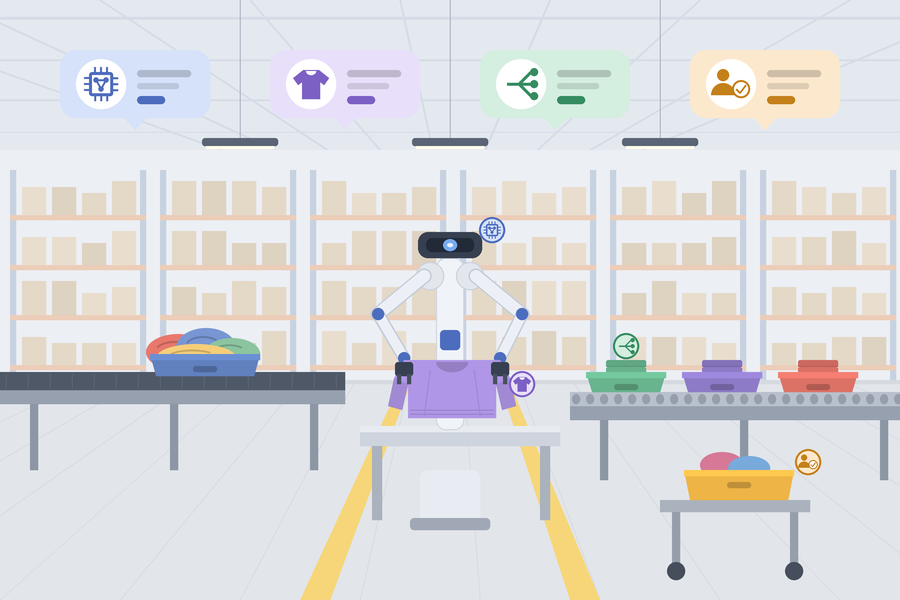
Each robot station recognises a returned item, grips it and sorts it. The same general model handles a shirt, a pair of jeans or a jacket, whatever state it arrives in, without being trained on that specific product.
People remain part of every station. Staff monitor the systems, take over the exceptions the robots cannot resolve and make the final quality decisions about what can be resold. The robots take the repetitive gripping and sorting.
The service model shapes how the technology improves. The robot maker owns, operates and maintains the machines, so new software reaches them without the retailer rebuilding its operation.
Where else machines are learning to handle goods
In the United States a major online retailer unveiled a two armed warehouse robot with a sense of touch in May 2025. Force sensors tell it when it makes contact with an item. One arm rearranges goods in a storage compartment while the other picks. The company says it was trained on touch data to pick around 75% of its stock and had processed half a million orders at sites in Spokane in Washington state and Hamburg in Germany.
The same retailer launched a generative AI model in 2025 to coordinate the movement of its warehouse robots. It said the model would cut robot travel times by 10% across a fleet that had just passed one million robots.
In China AI is being used to read clothing at the end of its life. A textile recycling plant in Jiangsu province uses a scanner that identifies the fibre content of each garment in under a second. It sorts 100 kg of clothing in two to three minutes, a job that takes one worker about four hours.
What retailers stand to gain
The clearest gain is capacity. Returns surge after peak seasons and sales events, and staffing that surge is hard and costly. Robots give retailers a way to absorb those peaks with less reliance on temporary hiring.
The second gain is speed back to stock. A returned item only earns money when it is back on sale. Faster sorting means less time in limbo and fewer items sold at the end of a season for less.
The third gain is flexibility. A model that handles unseen items does not need retraining every time the range changes. That matters in fashion, where thousands of new products arrive each season.
The fourth gain is better work. The repetitive handling moves to machines, while people focus on quality checks and judgement.
What still has to be proved
The German group has tied its second phase to the results of the first. Speed, accuracy and cost in daily operation will decide whether the robots spread.
Reliability is the critical test. Developers’ own arithmetic shows how small differences in success rates change the economics. Every failed grasp needs a person, and too many exceptions cancel the benefit.
Quality judgement remains hard. Deciding whether a returned dress is fit to resell involves stains, smells, missing tags and damage that cameras may miss. For now that decision stays with people.
Dependence is another question. Under a robotics as a service model the robot maker owns the hardware, the model and the improvements. Retailers gain speed but take on reliance on a single supplier for a core operation.
Workforce change will draw attention too. Returns centres employ many people. Moving them to supervision and quality roles needs training and careful planning.
Machines that learn on the job
The next steps are already set. The German group will decide on 15 more robots after its first phase and then on a wider rollout across its network. The online fashion retailer plans to take the system to other European sites after Greven and Świebodzin.
For retailers everywhere the shift is bigger than returns. Robots used to need a known item in a known place. These machines are built to handle the unknown, and their skills are updated centrally by their maker. Returns are a hard first test because clothing is soft, varied and constantly changing. If robots can master a crumpled jumper, many other jobs in retail logistics become open to them.
Sources
[1] TextilWirtschaft
[2] ad-hoc-news.de
[3] FashionNetwork
[4] GFM Nachrichten
[5] University of Bamberg Returns Management Research Group
[6] IEEE Spectrum
[7] Robotics 24/7
[8] TechCrunch
[9] The Robot Report
[10] Fortune

You may also like
The Checkout Supervisor Moves to a Control Room
Drone Delivery Takes Off Across an Entire US Metro