Smart Trolleys Retreat in America as Asia Keeps Rolling Them Out
The shopping trolley that scans, weighs and charges as you go is being wheeled out of American and British supermarkets. On 26 October a major US grocery delivery platform said it would wind down its smart cart business, days before a larger delivery platform agreed to buy it. In Lancashire a UK supermarket chain quietly ended its trial of the same carts. Yet in Singapore, Japan, Israel and Australia retailers are still ordering, building and rolling out trolleys with screens and scanners. The same technology is retreating in one part of the world and spreading in another, and the reasons say a great deal about how store technology succeeds.
A wind down on two continents
The US platform said retailer adoption had not scaled quickly enough to justify continued investment. A regulatory filing puts the cost of closing the business at about $55 million to $80 million before tax, including $12 million to $17 million for employee termination. The wind down is due to be complete by the end of the second quarter of 2027.
The carts were not a niche experiment. Several large US grocery chains tested or used them alongside many independent grocers. In July they were live in more than 100 US and Australian cities. As recently as August the company’s chief executive told investors the business was still scaling with partners in the US and the UK.
The UK trial started in July at a single supermarket in Ashton on Ribble, Preston. It has now ended and the trolleys are no longer in the store. The retailer said the trial had given it greater insight into how its customers’ shopping habits are changing and that it will keep piloting new solutions.
On 29 October a larger US delivery platform agreed to acquire the cart maker’s parent for about $17 billion. The deal is expected to close by the end of 2027 or in the first half of 2028. The platform says it is not retreating from technology inside stores. It is moving its effort from hardware to software, data and AI, including shelf views built from shopper video and real time inventory tools.
From the checkout queue to the trolley handle
For decades the supermarket checkout has worked the same way. Shoppers fill a trolley, unload every item onto a belt, wait while each one is scanned and then pack it all again. Self checkout moved the scanning to the shopper but kept the unloading and the queue.
The smart trolley tries to remove that last step entirely. Early versions were simple. By 2019 a Chinese maker had fitted tablets to ordinary trolleys at dozens of retailers in more than ten Chinese cities. Shoppers logged in, scanned barcodes and paid on the cart. The same carts were already running at a Japanese supermarket chain. The business model was clear from the start: sell the hardware, then earn from advertising on the screen and from shopper data.
What has changed is the sensing. The newest US carts used cameras, built in scales and location tracking to recognise items as they dropped into the basket. A US ecommerce group redesigned its own cart in January with faster barcode capture by computer vision, better location sensors and a produce scale built into the basket. The new version is a quarter lighter, holds 40% more and charges itself while parked, so staff no longer swap batteries.
How a smart trolley works today
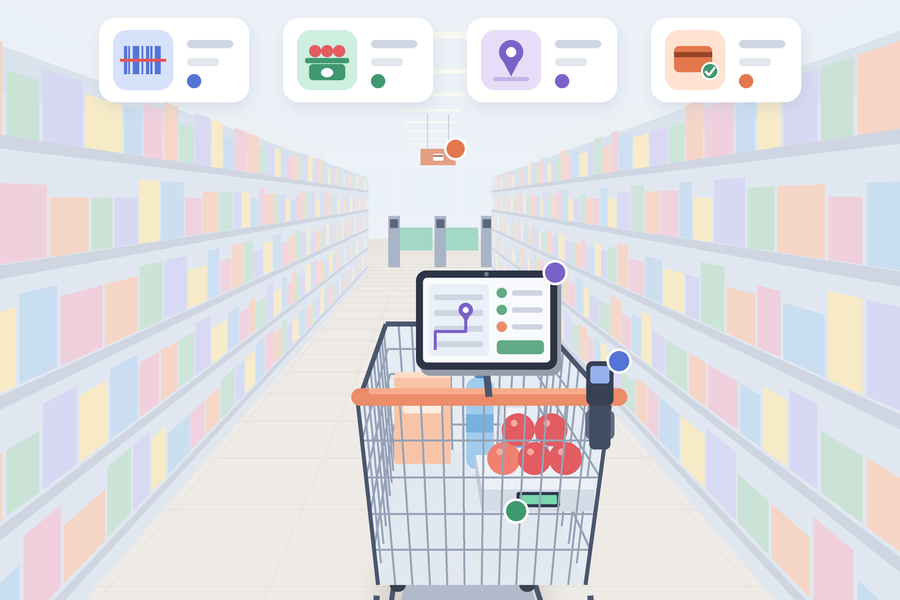
The basic journey is now similar everywhere. A shopper unlocks the cart with a loyalty card or a payment app. Each item is scanned or recognised as it goes in, and loose produce is weighed on the cart or at a scale that prints a barcode. A screen keeps a running total, shows offers and points the way to products. At the end the shopper pays through a dedicated lane or gate without unloading.
The details differ in ways that matter. In Japan a discount retail group developed its cart with its own technology arm, which now supplies it to other grocers too. Shoppers register a prepaid card or a payment app barcode, scan items with the attached scanner and leave through a payment gate that prints a receipt. The cart warns shoppers when it detects an item that has not been scanned and suggests products based on purchase history.
In Australia a large supermarket chain uses a tablet that clips onto the trolley handle and is unlocked with the shopper’s loyalty card. Shoppers pay at a self checkout by scanning a barcode on the tablet, so the shopping stays in the trolley all the way to the car.
Where the trolley keeps rolling
Japan has the deepest deployment. By the end of December 2024 the discount group’s carts were in 245 stores, including stores outside the group, with 20,725 units in use and about 4.8 million uses a month. A year later the figure stood at about 22,000 carts across 265 stores. In November 2025 the carts reached Tokyo for the first time, with 80 units at a store reopened under the merged brand of a city supermarket chain the group took over in July 2025.
Singapore is scaling fast. A large Singapore supermarket group first tested smart carts at a pilot store in a new digital business district in August 2025. It now plans to have them in 48 of its outlets by the end of 2026. The group says checkout times fell from several minutes to 36 seconds. Its pilot cart was a single unit that could not leave the store, which frustrated shoppers. Over three months it was rebuilt with a removable tablet so customers can push the trolley to a car or taxi after paying.
In Israel a national supermarket chain operating 150 stores signed a five year, $50 million agreement for 4,000 smart carts. A six store pilot began in the third quarter of 2026 ahead of a gradual rollout to every store. The deal also covers data, retail media and digital services, and the retailer expects the carts to generate about $35 million in profit.
Australia is expanding too. The supermarket chain’s tablet trolleys are running in five states, and in September they reached the national capital at an airport store. In South Africa a large grocery chain began a pilot in August 2025 with ten trolleys at each of two Cape Town stores. Its shoppers activate the trolley with a loyalty card, bag as they go and pay on the trolley with a card linked to the chain’s delivery app.
Even in the US the idea is not dead. The ecommerce group’s redesigned cart launched in three of its grocery stores in January, with plans for dozens more by the end of 2026.
What the carts offer
The first benefit is time. Shoppers skip the unload, the queue and the repack, and the Singapore figure of 36 seconds at checkout shows how much of the wait can disappear. One Australian shopper welcomed not having to unload anything until reaching the car.
The second is visibility. A running total lets shoppers track their spending as they go, which retailers in Australia and the US have promoted as a reason to use the carts. Location tracking and product finders help people in large stores who do not know the layout.
The third is revenue that a standard trolley cannot earn. The screen sits at the point where buying decisions are made, and it knows the shopper’s loyalty profile and the contents of the basket. That makes it a channel for targeted offers and advertising. The Israeli deal is built explicitly around retail media and data income, and the Chinese carts of 2019 were sold on the same promise.
The fourth is labour. In Japan the carts are presented as a way to shorten checkout lines and need fewer cashiers, an argument that carries extra weight where staff are hard to find.
Why adoption stalled
Cost comes first. Experts raised concerns about the high price of the US carts long before the wind down. Every cart carries cameras, scales, screens and batteries that must be bought, charged, cleaned and repaired, and a supermarket needs hundreds of them. Charging alone is a real task, and the latest US redesign now charges itself while parked so staff no longer swap batteries.
Shopper habit is the second barrier. A UK technology publication argued after the Preston trial ended that shoppers tend to prefer familiar ways of paying and that it is unclear whether scanning as you go is much faster than scanning at the till. In Canberra opinion is split. One shopper complained that customers are being asked to do work that staff once did, while others raised concerns about theft, jobs and the need to sign up to a loyalty scheme.
Design details can sink a rollout. The Singapore pilot showed that a cart which cannot leave the building is a nuisance for anyone with a car or a taxi waiting. A 2024 test of an earlier US ecommerce cart by a Seattle technology publication found it cumbersome, with a steep learning curve.
The business model is the deepest difference. In the US one specialist supplier had to sell carts to grocers one by one and recover the cost of hardware it did not own. Last year it even tried to reach independent grocers through point of sale equipment suppliers. Where the carts are growing, the retailer either built the technology itself, as in Japan, or signed a chainwide deal that ties the hardware to its own data and advertising income, as in Israel.
Where the trolley goes next
The outlook is now set by stated plans. The US cart business will close by mid 2027 and the acquisition of its owner is expected to close by the first half of 2028 at the latest. The Singapore rollout is due to reach 48 outlets by the end of 2026, the Israeli chain is moving from six stores towards 150, and the US ecommerce group plans dozens more stores this year.
For retailers the lesson is less about the trolley and more about who owns the economics. A smart cart pays back when it sits inside a retailer’s own system of loyalty, payment and advertising, and when the chain is large enough to spread the cost of the hardware. Sold as a standalone gadget into stores that each have to make their own case, it has struggled. The trolley itself is not going away. In the markets where it fits the whole store, it is becoming part of the furniture.
Sources
[1] Grocery Dive
[2] Path to Purchase Institute
[3] Retail Gazette
[4] TechRadar
[5] Supermarket News
[6] 36Kr Japan
[7] GeekWire
[8] Payment Navi
[9] Region Canberra
[10] Netshop Impress
[11] Computer Weekly
[12] Chain Store Age

You may also like
Robots Learn to Sort Clothes They Have Never Seen
The Checkout Supervisor Moves to a Control Room