Robot Pharmacies Move from Experiment to Everyday Healthcare
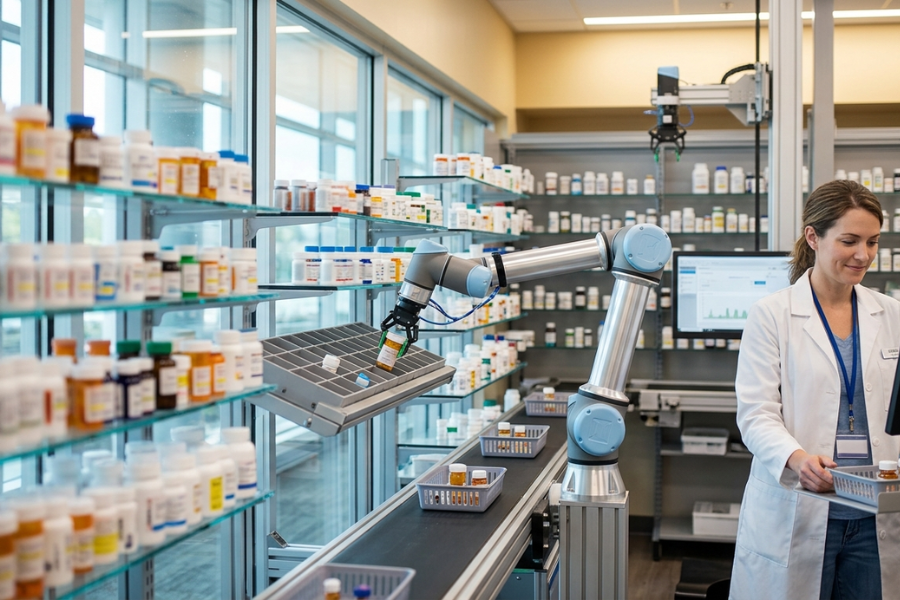
In July 2026, at the World Artificial Intelligence Conference in Shanghai, a robotic pharmacy system attracted significant attention. Three robots of different brands and configurations, working in coordination, received an order, retrieved the medication and completed the delivery; the entire process took 90 seconds. The system had already been deployed in a retail pharmacy in Shanghai. This demonstration was not a laboratory experiment; it was a live showcase of technology already operating in a real commercial setting.
The event highlighted a broader trend: robot pharmacies are moving from concept to operational reality across multiple countries and healthcare settings.
The Shanghai Model
The robotic pharmacy system demonstrated at WAIC 2026 represents one approach to pharmacy automation. The system uses what its developers describe as a “universal brain”, an AI foundation model that can drive different brands and configurations of robots to work together.
In the WAIC demonstration, three robots, two from different manufacturers and one developed in-house, were powered by a single AI model called LingBot-VLA 2.0. The robots could receive random orders, autonomously divide tasks among themselves and complete the retrieval and delivery of medications. One observer described the process as running “like an assembly line”.
The same system has been deployed in a retail pharmacy in Shanghai. According to reports, the pharmacy did not require any physical modifications to accommodate the robots; they were able to operate within the existing store environment. The robots are primarily used during nighttime hours to assist pharmacists with high-frequency, repetitive tasks, helping to improve service efficiency during hours when staffing is limited.
The system also integrates with online medical consultation services, creating what has been described as a complete experience from consultation and prescription to medication dispensing and packaging.
The technology behind this system has been trained on 60,000 hours of real-world data and has been adapted to more than 20 different robot configurations from 17 manufacturers. The system was named one of the top ten “Treasures of the Pavilion” at WAIC 2026, an award given to fewer than 10 exhibits each year based on technical merit, market potential, replicability and social value.
The US Model
A different approach to robotic pharmacy is being pursued in the United States. In June 2026, a California-based startup emerged from stealth with what it described as the world’s first fully autonomous robotic pharmacy.
The system is designed to operate without any on-site pharmacist. It takes sealed wholesale medication bottles and produces filled and verified prescription vials with minimal human intervention. The system currently supports 250 of the most commonly prescribed medications in the United States and can dispense up to 600 pills per minute.
The company claims the system can reduce prescription fulfillment costs by up to 96 percent compared with traditional pharmacy operations. It is designed to be deployed across retail locations, hospitals, clinics, rural communities, and other settings where pharmacy access is constrained.
In July 2026, the company raised $12.6 million in seed funding, bringing its total funding to $18.6 million. The system is designed to fill prescriptions in 60 seconds or less. The company has conducted a pilot in Palo Alto and is targeting broader rollout by early 2027.
However, the company’s cost reduction claims have not been independently verified. Industry observers have noted that the company faces two major hurdles at this stage: government regulations and gaining consumer acceptance.
The UK Model
In the United Kingdom, robotic pharmacy technology is being deployed within the National Health Service. In February 2026, NHS England reported that robotic dispensing technology was transforming pharmacy services across London.
At a pharmacy in Brixton, robotic automation handles medication dispensing, stock management, and even self-cleaning, freeing staff to provide expanded patient services including same-day consultations, vaccinations, and ear wax removal. The robots automatically select the correct medication and deliver it via conveyor belt directly to the dispensing pharmacist. Advanced features including 2D barcode scanning enable more effective expiry date management and batch number tracking, streamlining drug recalls without the need for manual stock checks.
In May 2026, a hospital in Tameside, England, introduced a robotic system designed to store, manage and dispense medicines safely and efficiently. Crucially, the robot can dispense medicines directly to clinical staff when the pharmacy is closed, helping get medicines to patients without delay throughout the night.
In China, a hospital pharmacy in Beijing has deployed an AI-driven system that scans, sorts, and dispenses medications in two to three minutes, operating 24 hours a day, seven days a week.
The Dubai Model
In June 2026, a hospital in Dubai began operating what was described as the region’s first smart pharmacy run by a robot. The system can store up to 35,000 medicines and dispense approximately 12 prescriptions in less than one minute. The dispensing process is paper-free, as the robot stores the prescription as soon as the doctor documents it electronically.
The Market Context
The emergence of robotic pharmacies in 2026 reflects a broader market trend. The pharmacy automation market is expected to grow from $7.19 billion in 2025 to $7.81 billion in 2026 and is forecast to reach $11.79 billion by 2031. The robotic pharmacy prescription market, a more specific segment, was valued at $214.16 million in 2025 and is projected to grow to $237.65 million in 2026, with a compound annual growth rate of 9.18 percent, reaching $396.21 million by 2032.
The broader hospital robotics (logistics and pharmacy) market reached $4.8 billion in 2024 and is expected to reach $14.77 billion by 2033. Sales in pharmacy automation robotics are projected to increase from $6.0 billion in 2026 to $14.2 billion by 2036.
Several factors are driving this growth. Pharmacies face severe staffing shortages. In the United States, pharmacy technician vacancies have been reported at 40 percent or higher. Pharmacy schools are graduating 3,000 to 4,000 fewer pharmacists than will be needed over the next five to six years. In the UK, pharmacies face at least £275 million in additional costs in 2026 due to inflation and wage increases.
Industry analysts note that workforce transformation is accelerating as pharmacists and technicians assume more clinical oversight roles, while robots handle repetitive or high-risk tasks. A systematic review published in April 2026 found that pharmacy automation technologies are highly cost-effective and efficient compared with manual dispensing systems, reducing errors and improving efficiency.
Challenges and Considerations
Despite the promise of robotic pharmacies, several challenges warrant consideration.
Regulatory hurdles. Autonomous pharmacy systems must comply with complex regulations governing the dispensing of prescription medications. In the United States, the startup developing fully autonomous pharmacy kiosks faces regulatory requirements that must be addressed before broad deployment. In Australia, the Australian Medical Association has raised concerns about autonomous pharmacist prescribing, warning that such models may be driven by business interests rather than evidence-based patient care.
Consumer acceptance. Gaining consumer trust in automated medication dispensing is another hurdle. Patients may be hesitant to receive prescription medications from a machine rather than a pharmacist. The technology must demonstrate not only efficiency but also safety and accuracy.
Technical limitations. While robotic systems can handle routine dispensing, they cannot replace the clinical judgment of pharmacists. Complex medications, interactions, and patient-specific considerations still require human expertise. The systems are currently limited to commonly prescribed medications — one system supports 250 drugs — and may not cover the full range of prescriptions.
Cost of deployment. While proponents argue that robotic pharmacies can reduce long-term operating costs, the upfront investment in hardware, software, and integration can be significant. Smaller, privately owned pharmacies may struggle to afford the technology.
Job displacement concerns. The automation of pharmacy dispensing raises questions about the future of pharmacy technician and pharmacist roles. While proponents argue that automation frees staff for higher-value clinical work, the transition may be disruptive.
Looking Ahead
The deployment of robotic pharmacies in 2026 represents a significant step in the automation of healthcare services. From Shanghai to London to Dubai, robots are now dispensing medications in real-world settings, handling tasks that were previously performed entirely by humans.
The technology is advancing rapidly. The Shanghai system demonstrates that multiple robots of different configurations can work together under a single AI “brain”. The US system shows that fully autonomous pharmacy kiosks may soon be capable of operating without any on-site pharmacist. The NHS deployments illustrate how robotics can integrate with existing healthcare infrastructure.
However, the path to widespread adoption is not assured. Regulatory approval, consumer trust, and cost-effectiveness will all determine how quickly robotic pharmacies become a standard feature of healthcare delivery. As one industry observer noted, “The two major hurdles for the company at this stage will be government regulations and getting consumers on board”.
What is clear is that robotic pharmacies are no longer a theoretical concept. They are operating in pharmacies, hospitals and clinics across multiple countries, and their numbers are growing.
Sources:

You may also like
Why Every Online Order May Soon Get a Made to Measure Box

AI Agents Step Into the Store Manager’s Office