Stores on Wheels Are Changing the Future of Retail
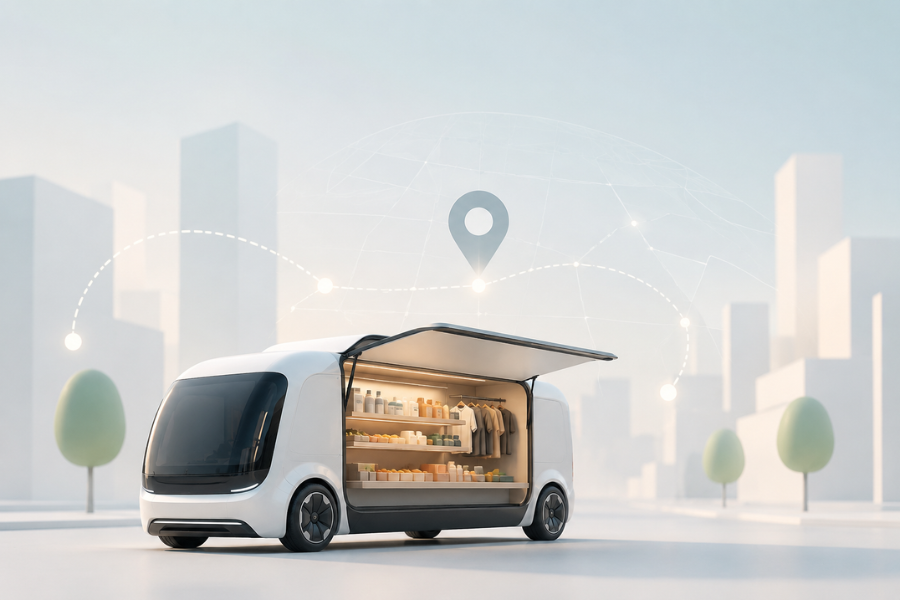
As retailers increasingly embrace artificial intelligence, robotics and autonomous vehicles, a new retail model is beginning to emerge: mobile stores that drive directly to customers instead of waiting for customers to come to them. New research finds that retailers operating fleets of mobile “stores on wheels” can outperform traditional fixed-location stores by continuously relocating to areas of highest demand while simultaneously learning where future demand is likely to occur.
The Emergence of Mobile Retail
A shift toward shopping at autonomous wheeled vending stores is redefining urban retail. Compared with traditional brick-and-mortar stores, mobile stores are cost-efficient to deploy and adaptive to fast-evolving business environments. They can relocate quickly to high-demand areas, operate with lower labour and real estate costs and allow retailers to test new markets without committing to permanent locations.
However, mobile stores are confronted with unknown demand and limited capacity. Customer demand is initially unknown and constantly evolving, while limited onboard inventory means stores must balance serving customers with making costly trips to replenish stock. Store mobility enables demand learning and profit maximisation, yet an optimal dynamic store location policy has remained unclear.
A Mathematical Framework for Location Decisions
Researchers developed a mathematical framework that enables retailers to determine where mobile stores should operate while simultaneously improving their understanding of consumer demand over time. Rather than relying on fixed operating plans, the model continuously updates store placement decisions as new information becomes available.
The study examined how retailers can solve the challenge of deciding where to position mobile stores when customer demand is uncertain, constantly changing and influenced by factors such as weather, population density and neighbourhood activity.
The researchers modelled this “learning-and-earning” problem by taking optimistic actions under parameter uncertainty. The joint optimisation over parameter and action set is complicated by the combinatorial nature and infinite choices within the action set. To overcome these challenges, they leveraged continuous-approximation methods and proposed a continuous-approximation optimistic learning framework. For more general scenarios, the problem remains intricate because of nonconvexity in unknown parameters, so they alternatively proposed a faster learning algorithm by utilising first-order approximation techniques.
Key Findings
Using a case study based on Toronto retail data, the researchers found that adaptive mobile stores increased profits by 2.56% compared with conventional location strategies simply by repositioning themselves in response to changing demand patterns.
The algorithm significantly outperformed baselines in the Toronto case study. Mobile stores earn higher profits than brick-and-mortar stores through demand learning and store mobility.
As a co-author of the study, stated: “The future of retail isn’t simply autonomous stores, it’s autonomous stores that know where they should be. Retailers don’t have to choose between exploring new markets and maximising today’s profits. With the right analytics, they can do both at the same time”.
“A mobile store has an advantage only if it knows where demand is moving,” said lead author of the study. “Mobility creates the opportunity, but learning creates the value. The retailers that continuously adapt will have the greatest competitive advantage”.
Practical Challenges
The researchers also identified practical challenges that mobile retail faces.
Customer demand is initially unknown and constantly evolving, while limited onboard inventory means stores must balance serving customers with making costly trips to replenish stock. The study demonstrates how retailers can account for both challenges simultaneously.
The findings suggest retailers considering mobile stores should adopt adaptive, data-driven location strategies rather than static operating plans. By continuously balancing what they know with what they still need to learn about consumer demand, retailers can improve profitability while reducing the risks associated with expanding into new markets.
Real-World Applications
Several companies have already begun deploying variations of these mobile retail concepts. The mobile business industry has grown to hundreds of vehicles across the United States, with established brands and retail hopefuls outfitting trucks, trailers, buses and recreational vehicles as a more cost-effective solution to launching a traditional stationary storefront.
A few apparel, jewellery and electronics retailers have rolled out “store-on-wheels” concepts, bringing the store to customers’ doorsteps. Fashion retailers have experimented with mobile retail formats such as pop-up stores and shop-on-wheels to overcome challenges and meet demand.
Broader Implications
More broadly, the paper envisions the future landscape of urban retail enhanced by omnipresent mobile facilities. As autonomous technology continues to mature, mobile retail stores could become an increasingly common part of urban commerce.
The research suggests their success will depend not only on advances in self-driving technology, but also on the analytics that determine where those stores should go next. The researchers’ mathematical framework provides a foundation for retailers to make data-driven location decisions while continuously learning from customer demand patterns.
Conclusion
The study offers a rigorous academic examination of mobile retail’s potential. By combining mobility with continuous demand learning, retailers operating fleets of mobile stores can outperform traditional fixed-location stores. The findings suggest that the future of retail may not be exclusively about building more stores in fixed locations, but about deploying intelligent, mobile retail units that can adapt to where demand is and where it is moving next.
Sources:

You may also like
Why Every Online Order May Soon Get a Made to Measure Box

AI Agents Step Into the Store Manager’s Office