Physical AI Brings 24/7 Robotic Shelf Replenishment to Retail
At a recent retail industry convention in Tokyo, a robotics company unveiled what it described as the world’s first Physical AI 24/7 service solution designed for open retail environments. The system is built around a self-developed “embodied brain” and is intended for human-robot collaboration in shelf replenishment, store inspection and inventory tasks, without requiring modifications to store shelving or customer flow paths.
The announcement represents a notable development in the application of embodied AI to retail: rather than confining robots to structured back-of-house environments, the solution is designed for the open, dynamic conditions of a working convenience store or supermarket.
Retail’s Open-Environment Challenge
Retail stores present a uniquely difficult environment for robotic automation. Store counts are large, SKU assortments are extensive, shelving is dense, aisles are narrow and both customer traffic and product placement change continuously. This combination of standardisation and dynamism demands environmental perception, real-time decision-making and dynamic adaptation capabilities that exceed the requirements of more structured settings.
Most existing robotics solutions have concentrated on structured, fixed environments such as warehouses and closed storage areas. They struggle to operate in the front-of-store environment where foot traffic is dense, pathways are complex and demand patterns shift constantly. The real operational need in retail is efficient division of labour: front-of-store staff must respond flexibly to customer enquiries while maintaining order and experience, while back-of-store functions, replenishment, sorting, inventory turnover, must adapt to holiday traffic and fluctuating demand.
Two Robots and a Unified Platform
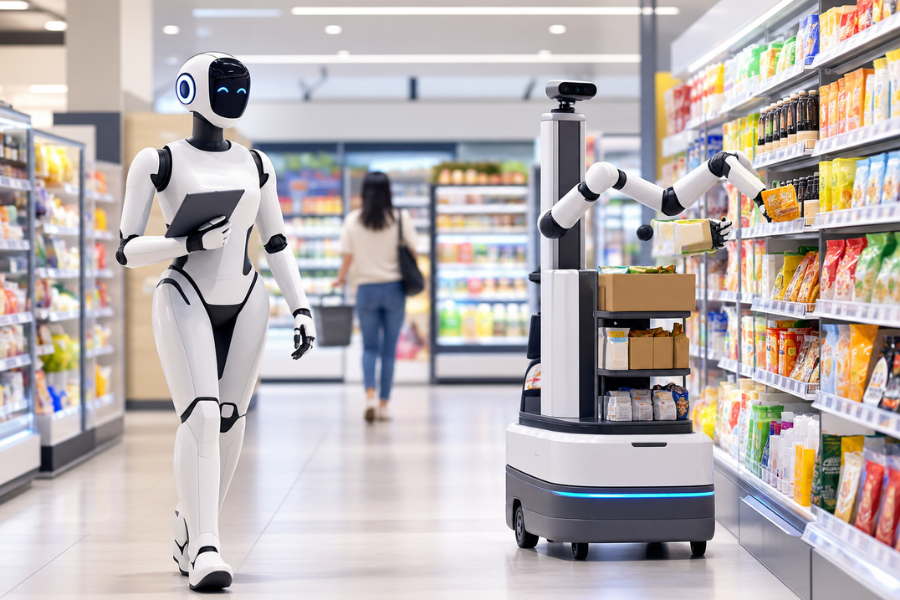
The solution comprises three principal components: two robot本体 (physical robot bodies) and a unified robot management platform.
- The Dual-Legged Humanoid Robot
The first robot is a general-purpose bipedal humanoid designed for human-occupied spaces. It features a soft exterior design, supports interaction in more than 20 languages and is capable of 45 facial expressions and 36 gestures. An open API enables secondary development for diverse operational needs.
- The Wheeled Dual-Arm Replenishment Robot
The second robot is a wheeled, dual-arm unit designed specifically for narrow spaces. It uses a narrow-body omnidirectional chassis that allows it to navigate the confined aisles of convenience stores without requiring modification to existing shelving. The robot is designed for transport, shelf replenishment, inventory counting and inspection.
The Management Platform
The third component is a unified robot management platform that serves as the coordination hub for multi-robot operations. It is described as a self-developed, integrated hardware-software operational foundation compatible with multiple robot forms and cross-scenario deployment. The platform connects device onboarding, task execution, and data review, supporting large-scale deployment, orchestration and continuous optimisation of human-robot collaborative tasks.
The Embodied Brain
The technical foundation of the solution is what the company calls an “embodied brain”, a complete physical intelligence system comprising embodied models, algorithms, data and infrastructure. Beyond basic capabilities such as environmental understanding, motion learning and task execution, the system is designed to iterate and evolve continuously through actual operations in real-world scenarios.
At the core of the embodied brain is an intelligent agent foundation that integrates three capabilities: the task understanding and planning abilities of a general-purpose large model; the fine manipulation abilities of expert models including Vision-Language-Action systems; and memory, tool invocation and robot interface capabilities. This forms a complete chain from perception to decision-making to execution to error-correction feedback.
The system’s operational logic can be illustrated through a concrete example. Given the task “replenish the designated shelf,” the agent first decomposes the task objective and plans the execution sequence. It then dispatches navigation, recognition and manipulation modules to work in coordination. During execution, it monitors progress in real time; when anomalies occur, such as product position deviation or grasping failure, it adjusts strategy or re-plans to ensure the robot both accurately understands the task goal and completes each step with quality.
Human-Robot Collaboration
The solution is explicitly designed around human-robot collaboration rather than full automation. Robots are capable of completing 99% of tasks autonomously, handling high-frequency, repetitive, physically demanding and overnight shifts. This frees front-line employees from inefficient repetitive labour to focus on customer service, operational optimisation and complex problem-solving, work that is described as more valuable and more human.
During nighttime operating hours, robots can continuously undertake on-duty and operational tasks, replacing employees in overnight work while ensuring the store operates around the clock and reducing physical burden on staff.
Commercialisation and Deployment Plans
The solution was announced alongside a partnership with a global chain retail enterprise to advance product testing and commercial validation. The partners will verify the embodied intelligence solution’s operational capabilities in real, open retail environments, continuously optimise robot task flows and operational systems, rapidly validate return on investment and gradually expand application scenarios to hot food handling, inventory management, delivery sorting and packaging.
Commercial service is planned for 2027. Customers will be able to choose between direct purchase and a Robotics-as-a-Service subscription model, with service coverage spanning hardware, software, operations and maintenance and continuous upgrades. Future plans include a heavy-load version of the robot and an A1 precision manipulation robot for fine operations such as cashiering and bagging, forming a complete product portfolio of standard, dexterous and heavy-load types.
Broader Industry Context
The announcement reflects a broader movement toward physical AI in retail. Industry analysis has identified 2026 as a pivotal year for physical AI in retail and logistics, with systems increasingly interpreting and acting on data where it is created, enabling retailers to automatically track inventory and prevent stockouts.
The global physical AI market was projected to grow from $18 billion in 2026 to $95–100 billion by 2031, representing a compound annual growth rate of approximately 40%. Global humanoid robot shipments reached nearly 25,000 units in the first half of 2026, a year-on-year increase of 432.1%, with application scenarios accelerating into industrial manufacturing, retail, transportation and logistics and consumer settings.
Parallel developments in Europe illustrate the same trajectory. In Denmark, a major retailer began trialling humanoid robots for shelf-restocking at a supermarket near Copenhagen in June 2026, with the goal of independent overnight restocking by early 2027. That retailer’s CEO noted that workers spend between 40 and 50 percent of their time replenishing shelves, a figure that underscores the scale of the operational burden that retail robotics aims to address.
Challenges and Considerations
Several factors warrant attention as this technology develops.
The solution is at the validation stage. The commercial partnership announced alongside the launch is described as being for product testing and commercial validation. The robots have not yet been deployed at scale in live retail environments and operational performance data from real store conditions has not been published. The 99% autonomous task completion figure is a company-reported capability, not an independently verified result from sustained operations.
The economics of retail robotics remain unproven at scale. The cost of the robots, the RaaS subscription pricing, and the actual labour savings achieved in practice have not been disclosed. Whether the return on investment materialises depends on factors including utilisation rates, maintenance costs and the degree to which robots genuinely replace versus supplement human labour.
Bipedal humanoid robots in retail remain an early-stage proposition. While the bipedal robot is designed for human-occupied spaces, the wheeled unit is described as specifically engineered for narrow convenience store aisles. The relative utility of bipedal versus wheeled forms in retail settings is an open question and the company’s own product roadmap includes multiple form factors, suggesting that no single configuration is viewed as universally optimal.
Integration with existing store operations requires change management. Introducing robots into working retail environments involves not only technical deployment but also changes to staff roles, workflows and training. The human-robot collaboration model described, where humans focus on service and robots handle repetitive tasks requires that staff be prepared and willing to work alongside robotic systems.
Conclusion
The Physical AI 24/7 service solution represents a significant step in the application of embodied intelligence to open retail environments. By combining two robot platforms with a unified management system and an evolving embodied brain, it addresses the specific operational challenge of shelf replenishment in convenience stores, a task that consumes a substantial portion of staff time and is particularly burdensome during overnight hours.
The solution’s “zero modification” deployment model, requiring no changes to existing shelving or customer pathways, removes one of the traditional barriers to retail robotics adoption. Whether it can deliver on its promise in live retail environments, at a cost that justifies the investment, will be determined by the commercial validation now underway.
Sources:

You may also like