Drone Delivery Takes Off Across an Entire US Metro
In a fenced corner of a supermarket car park in Charlotte, North Carolina, a dozen small aircraft sit on their launch pads waiting for orders. Since 21 October 2026 shoppers across the city and six neighbouring towns have been able to send for one. A major US retailer and a US drone delivery company switched on drone delivery from seven superstores in the region that day, packaging stores that had started one at a time into a single service for the whole metro area. Groceries, household goods and medicines sold without prescription now arrive by air in as little as 30 minutes. For retailers everywhere the launch is a test of whether delivery from the sky can move beyond novelty and become an ordinary option at checkout.
What happened in Charlotte
The seven stores serve Charlotte, Gastonia, Concord, Kannapolis, Lincolnton, Shelby and Kings Mountain. A drone trade publication reported that the first of them began flying in December 2025, with others added through 2026. A local television station reported that two more Charlotte stores are due to join in the coming weeks.
The metro launch is one step in a much larger plan. The two companies say the service now runs in five metro areas: Atlanta, Dallas and Fort Worth, Houston, Orlando and Charlotte. Fourteen more are listed as coming soon, from Los Angeles and Miami to Seattle and the San Francisco Bay Area. The partners plan to offer drone delivery from more than 270 stores and aim to build a coast to coast network in 2027 that would reach more than 10% of the US population.
Ordering looks like any other home delivery. If a shopper’s address falls inside the service area, a drone option appears in the retailer’s app or website. Delivery is free for a limited period. After that the standard price for shoppers without the retailer’s paid membership is $19.99 per delivery, according to the local station.
From one off trials to a delivery network
Drone delivery in American retail has a stop and start history. The same retailer spent about four years working with a different drone operator. In 2022 that network completed more than 6,000 deliveries from 36 hubs in seven states, an aviation magazine reported. In 2024 the partners cut the network by more than half, and by the end of that year the contract had ended. The retailer narrowed its focus to the Dallas and Fort Worth area with new drone partners.
The current partnership began there in 2023. A technology news site reported that the first pilot used two stores in the Dallas area and reached about 60,000 homes. It grew to 18 superstores across that metro. In June 2025 the companies announced the jump to more than 100 additional stores in five new metro areas, Charlotte among them. At the time the drone company’s chief executive described it as moving decidedly out of the pilot and trial phase.
The difference between those two eras lies in the operating model. The earlier network spread dozens of hubs across seven states. The current model attaches a small permanent drone base to an existing store, takes orders through the retailer’s normal app and treats the drone as one more fulfilment option alongside vans and collection points.
How the technology works
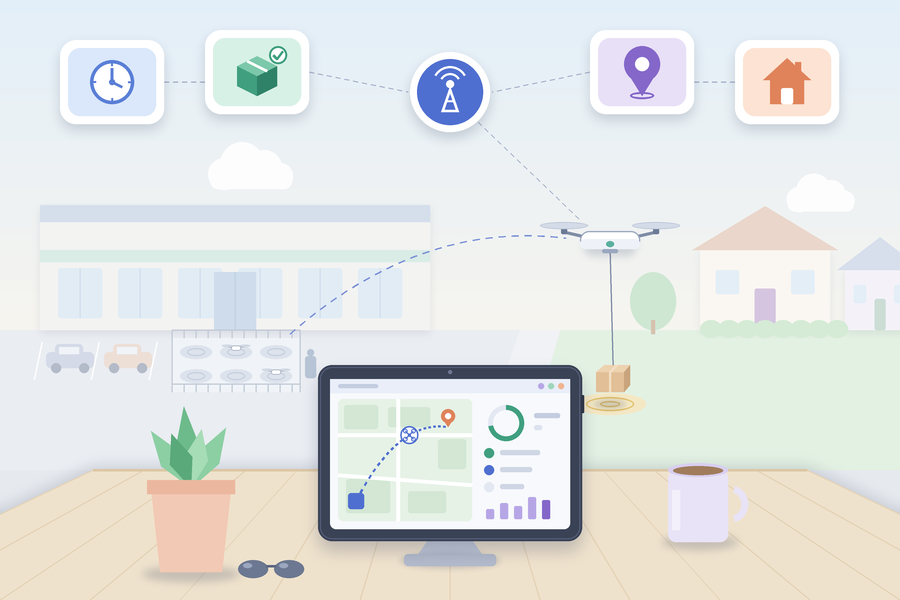
Each store hub is a fenced area with launch pads in a corner of the car park. Orders come from a range of drone eligible items that the drone company says runs to thousands of products. The aircraft weigh about five kilograms. They cruise between roughly 46 and 61 metres above the ground at up to about 97 kilometres per hour, flying over the road network. A reporter at the Charlotte demonstration compared the noise to a quiet lawnmower.
The drones never land at the customer’s home. On arrival they hover about seven metres up and lower the order to the ground on a tether. The customer needs a clear outdoor drop spot about the size of a picnic blanket. The shopper chooses that spot at checkout, and some apartment buildings with shared drop areas qualify. Each drone serves homes within about 9.7 kilometres of its store and carries orders of up to about 1.1 kilograms. Flammable goods, alcohol and pharmacy products are excluded. Orders can be tracked live on the customer’s phone, and the drone company says its arrival countdowns are accurate to within a couple of seconds.
The flights operate under federal aviation approvals rather than local permits. A drone trade publication reported that the federal environmental review for the Charlotte area sets flight hours and caps the operator at 25 hubs in the metro. Towns have a say only over the use of the store car park.
Where drone delivery is used around the world
China has moved fastest at city scale. A major Chinese food and retail delivery platform said in May 2026 that its drone network had left the testing stage and entered commercial operation. A Chinese business news service reported that the platform ran 70 drone routes by the end of 2025 across Shenzhen, Beijing, Shanghai, Guangzhou, Hong Kong and Dubai. It had completed more than 780,000 orders. The company says capacity at a single site has risen from about 10 orders a day to as many as 400, and that its cost per order has fallen by roughly 40% to 50% each year. Its first real delivery took place in Shenzhen in early 2021.
In Hong Kong the same platform opened its first route in June 2025 under a government sandbox scheme. The drone crosses about 1.8 kilometres of sea between a science park in Sha Tin and the Ma On Shan waterfront. A Hong Kong newspaper reported the flight takes about five minutes against roughly 40 minutes for a rider by road. Customers pay HK$30 per drone order, a fee the company’s vice president said does not cover costs.
In the Middle East the platform began drone deliveries in Dubai in December 2024, its first market outside China. A Gulf business publication reported plans for new routes along the Dubai Marina waterfront, mainly for urgent needs and medical supplies. The UAE civil aviation authority has been working with partners to map air corridors and operating rules for drones and air taxis.
In Australia the national aviation safety regulator has certified two operators. One is approved to fly in East Melbourne, North Canberra and Logan, a city south of Brisbane. The regulator requires a licensed pilot to oversee every operation and attached conditions on quieter drones when it granted approval.
The benefits for shoppers and stores
Speed is the obvious gain. A half hour delivery competes with a trip to the shop, and the aircraft avoid traffic, red lights and crowded car parks. That suits small baskets that are awkward to serve by van. The drone company points to game day supplies, everyday essentials and weeknight dinners as typical orders. In Charlotte the launch demonstration included Halloween costume items and sweets.
The model also reuses property retailers already own, because each hub sits in the car park of an existing store. The drone company has said it is working to scale deliveries without adding staff in step. In China the cost and capacity figures reported by the delivery platform show how quickly unit economics can move once a network is dense enough.
Drones also open delivery across barriers that slow road couriers. The Hong Kong sea crossing turns a 40 minute ride into a five minute flight. Operators in China and Dubai already use drones for medical samples and supplies, where a few minutes matter.
The challenges that remain
The physical limits are tight. A ceiling of about 1.1 kilograms rules out most weekly grocery shops. A range of about 9.7 kilometres ties service to homes near a hub, and a clear outdoor drop spot excludes many apartments and dense city centres. Airspace approvals and the cap on hubs in each area limit how far a single metro can grow.
Cost is the second hurdle. The standard price in Charlotte will be $19.99 per delivery for shoppers without membership once the free period ends. In Hong Kong the operator says its HK$30 fee does not cover costs. Wider demand will depend on whether prices fall as volumes rise.
Community acceptance can halt a network outright. In June 2026 a drone delivery operator paused its services in Ireland after Dublin councils refused planning permission for hubs and residents complained about noise at take off and drones flying over homes. The operator had completed about 300,000 deliveries there and acknowledged one complaint for every 500. It said Ireland lacked a clear national pathway to scale commercial drone delivery. Even near Charlotte, a planned drone site at one store was approved by a three to one vote after a local petition.
Regulation in the United States is also unsettled. Today operators rely on federal waivers and approvals for flights beyond the pilot’s line of sight. In August 2025 the federal aviation regulator proposed a rule that would replace those case by case waivers with operator certification and routine flights below about 120 metres from approved sites.
What comes next for retailers
For large chains the lesson from Charlotte is that drone delivery is becoming a store format decision rather than a technology experiment. A store needs car park space for a hub, a picking process for small fast orders and a catalogue filtered by weight and product type. Integration matters as much as the aircraft: the drone appears as an option inside the retailer’s own app, alongside existing delivery and collection.
Retailers in other markets face different paths. In China, drones are already woven into a food delivery platform’s network. In Australia and the UAE, national regulators set the pace. Ireland shows that local planning and residents’ tolerance for noise can matter as much as aviation approval. Any retailer considering drones will need early engagement with neighbours and clear figures on cost per order before committing stores.
The next year will show whether the Charlotte model can be repeated quickly. The partners plan to reach more than 270 stores and aim for a coast to coast network in 2027, with Denver and Seattle among the new metro areas named for that year. In China the leading platform is recruiting logistics partners nationwide to run its drone infrastructure. In the United States the final shape of the federal rule for routine flights beyond sight will decide how easily operators can add hubs. For retailers the question is no longer whether drones can deliver a small basket in half an hour. It is whether enough customers will pay for that speed, and whether neighbours will accept the sound overhead.
Sources
[1] DroneXL
[2] DroneLife
[3] FLYING Magazine
[4] TechCrunch
[5] Yicai Global
[6] The Standard
[7] AGBI
[8] The Irish Times

You may also like
Why Every Online Order May Soon Get a Made to Measure Box

AI Agents Step Into the Store Manager’s Office