Ambient IoT Enables Real Time Retail Supply Chain Visibility at Scale
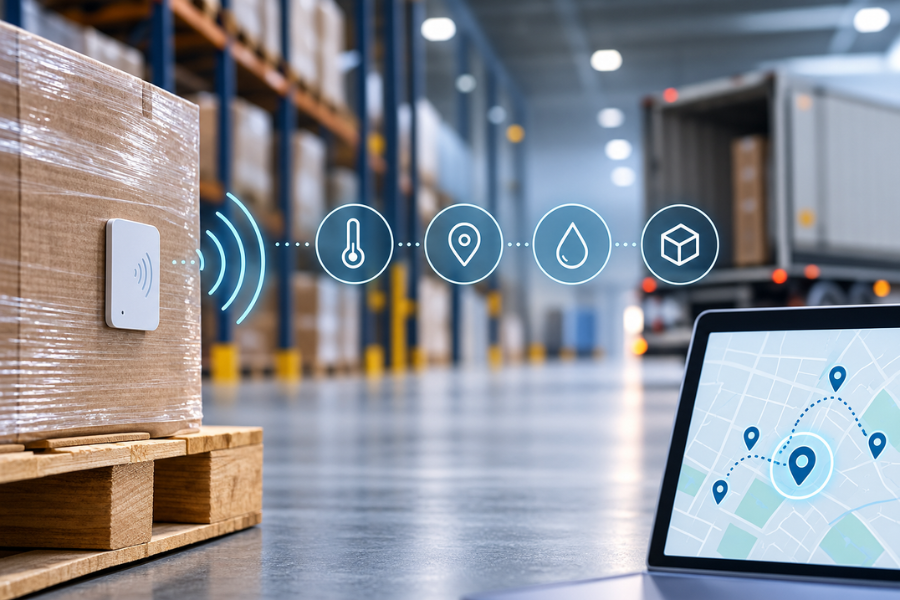
In October 2026, a major U.S. omnichannel retailer confirmed the full-scale rollout of ambient Internet of Things technology across its supply chain, deploying millions of battery-free sensors that continuously report the location, temperature and condition of inventory in real time. The deployment, described by the technology provider as the first large-scale implementation of ambient IoT in the retail sector, targets 90 million pallets across more than 4,600 locations by the end of 2026.
What Is Ambient IoT and Why It Matters
Ambient IoT is a class of connected devices that operate without batteries, harvesting energy from ambient radio waves, light, motion or heat. Unlike traditional RFID tags, which require a dedicated reader to interrogate them within a limited range, ambient IoT sensors communicate over standard Bluetooth and cellular infrastructure already present in most commercial environments. They do not wait to be scanned; they broadcast continuously.
This distinction addresses a limitation that has constrained supply chain visibility for two decades. Traditional RFID tags could transmit identity but not continuous sensor data, because the energy harvested from radio waves was insufficient to sustain a stream. The infrastructure requirements, proprietary readers deployed at every chokepoint, meant that anything outside those chokepoints remained invisible. Pallets on a truck, merchandise in a backroom, stock sitting in a receiving bay: all dark between scan events.
In February 2026, the ISO/IEC 18000-65 standard was finalised by a consortium including Panasonic and Keio University, addressing this constraint by giving each tag a dedicated sub-channel that lets it wake up, identify itself and shift into streaming mode for vibration, temperature or strain readings, without a battery. The Ambient IoT Alliance, formed earlier this year, is now working to align Bluetooth, 3GPP and IEEE around a common ecosystem, with the explicit goal of avoiding the proprietary fragmentation that stalled first-generation RFID.
The Deployment at Scale
The rollout represents one of the largest sensor deployments in retail history. As of October 2026, the solution had been deployed across 500 locations, with national expansion planned to cover 4,600 Supercenters, Neighborhood Markets and over 40 distribution centers. The goal is to track 90 million pallets by the end of 2026.
The sensors capture signals about temperature, location, humidity and dwell time. These signals are linked with the retailer’s artificial intelligence systems, enabling improvements in supply chain efficiency, inventory accuracy and cold chain compliance. As one senior executive explained, “We expect to be active in about 500 locations by the end of the year, with plans for national expansion in 2026”.
The retailer will know in real time exactly where merchandise is located across its network and whether it is owned by the retailer, at any moment. The data provides proof of delivery, improves replenishment decisions and feeds directly into AI systems.
Operational Impact and the Shift from Prediction to Precision
The technology initiative is already making a significant impact by eliminating manual tasks and providing automated alerts. Associates no longer need to perform time-consuming checks to locate items. Automated alerts now flag this information in real time, allowing associates to act faster and dedicate more time to serving customers.
The enhanced visibility is also helping resolve inventory discrepancies. As the senior executive noted, “By combining continuous sensing with AI, we’re moving from probabilistic predictions to precision decision-making”. The underlying logic is straightforward: AI system performance is predicated on its training data and the better the data, the better the AI. The ambient IoT deployment provides a new stream of high-resolution supply chain data that enables the AI to be more effective.
This matters particularly for cold chain compliance. Temperature and condition monitoring at the case level supports freshness, regulatory compliance and waste reduction for perishables and sensitive goods.
RFID’s Promise Finally Delivered
The business case for item-level supply chain visibility has been understood since RFID mandates began appearing in 2003 and 2004. However, the cost-per-tag and infrastructure overhead made item-level tracking impractical. Pallets could be tagged, but the economics did not support tagging every case or every item. The infrastructure problem, the need for dedicated readers at every chokepoint, created a fragmented, incomplete picture of the supply chain.
The gap between classic RFID and ambient IoT comes down to how data moves. Ambient tags communicate over standard Bluetooth and cellular infrastructure already present in most commercial environments. They broadcast continuously, rather than waiting to be interrogated. The cost equation has shifted, though whether it has shifted enough to hold at 90 million pallets in production remains an open question.
Remaining Questions and Limitations
Despite the scale of the deployment, several important caveats apply.
The 90 million figure is a target, not a confirmed achievement. The goal is to reach 90 million pallets by the end of 2026. As of October 2026, the deployment was live at 500 locations. The full rollout to 4,600 locations and 40-plus distribution centers was planned for later in the year. Whether the target is met in full has not been independently verified.
Financial performance data has not been disclosed. The retailer’s senior executive did not disclose specific figures such as cost savings. The anticipated gains from higher supply chain efficiency, improved inventory accuracy, reduced manual tasks and faster shelf replenishment remain projections rather than reported results.
The technology’s reliability at scale is still being tested. The IoT for All analysis noted that “whether it’s shifted enough to hold at 90 million pallets in production is still an open question”. The transition from a 500-location pilot to a 4,600-location national rollout introduces variables, network density, interference, infrastructure variations across different facility types that may not have been fully exercised in the initial deployment.
Standards and interoperability remain in development. While the ISO/IEC 18000-65 standard was finalised in February 2026 and the Ambient IoT Alliance is working on alignment, the ecosystem is still evolving. The deployment relies on a single technology provider’s platform and broader industry adoption will depend on whether standards mature sufficiently to support multi-vendor environments.
Privacy considerations for item-level tracking. Continuous, scan-free visibility at the item level raises questions about data governance, particularly as the technology moves from pallet-level tracking toward case-level and potentially item-level sensing. The current deployment focuses on pallets, which mitigates some privacy concerns compared to consumer-facing item tracking, but the trajectory of the technology points toward finer granularity.
Conclusion
The ambient IoT deployment represents a meaningful advance in retail supply chain visibility. By eliminating the need for batteries and dedicated reader infrastructure, ambient IoT addresses the cost and complexity barriers that have limited item-level tracking since RFID’s first promises two decades ago. The combination of continuous sensing with AI systems offers a pathway from periodic, probabilistic inventory management to real-time, precision decision-making.
But the deployment is still in its rollout phase. The 90 million pallet target, the 4,600-location footprint and the claimed operational benefits are projections and targets, not yet fully realised results. The coming months will determine whether ambient IoT can deliver at national scale what it has demonstrated in pilot deployments and whether the cost equation holds when the sensor count reaches nine figures.
Sources:

You may also like
Physical AI Brings 24/7 Robotic Shelf Replenishment to Retail