Smart Carts Are Quietly Replacing Self-Checkout
Self-checkout has been positioned as the future of in-store retail. It promised efficiency, lower labor costs and faster throughput. And for a while, retailers scaled it aggressively.
But in 2025 and 2026, the narrative has started to shift.
Not in a single announcement, but through a series of quiet reversals. Retailers have begun limiting self-checkout usage, reintroducing staffed lanes and rethinking how the model fits into store operations. The issue isn’t that the technology failed. It’s that the assumptions behind it didn’t hold up at scale.
And in that gap, a different model is gaining traction – Smart carts.
The Problem Was Never the Technology
Self-checkout was designed to move operational work from staff to customers. In theory, this made sense. In practice, it concentrated complexity into a single moment: the end of the shopping journey.
That moment became a point of friction.
Customers were expected to scan, weigh, verify and pay with precision. Some did. Many didn’t. The result was a system that required constant intervention, undermining the efficiency it was supposed to create. At the same time, retailers began reporting rising levels of shrink associated with self-checkout environments, forcing a rethink of how much responsibility could realistically be shifted onto customers.
Major players like Walmart and Target have acknowledged these pressures, with some stores reducing or restricting self-checkout usage as a result.
The flaw wasn’t technical, it was behavioral.
Smart Carts Change the Structure of the Journey
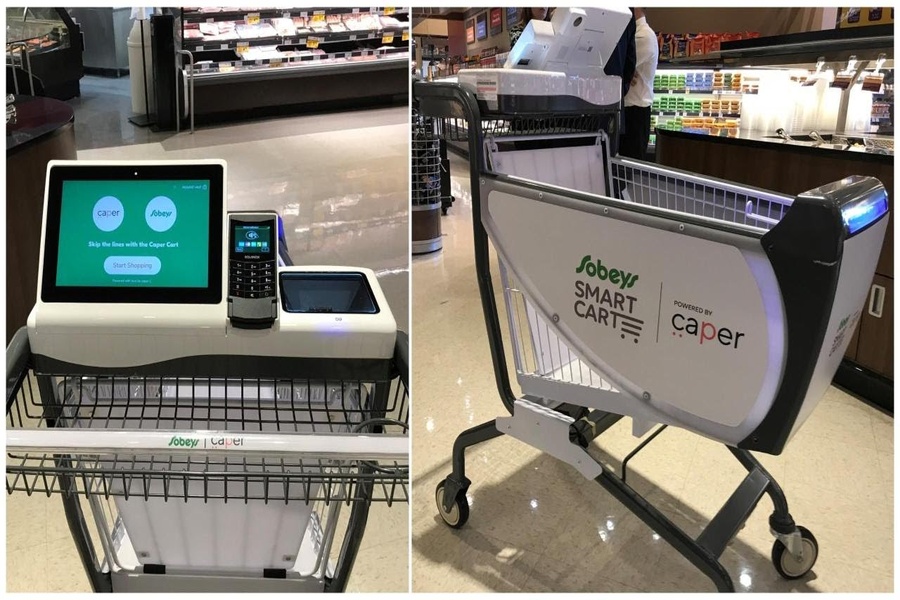
Smart carts approach the same problem from a different angle. Instead of concentrating effort at checkout, they distribute it across the act of shopping itself.
As items are placed into the cart, they are automatically identified using a combination of computer vision and weight sensors. The total updates in real time and by the time the customer finishes shopping, the transaction is effectively complete.
There is no distinct “checkout moment.”
This model is no longer experimental. Instacart has expanded its AI-powered Caper Carts across multiple retailers and geographies, including partnerships with Kroger in the US and Morrisons in the UK. In 2025, Instacart reported that it had significantly expanded deployments, bringing the technology into more stores and new international markets as retailers looked for alternatives to traditional checkout models.
At Morrisons, for example, customers can scan items as they shop, track their spending live and leave the store without queuing, effectively bypassing the traditional checkout process altogether.
Amazon’s Bet: Not Checkout-Free Stores, but Checkout-Free Journeys
At the same time, Amazon is doubling down on its own version of the concept through the Dash Cart.
Rather than relying solely on fully autonomous stores, Amazon has continued to evolve the cart itself, embedding cameras, sensors and payment systems directly into it. The latest iterations allow customers to add items, monitor their total in real time, and pay simply by exiting through a designated lane.
This is a subtle but important shift.
Instead of removing infrastructure at the store level, Amazon is moving intelligence closer to the customer. The cart becomes the system.
Theft Is Accelerating Adoption
While smart carts are often positioned as a convenience upgrade, the underlying driver is more pragmatic.
Retail theft has become a growing concern, particularly in high-frequency environments like grocery. Self-checkout introduced ambiguity into the transaction process, making it easier for items to go unscanned, whether intentionally or not.
Smart carts reduce that ambiguity.
Because items are identified at the moment they enter the cart, the opportunity for “missed scans” is significantly reduced. The system tracks the basket continuously, rather than relying on a single point of verification at the end.
This allows retailers to reintroduce control without reintroducing friction, something traditional loss prevention methods have struggled to achieve.
The Economics Are Starting to Work
For years, smart carts were held back by cost. Outfitting each cart with sensors, cameras and compute capability is not a trivial investment.
What’s changed is the broader context.
Shrink is rising. Labor remains expensive. Customer expectations around speed and convenience have increased. At the same time, the cost of underlying technologies has declined. When viewed against these pressures, the economics of smart carts are becoming more viable.
There is also a strategic upside that goes beyond checkout.
Smart carts generate a level of behavioral insight that physical retail has historically lacked. Retailers can see not just what customers buy, but how they decide, what they pick up, what they put back and how their basket evolves in real time.
That data has implications far beyond the store.
A More Practical Path Than Fully Autonomous Stores
Fully autonomous stores, often associated with “Just Walk Out” technology, represent the most frictionless version of retail. But they are difficult and expensive to scale, requiring dense sensor networks and complex infrastructure.
Smart carts offer a more modular approach.
They localize intelligence at the cart level, allowing retailers to introduce automation without redesigning the entire store. This makes them easier to deploy, easier to scale and more adaptable to existing formats.
In many ways, they represent a more realistic path toward the same end goal.
The Cart Becomes the Interface
There is a deeper shift happening beneath all of this.
When the cart tracks spending in real time, integrates payment and potentially delivers recommendations, it stops being a passive object. It becomes an active interface.
Instacart has already begun layering AI capabilities into its carts, including features that can suggest products or guide shoppers through their journey. This points to a future where the cart is not just part of the experience. It is the experience.
The implications are significant.
Retail has always struggled to digitize the in-store journey in a meaningful way. Smart carts may finally provide that layer.
Sources:

You may also like
Digital Identity Goes Live at the Checkout
The Identity Infrastructure Behind AI Shopping