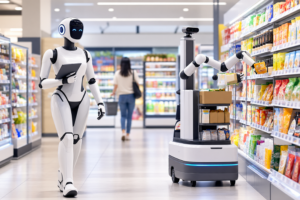
Is Retail Becoming a Utility Service?
Retail is increasingly shifting away from traditional shopping behaviour toward an infrastructure model centred on speed, availability and convenience. Across grocery, e-commerce and convenience retail, major retailers are investing heavily in rapid fulfilment networks, automated logistics and always-on delivery systems designed to make purchasing immediate and frictionless.
This transition reflects a broader structural change in how retail operates. Historically, retailers competed through assortment, pricing and physical locations. Increasingly, they are competing through fulfilment speed and continuous accessibility.
The result is a retail environment that resembles utility infrastructure more than conventional commerce.
Speed Is Becoming the Product
One of the clearest signals of this shift is the rapid expansion of ultra-fast delivery services.
In May 2026, Amazon announced the rollout of Amazon Now, its 30-minute-or-less delivery service, to dozens of cities across the United States, with plans to reach tens of millions of customers by the end of the year. The service is now widely available in Atlanta, Dallas–Fort Worth, Philadelphia and Seattle, with rapid expansion underway in cities including Austin, Houston, Minneapolis, Orlando, Phoenix, Denver and Oklahoma City. According to Amazon, the service provides fresh groceries, household essentials and locally relevant items, and is available 24 hours a day in most areas where it is offered. Prime members pay a delivery fee of $3.99 per order.
The significance of this development extends beyond delivery speed itself. It reflects a shift where consumers increasingly expect retail access to function continuously and on demand rather than around traditional shopping journeys. Amazon senior vice president Udit Madan stated that the service is designed for “when you need or want the convenience of getting your Amazon order delivered in 30 minutes or less,” adding that customers can get “everything from groceries for dinner, to AirPods before a flight, to household essentials like laundry detergent or toothpaste delivered right to your door.”
This infrastructure-led approach is also visible in convenience retail. In May 2026, Southern Co-op expanded rapid grocery delivery across 140 stores, representing approximately 80% of its food estate, through a partnership aimed at boosting its e-commerce capabilities. Anuj Christi, Head of Store Operations at Southern Co-op, stated: “Our stores are at the heart of the communities they serve, and this is about making it even easier for customers to access them in a way that fits around their day.”
In both cases, retail is increasingly operating as a service layer designed for constant availability.
Retail Infrastructure Is Becoming Hyper-Local
To support these expectations, retailers are redesigning logistics infrastructure around proximity and immediacy.
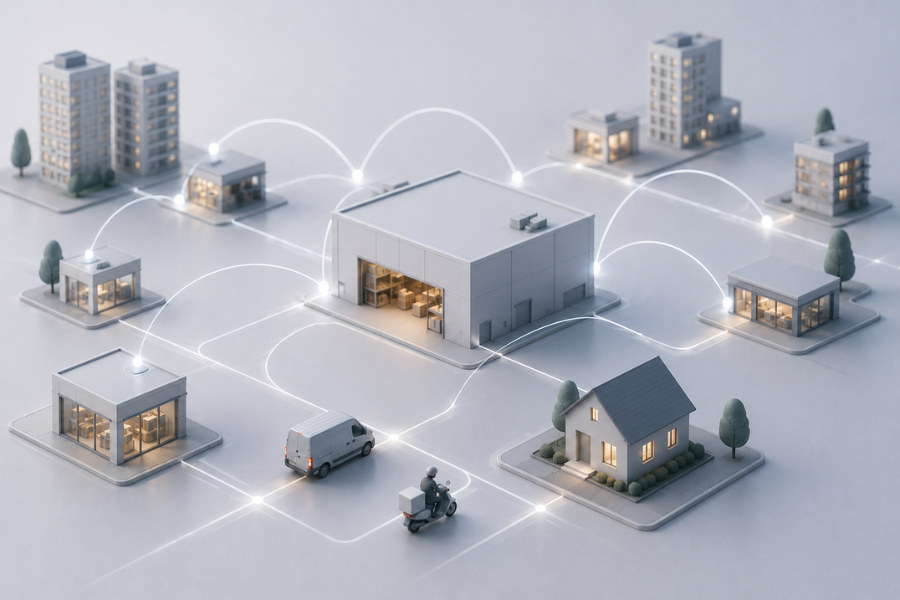
Amazon stated that Amazon Now “uses a network of smaller locations designed for efficient order fulfilment, strategically placed close to where customers live and work.” This approach reduces the distance delivery partners need to travel and enables faster delivery times. Industry analysts note that the service relies on “small fulfilment centres placed close to customers,” supporting ultra-fast 30-minute delivery.
This reflects a wider industry movement toward decentralised fulfilment networks. Rather than relying exclusively on large regional warehouses, retailers are increasingly investing in micro-fulfilment centres, local delivery hubs, and automated urban logistics infrastructure. The objective is not simply operational efficiency, it is to make retail continuously accessible in the same way consumers access utilities such as electricity, broadband or streaming services.
Amazon has also separately invested more than $4 billion to build out a last-mile delivery network for rural customers, more than doubling same-day deliveries to rural areas in 2026 with additional delivery stations planned. CEO Andy Jassy told CNBC: “If you live in a rural area, the fact that you can’t get items via e-commerce in less than three days, I think it’s unfair and I think it’s a bad customer experience. We’re going to be able to get items to customers in rural areas so much faster, inside a day or two, which is a very different customer experience than what you could do before.”
The investment is expected to triple the size of Amazon’s rural delivery network by the end of 2026, covering more than 13,000 ZIP codes and extending same-day and next-day delivery to over 4,000 small cities, towns and rural communities. The emphasis on geographic coverage demonstrates that fulfilment accessibility itself is becoming a competitive differentiator.
Convenience Is Reshaping Consumer Expectations
As rapid fulfilment becomes more common, consumer expectations are evolving alongside it.
Amazon stated that customers increasingly use ultra-fast delivery for both planned and urgent purchases, including groceries, household essentials and last-minute items. Perishable goods make up nine of the top ten most-ordered items for same-day delivery on Amazon, CEO Andy Jassy noted on an earnings call in early 2026.
This changes the role of retail in daily life. Shopping is becoming less event-driven and more embedded within continuous consumption behaviour. Instead of planning purchases around store visits or delivery schedules, consumers can increasingly treat retail access as an always-available utility. The transaction becomes secondary to the expectation of immediate fulfilment.
This shift is also affecting physical retail. Southern Co-op explicitly stated that its rapid delivery expansion is intended to make stores more accessible in a way that “fits around their day,” adding that the service builds on “the different ways people can shop with us while keeping that important local connection.” Convenience stores are increasingly functioning as local fulfilment infrastructure supporting digital ordering and rapid delivery rather than purely walk-in traffic. The operational role of the store is therefore expanding beyond merchandising into fulfilment and accessibility infrastructure.
Retailers Are Investing in Logistics Over Store Expansion
The shift toward utility-style retail is also visible in capital allocation decisions.
In May 2026, Marks & Spencer agreed to acquire a fully automated distribution centre from ASOS in Lichfield, Staffordshire, for £67.5 million. The 437,000-square-foot site, which will become operational in 2027, is expected to create 600 jobs and is part of M&S’s strategy to double online fashion sales. M&S managing director for Fashion, Home and Beauty, John Lyttle, said: “As we transform M&S Fashion, Home and Beauty, our ambition is to double online sales. To achieve this and serve our customers faster, more efficiently and with better availability, our 24/7 distribution network needs more capacity.”
The facility will enable later order cut-off times, support more sizes and styles being stocked, and improve speed from supplier to customer.
At the same time, M&S has accelerated its online fashion strategy through the launch of “The Love That Drop,” a monthly capsule programme that delivers trend-led pieces from design to customer in the retailer’s “quickest ever time.” Each 20-to-35-piece collection is aligned with catwalk looks and emerging trends, and the programme is supported by a streamlined supplier model enabling shorter timelines from concept to launch. According to M&S, reducing the time it takes to bring new fashion to market is “a key strand of the Fashion, Home and Beauty transformation as M&S reshapes for growth.”
This broader operational focus shows how retailers are reorganising around responsiveness, fulfilment speed and continuous product availability rather than static seasonal retail models.
The Economics of Retail Are Changing
Utility-style retail also changes the underlying economics of the industry.
Traditional retail models relied heavily on driving footfall and maximising transaction value during discrete shopping occasions. Rapid delivery and subscription-style convenience models shift the focus toward frequency of engagement, fulfilment efficiency, retention, infrastructure scale and operational reliability.
Amazon’s investment into smaller fulfilment locations positioned close to customers reflects this operational logic. The company’s network is designed so that inventory can be staged closer to where demand is anticipated, with AI systems used to position stock before orders are placed.
Retail therefore becomes less dependent on customers actively searching for products and more dependent on infrastructure capable of responding instantly when demand appears.
Retail Is Becoming Invisible
One of the most important consequences of utility-style retail is that the shopping process itself becomes less visible.
Consumers increasingly interact with retail through automatic replenishment, rapid delivery, predictive recommendations, app ecosystems and embedded fulfilment systems. In the U.S., Prime members received more than 8 billion items the same or next day in 2025, a more than 30% increase compared to the prior year, with groceries and everyday essentials making up half of the total.
The friction traditionally associated with shopping is gradually being removed. This mirrors how utilities operate: consumers rarely think about the underlying infrastructure unless it fails. The same principle increasingly applies to retail platforms where convenience and reliability become the primary expectation.
As delivery speeds compress and fulfilment networks expand, the competitive focus shifts away from the act of shopping itself toward seamless access and operational consistency.
Retail is increasingly evolving into an infrastructure-driven service model built around continuous access, fulfilment speed and operational responsiveness.
Amazon’s nationwide rollout of 30-minute delivery, Southern Co-op’s expansion of rapid grocery delivery across 140 stores, Amazon’s $4 billion investment in rural delivery infrastructure, and M&S’s acquisition of automated logistics capacity to double online sales all point in the same direction: large retailers are no longer competing solely through products or store footprints, they are competing through accessibility.
Consumers are beginning to expect retail to function continuously and invisibly, available whenever needed with minimal friction.
In that sense, retail is starting to resemble a utility service.
The competitive advantage is no longer just what retailers sell. It is how reliably and instantly they can provide access to it.
Sources

You may also like
Pay Later Moves From the Shopping Basket to the Shop Counter
Pavement Robots Move From Pilot Projects to Grocery Delivery