Why Biometric Checkout Is Becoming a Competitive Necessity
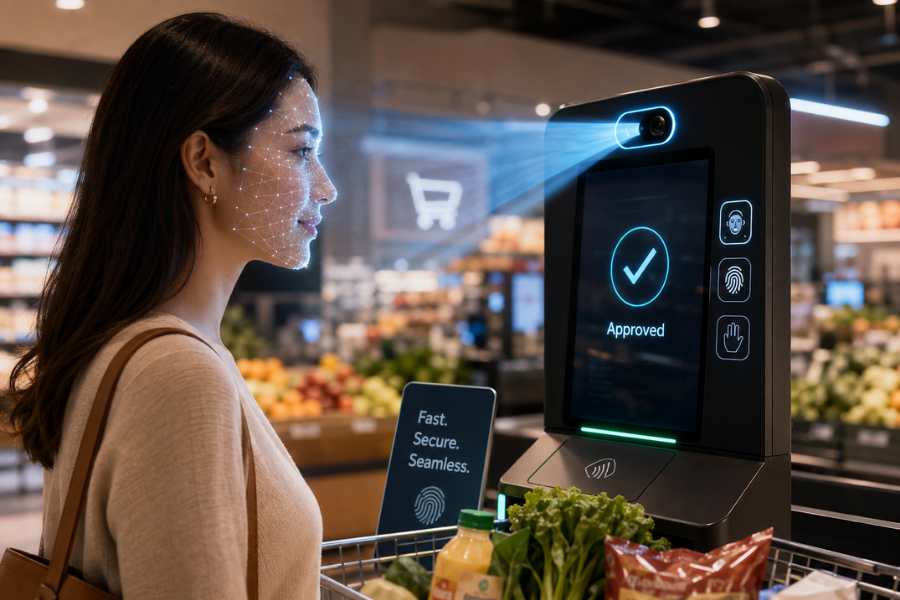
The final moment of a retail transaction has remained stubbornly analogue for far too long. In a world where consumers can summon a taxi, check their bank balance and unlock their front door with a glance or a touch, the act of paying at a physical store still often means fumbling for a card, waiting for a sluggish PIN pad or abandoning the purchase altogether when the queue snakes too far. This friction is no longer a minor inconvenience. It has become a competitive liability and the retailers that recognise this are quietly turning their checkout lanes into a source of strategic advantage. Biometric authentication, using fingerprints, facial recognition or palm scanning, is emerging as the clearest answer the industry has today to a problem that is costing billions in lost sales annually.
Why Traditional Checkout Is Failing
Long queues have become one of the leading causes of lost in-store sales, with retailers consistently citing checkout delays as a direct driver of abandoned purchases. It is not just an annoyance but lost revenue, brand friction and increasingly, a reason customers choose a competitor. The cost of this friction is immense and the retailers who recognise this are asking a different question: not how to process payments faster, but how to remove the act of paying altogether. The answer, increasingly, lies in biometric checkout, which has gone from a futuristic concept to a mainstream necessity in 2026.
The numbers underscore a massive shift in consumer expectations around digital payments. A 2026 report on the global biometric in-store payments market reveals that it generated USD 9.7 billion in 2025 and is predicted to grow to USD 12 billion in 2026, eventually reaching approximately USD 87.1 billion by 2035, recording a CAGR of 24.60%. Furthermore, the global biometric payment authentication market was valued at USD 17.62 billion in 2025, with projections to grow to USD 21.63 billion in 2026 and reach USD 111.9 billion by 2034. This growth is not happening in a vacuum; it is being driven by a fundamental shift in consumer attitudes.
The modern shopper has overwhelmingly embraced speed and convenience. A survey by the global technology firm Incode found that over half (54%) of global consumers believe digital authentication methods such as biometrics are revolutionizing the customer experience when it comes to online transactions and payments. The technology is also moving beyond early adopters; a Censuswide survey of 2,001 Americans found that nearly half of U.S. consumers would use palm‑based payments if they were confident their biometric data was secure. This acceptance is particularly pronounced among younger demographics, with 46% of 25-to-34-year-olds saying they already trust biometrics, compared to just 28% of those over 55.
Biometrics as a Fraud Shield
The move to biometric checkout is driven not only by a desire for speed but also by a pressing need for enhanced security. Fraud is becoming more sophisticated across all channels, and static authentication methods such as PINs and passwords were not designed for the threats retailers face today. Biometrics fundamentally shifts this balance. It is far harder to replicate a fingerprint or a facial pattern than it is to compromise a four-digit code.
For retailers processing high transaction volumes, the fraud reduction case alone is compelling. The integration of identity, payment, and loyalty into a single biometric transaction allows merchants to offer new checkout experiences that not only shorten transaction times but also reduce fraud exposure without adding operational complexity. Advanced systems now incorporate AI-based liveness detection capabilities to ensure that a face or fingerprint belongs to a live person, not a photograph or a spoof, further reducing fraudulent transactions.
This trust in biometrics is already widespread. A 2026 report from payments technology company Verifone revealed a stunning statistic: 81% of consumers say they believe biometrics are more secure than passwords, indicating that the consumer trust barrier may have largely dissipated. The conversation is now shifting from “Is biometric authentication secure?” to “Why is it not yet standard everywhere?”
The Power of a Single Identity
Perhaps the most transformative aspect of biometric checkout is its ability to unify the entire retail experience. By connecting in-store, mobile, and online journeys through a single biometric identity, merchants can link payments, loyalty enrollment, and even instant age verification into one seamless, secure moment. This is not just about speeding up a transaction; it is about recognising the customer at every touchpoint without requiring them to perform any action beyond their presence. This fusion of identity and payment creates a powerful, low-friction loop that can increase repeat visits and dramatically reduce cart abandonment.
How Brands Are Deploying Biometric Checkout
The theoretical advantages of biometric checkout are being validated by real-world deployments from some of the world’s largest companies. Mastercard, a leading global payments network, has introduced a new biometric checkout program that allows consumers to simply smile at a camera or wave their hand over a reader to pay, with the first pilot launched in Brazil in partnership with the supermarket chain St Marche. This program brings together a consortium of partners to ensure interoperability and security at scale.
On the point-of-sale front, the large commerce solutions provider Clover has integrated multimodal biometric payments, supporting contactless palm, face, and voice recognition, directly into its software stack. This integration, enabled through a partnership with a specialised technology provider, brings identity-based payments to hundreds of thousands of merchants, allowing them to reduce line friction, lower labour dependency for age-restricted sales, and combat fraud without requiring new hardware.
In Asia, the technology has seen even deeper integration. The Japanese technology powerhouse NEC has been running field trials of facial recognition payment systems in its Tokyo headquarters, with plans to expand to retail and entertainment industries. Meanwhile, the Chinese e-commerce giant Alibaba has tested and deployed its “Smile to Pay” facial recognition service, demonstrating its commitment to reimagining offline retail spaces through advanced, cashless technology. More recently, at the major retail technology event EuroShop 2026, the European payments leader Worldline unveiled “One Commerce,” a unified retail proposition that explicitly aims to converge payments and digital identity to deliver faster, more connected customer journeys.
Designing for Privacy and Consumer Trust
Despite the clear momentum, the path to ubiquitous biometric checkout is not without its challenges. The most significant hurdles are not technological but societal: privacy, data security and consumer trust. The recent decision by Amazon to phase out its “Amazon One” palm payment system from all Whole Foods locations, citing limited customer adoption, serves as a stark reminder that simply having the technology is not enough. This setback highlights the absolute necessity of transparent data handling and giving consumers a genuine choice.
The industry is responding by baking privacy and security into the design of these systems. Instead of storing raw biometric data, which would be a catastrophic security risk, modern platforms create a biometric profile that is stored in a secure, tokenised vault, physically separating a person’s identity data from their payment credentials. This approach is designed to reduce fraud risk and support compliance with strict data protection requirements. Surveys confirm that data security is the key to mass adoption; the Handwave research found that 48% of consumers would use palm payments regularly if they trusted how their data was handled. For retailers willing to invest in clear communication and robust security, the biometric checkout presents a massive opportunity to outmanoeuvre competitors still reliant on friction-filled legacy systems.
The Overlooked Accessibility Case
Beyond speed and security, there is a powerful argument for biometric checkout that is often overlooked: accessibility. For customers with cognitive, motor, or visual impairments, traditional checkout presents significant real-world barriers. Entering a PIN on a small screen, handling loose change, or physically swiping a card is not always straightforward or even possible. Biometric authentication removes many of these physical and cognitive challenges, allowing customers to complete transactions in a way that aligns with how they naturally interact with the world.
Industry leaders are recognising this imperative. Visa, for instance, has stated that it strives to innovate with accessibility at the forefront, empowering more people to participate fully in the digital economy. In the UK, major financial industry groups are working to ensure point-of-sale technology remains accessible for those who are visually impaired, identifying opportunities to embed features that make the most difference in practice. By adopting biometric systems, retailers are not just embracing a new technology; they are opening their doors to a segment of the population that has historically faced unnecessary friction.
The Checkout Is Now a Competitive Weapon
For decades, the checkout lane was viewed as a necessary evil, the final, unavoidable step to complete a sale. In 2026, that perception has become dangerously outdated. The retailer’s ability to authenticate a customer’s identity and complete a transaction in a fraction of a second, without any physical or mental effort from the shopper, is becoming a defining feature of the brand experience. The businesses that embrace this autonomous shift will gain a competitive advantage through what is being called “experience orchestration”, a strategy that prioritises speed and security above all else.
The question is no longer whether biometric checkout will become standard, but which retailers will be leading the charge when it does. The technology is ready. Consumer trust is building. And the cost of doing nothing, lost sales, frustrated customers and a slow but steady erosion of market share has never been higher.
Sources:

You may also like
Pay Later Moves From the Shopping Basket to the Shop Counter
Pavement Robots Move From Pilot Projects to Grocery Delivery