When the Customer Is an Algorithm
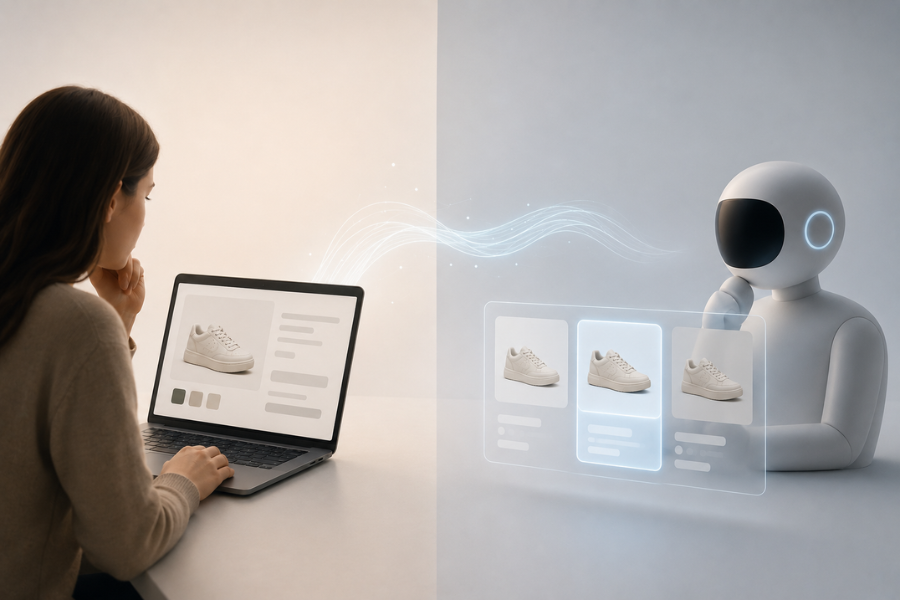
For decades, the science of e-commerce conversion has rested on a stable set of psychological principles. Scarcity drives urgency. Countdown timers push the hesitant toward action. Strike-through pricing makes discounts feel like gains. Social proof, “1,200 people bought this today”, signals that others have done the due diligence, so you do not have to. These tactics have been tested, refined and embedded into the architecture of online retail, forming a persuasion playbook that generations of marketers have treated as close to universal law.
That playbook is now cracking. The reason is simple and unsettling: a growing share of shoppers is not human.
AI shopping agents, software systems that browse, compare and increasingly purchase on behalf of consumers, are rapidly becoming a meaningful share of online “shoppers.” In the first quarter of 2026, AI-sourced traffic to US retail sites rose 393% year over year. Consumer adoption of agentic shopping is projected to increase from 19% in 2025 to 46% by the end of 2026. McKinsey estimates that AI-driven commerce could mediate $3 trillion to $5 trillion of global consumer commerce by 2030. And yet, new research published in Harvard Business Review in May 2026 reveals something that most marketing organisations have not yet absorbed: the persuasion tactics built for human cognition do not work the same way on AI agents. Some do not work at all. Some actively backfire.
The customer is changing. The question is whether marketing will change with it.
The Shopper Who Is Not Human
The shift from human-directed to agent-directed commerce has accelerated faster than most retailers anticipated. In January 2026, Google launched the Universal Commerce Protocol, an open standard designed to let AI agents communicate with commerce systems across the entire buying journey, from discovery through checkout and post-purchase. Developed in collaboration with Walmart, Shopify, Wayfair, Target, Etsy and more than 20 other commerce and payments organisations, UCP enables shoppers to discover, evaluate and complete purchases inside conversational interfaces like Google AI Mode and the Gemini app without ever visiting a retailer’s website. By March, Gap Inc. was live with UCP, allowing customers to complete purchases directly within Google Search’s AI Mode.
OpenAI has pushed ChatGPT deeper into product discovery and merchant integrations. ChatGPT now handles roughly 50 million shopping-related queries per day. In March 2026, OpenAI pivoted its commerce strategy, retiring its Instant Checkout feature, which fewer than 30 of Shopify’s millions of merchants had gone live with at the time, in favour of letting merchants own checkout themselves while ChatGPT handles discovery and evaluation. “The goal is for ChatGPT to be a super assistant,” said Neel Ajjarapu, who leads commerce at OpenAI. “When it comes to shopping, it should be able to help you find products, optimise carts, and buy things.”
Amazon, meanwhile, has been on its own trajectory. In May 2026, the company retired its Rufus chatbot, used by more than 300 million customers in 2025, and replaced it with Alexa for Shopping, a more deeply personalised AI assistant embedded directly into the Amazon search bar. The move signals Amazon’s conviction that AI will become the primary interface between customers and its catalogue.
The scale is largest in China, where agentic commerce has moved beyond experimentation into daily infrastructure. Alibaba’s Qwen AI assistant, now fully integrated with Taobao’s catalogue of more than four billion products, reached 300 million monthly active users by early 2026. Alipay processed 120 million AI-agent transactions in a single week in February, completed purchases ordered through a chatbot and paid without the user leaving the conversation. Meituan, JD.com, ByteDance and Tencent are all racing to deploy similar capabilities across platforms that collectively serve China’s roughly 975 million online shoppers.
The infrastructure for agent-driven commerce is being laid at extraordinary speed. What has lagged is any systematic understanding of how these agents actually make decisions.
What AI Agents Actually Respond To
The Harvard Business Review research, conducted by a team of academic researchers, set out to answer a question that few marketers had thought to ask: when an AI agent evaluates products, do the same promotional cues that work on humans produce the same effects?
The researchers built a proprietary simulation that replicates how AI agents interact with typical e-commerce product pages. They tested four different AI models – GPT-4.1-mini, GPT-5, Gemini 2.5 Pro and Gemini 2.5 Flash Lite, each tasked with selecting among products presented in a realistic grid layout. They varied eight types of promotional badges commonly used in online retail: assurance signals such as money-back guarantees, countdown timers, strike-through pricing, scarcity cues such as “Only 2 left!,” social proof in the form of purchase counts, vouchers, bundles and star ratings. Product categories rotated across four everyday items, a phone, a fitness watch, a washing machine and a mouse pad to test whether patterns held across common retail contexts. For each model and product, they ran 1,000 simulated shopping rounds, yielding more than 16,000 choice situations in total.
The headline finding was clear. Only one tactic, star ratings, consistently pushed choices upward across all four models and product categories, mirroring the well-established human reliance on quality signals. Social proof was the next most robust signal, but even that varied across cases.
Every other promotional cue produced effects that varied by model and product category, sometimes dramatically. Strike-through pricing, countdown timers and bundling showed no stable pattern. In some cases they increased selection; in others they had no effect; and in at least one case, bundling reduced it. A scarcity badge that triggered a fear-of-missing-out response in a human shopper had no effect on some models, and GPT-5 even reacted negatively to it in certain product categories, suggesting a pattern that runs counter to what is typically observed in humans.
What Stops Working and What Starts Working Against You
Perhaps the most uncomfortable finding in the research concerns the direction of travel. A common assumption is that as AI models become more capable, they will become more “rational”, less susceptible to marketing cues and more like the perfectly informed utility maximisers of economic theory. The research challenges this directly.
The more advanced reasoning models, GPT-5 and Gemini 2.5 Pro, were not simply indifferent to promotional cues. In several cases, they appeared to penalise overt persuasion tactics, as though interpreting them as signals of low quality or manipulation. For Gemini 2.5 Pro, as the discount cue became more extreme, its additional persuasive effect weakened rather than strengthened. The direction of travel, the researchers concluded, is not toward agents that simply ignore marketing. It is toward agents where more persuasion produces *less* selection.
This creates a genuinely novel problem for marketers. For decades, the worst-case scenario for a promotional tactic was that it would be ineffective, that a countdown timer or a “limited stock” badge would fail to move the needle. In an agentic commerce environment, the worst-case scenario is that the same tactic actively reduces the likelihood of being selected. Aggressive promotional cues, the kind that still work on many human buyers, may increasingly become counterproductive as agent models advance. In the blunt formulation of the HBR research: “The brands that thrive will be those disciplined enough to know when persuasion itself has become the problem.”
Across every model tested, only two factors behaved exactly as they do for humans: price and ratings. Higher prices consistently reduced selection; higher ratings consistently increased it. Before investing in agent-specific tactics, the researchers argue, firms should ensure their fundamentals are airtight: competitive pricing and strong, authentic review profiles. Everything else is now a hypothesis to test, and findings may expire with every model update.
What Marketers Think They Know
If the research findings are unsettling, the state of marketer preparedness is perhaps more so. In an exploratory survey of 50 e-commerce executives across the US and UK, conducted as part of the same HBR study, the majority said they have already noticed traffic or conversion shifts they attribute to AI agents and are actively seeking ways to improve how agents engage with their sites. Yet many of these same executives believe that the cues that persuade human shoppers also tend to influence AI agents in similar ways and that they already understand which elements of their websites matter most to agent behaviour.
The research suggests this confidence is misplaced. The mechanics of persuasion were built on human subjects: on loss aversion, anchoring, scarcity bias, social proof. For AI buyers, these are not reliable principles. They are hypotheses to test. And a tactic that works on GPT-5 today may produce an entirely different result after the next model update.
This knowledge gap is compounded by a deeper structural shift. As a retail technology analyst firm noted after CES 2026, the traditional linear retail funnel is obsolete. Storefronts are no longer static pages; they are dynamic interfaces where AI agents act on behalf of buyers to conduct research within product catalogues and provide comprehensive summaries to aid decision-making. The emerging reality is agent-to-agent commerce, where a consumer’s personal AI negotiates directly with a retailer’s AI to execute a purchase. In that world, traditional marketing designed to sway human emotion through display ads becomes irrelevant in an interaction between two algorithms.
Google, OpenAI and Amazon Stake Their Claims
Behind the scenes, a massive effort is underway to build the infrastructure that will make AI shopping ubiquitous. The commerce leads at Google and OpenAI say we are months (not years) away from a tipping point where agentic commerce becomes commonplace. Whoever builds the shopping experience consumers want to use will own one of the most lucrative pieces of real estate in the history of retail.
Google’s Universal Commerce Protocol represents the most ambitious infrastructure play. UCP is an open-source standard, not a proprietary format and was developed in collaboration with major commerce and payments partners. As of March 2026, Google had expanded UCP to include cart support and real-time catalogue access, including inventory and pricing. The protocol creates a common language that allows AI agents and commerce systems to work together across consumer services, retailers and payment providers. For merchants, this means a structural shift: shoppers can discover, evaluate and purchase products inside conversational flows across Google surfaces, including AI Mode and Gemini, without ever landing on a retailer’s site. Selection replaces ranking. The agent narrows choices down to a small set of products, putting more pressure on data quality and trust signals than on traditional search optimisation.
OpenAI’s approach is different. After the false start of Instant Checkout, which the company quietly killed in March 2026, acknowledging that building AI-native checkout was more complex than anticipated, OpenAI has pivoted to a strategy where ChatGPT handles discovery and evaluation while merchants own the transaction. “It’s not enough to have a basic checkout page,” Ajjarapu told *Fast Company*. “You need to think about things like loyalty points, in-store pickup, basket promos and dozens of features that are specific to the geography, category and merchant type.” OpenAI bets that ChatGPT’s 900 million weekly active users represent a discovery surface too large for retailers to ignore.
Amazon’s move is more defensive but equally significant. By retiring Rufus and folding its recommendation capabilities into Alexa for Shopping, a deeply personalised assistant embedded directly into the search bar, Amazon is betting that the AI shopping experience should be native to its own platform rather than mediated by third-party agents. The Alexa for Shopping rollout gives Amazon a conversational layer that sits on top of its vast product catalogue, customer purchase history and logistics infrastructure.
The new consensus emerging from these developments, as MarketResearch.com noted in its March 2026 analysis, is that agentic AI is mostly a threat to retail media networks rather than to gross merchandise volume. Retail media and advertising are being reimagined as brands pay for visibility not on search result pages but inside AI-driven recommendation flows.
The New Rules of Visibility
What does it take to be chosen by an agent? The answer is only beginning to emerge, but several principles are already clear.
The first is that fundamentals eclipse tactics. Across every model tested in the HBR research, price and ratings were the only factors that behaved consistently. Everything else was noise. For marketers who have spent decades layering promotional cues on top of product pages, this is a sobering message: the bells and whistles may not help, and they may hurt. Competitive pricing and strong, authentic review profiles are the new table stakes for agentic visibility.
The second is that structured data is becoming more important than persuasive copy. As Next-Cart’s analysis of agentic commerce puts it, in this new environment, the product page becomes a data endpoint. It must be structured, consistent and accessible across all attributes, from product dimensions to shipping conditions, so that AI agents can integrate the information programmatically. Success in visibility is no longer determined by how attractive a homepage or product description looks; it depends on how clearly data communicates to machines. Schema markup, machine-readable attributes and real-time inventory accuracy are no longer technical nice-to-haves. They are the new SEO.
The third is that brand matters more, not less. When AI makes discovery and product comparison easier, trust and brand affinity become the tiebreakers. As Stripe’s analysis from Shoptalk 2026 noted, in an AI world, brand matters more than ever. The signal carries through: if an agent is comparing five near-identical products on price and specifications, the brand the consumer already trusts is more likely to be recommended and more likely to be accepted when recommended.
The fourth is that marketers must treat each AI model as a distinct market segment. The HBR research showed that the same promotional badge could produce opposite effects on the same model depending on product category and that different models respond differently to identical cues. Marketers have spent decades segmenting human buyers by demographics, geographics, psychographics, and behaviour. They now need to consider a new segmentation variable: the AI model itself. This is not a theoretical exercise. As purchases increasingly flow through commerce protocols like Google’s UCP, merchants gain visibility into which AI platforms are driving their transactions. The companies that begin building testing infrastructure now will be best positioned to act when real-time tailoring becomes feasible.
The Testing Imperative
Perhaps the most important structural takeaway from the research is that any fixed “agent optimisation strategy” has a short shelf life. The promotional effects measured in May 2026 will not be the same after the next model release. Every major update, fine-tuning adjustment, or new safety alignment can shift how an agent responds to pricing frames, urgency cues, or social proof.
The researchers recommend that firms build simulation environments where they can systematically run AI agents against their product pages across models, categories, and promotional configurations. They should maintain a versioned database of agent behaviour, indexed by model release, so they can detect when a tactic that worked last quarter has stopped working or started backfiring. This mirrors the early days of mobile optimisation, when firms initially designed for the dominant device before building fully responsive experiences. The difference is that the “devices” in this case, AI models, are evolving far more rapidly than smartphones ever did.
A more advanced approach is dynamic: detecting the agent model in real time and adjusting promotional cues accordingly, which badges appear, how pricing is framed, whether bundles or vouchers are surfaced, based on which agent is evaluating the page. Today, this remains difficult, as most AI shopping agents browse through standard web browsers, making them hard to distinguish from human visitors. But as commerce protocols mature and behavioural detection improves, the gap will narrow.
Retail Media, Trust and the Consumer
Beneath the technical findings lies a larger structural story. Agentic commerce does not just change how individual products are selected; it threatens to rewire the economics of online retail.
Retail media networks, the advertising businesses that have become among the most profitable segments of companies like Amazon, Walmart and Tesco, are built on the assumption that shoppers visit retailer websites and see ads while they browse. If AI agents pull shoppers away from retailer websites, strip out the on-site ad impressions that fund retail media and hand discovery over to platforms like ChatGPT and Gemini, the entire model comes under pressure. As The Drum reported from Shoptalk 2026, most of the agentic commerce conversation treats this as an external threat. But retailers are also beginning to build agents on their own turf, recognising that the threat can become an opportunity if they control the discovery surface themselves.
The consumer dimension is equally complex. While 61.5% of consumers have used AI tools for product discovery and recommendations, only 10% are willing to let agents operate independently. A Riskified survey in Q1 2026 found that 55% of consumers are not comfortable with AI agents making purchases on their behalf, with fraud, security, and accountability concerns topping the list. Trust is the primary bottleneck, and it is as much a brand challenge as a technical one.
This is where the HBR findings connect to the broader marketing conversation. If persuasion tactics are becoming unreliable or counterproductive when directed at AI agents, then brand strength, built on consistency, reliability and authentic quality signals, becomes the most durable competitive advantage. As the CMO-focused analysis from The Drum puts it, agentic commerce does not reduce the importance of brand. It deepens and extends it into the foundations that make a brand interpretable to a machine. The question every marketing leader must now answer is simple: are we ready to be chosen by an agent acting on behalf of the consumer?
The evidence from 2026 is clear and uncomfortable. Scarcity cues, countdown timers, strike-through pricing, and bundling, the tools marketers have relied on for years, do not work consistently on AI agents. Some produce no effect. Some produce effects that vary unpredictably by model and product category. And some, particularly as models become more advanced, appear to trigger penalties rather than persuasion.
For marketers, this demands a fundamental reset. The first audience for a product page is increasingly a machine, not a human. That machine does not respond to the psychology of loss aversion or the anchoring effects of crossed-out prices. It responds to structured data, competitive pricing, strong ratings and clear, consistent quality signals. The brands that thrive will be those that recognise the shift early and invest in the unglamorous fundamentals: data architecture, review authenticity, pricing discipline and systematic testing across models.
The uncomfortable truth of agentic commerce is that sometimes the best marketing move is to dial back the marketing. The brands that learn when to stop persuading and start being verifiably good will be the ones the algorithms choose.
Sources:

You may also like

Pay Later Moves From the Shopping Basket to the Shop Counter
Pavement Robots Move From Pilot Projects to Grocery Delivery