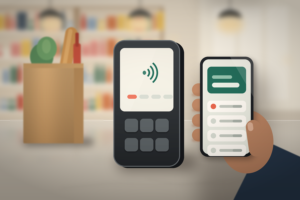
The Rise of the “Hybrid” Autonomous Store
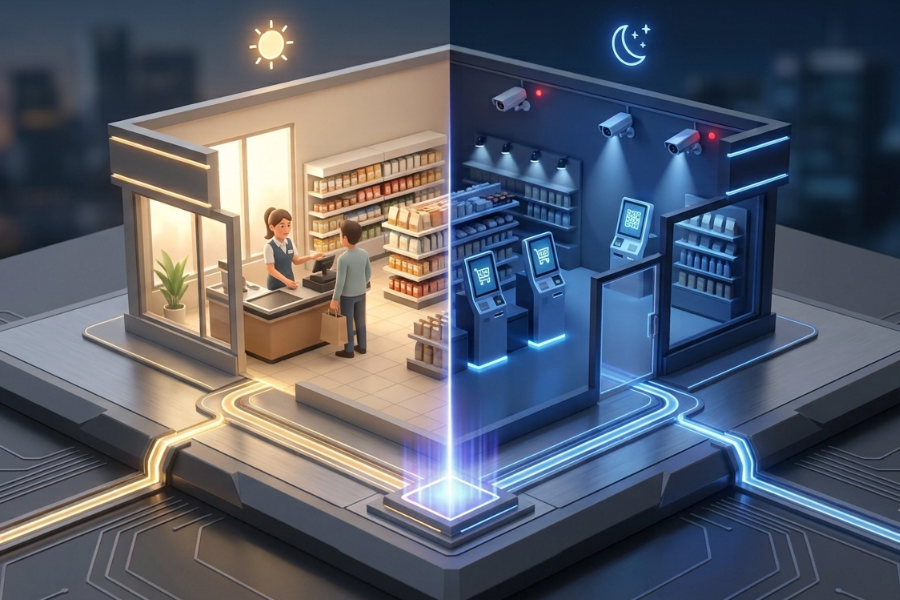
A new model of autonomous retail is quietly gaining traction across multiple markets: the “hybrid” store. This approach involves a store that operates with a full staff during regular daytime hours but seamlessly transitions to an unstaffed, self-service model at night, on Sundays or on public holidays. By sharing infrastructure between staffed and unstaffed operations, retailers can reduce the substantial upfront investment required for fully autonomous stores while still capturing incremental sales during hours when stores would otherwise be closed.
The hybrid model represents a departure from the binary choice between traditional and fully autonomous stores. It is emerging as a pragmatic, economically viable solution to the challenges of 24/7 retail, particularly in regions with specific labour laws, high costs or unique consumer demands.
The Swiss Model
In Switzerland, the hybrid store model has been adopted to address both consumer demand and strict labour regulations. In July 2026, a major Swiss retailer opened its first 24-hour supermarket in Herisau, a town in northeastern Switzerland. This store operates with staff until the usual closing time of 7:00 PM. After that, it automatically switches to a self-service mode. Customers must scan a QR code with their smartphone to gain access and can pay for their purchases at self-checkout tills. The shop, which is just under 300 square metres and stocks around 7,000 items, is monitored by CCTV and sensors for security reasons. Notably, under the Swiss Employment Act, shelves may not be restocked at night or on Sundays and public holidays; restocking must take place immediately before or after staffed opening hours.
This pilot project was a response to growing demand for flexible shopping options. Technically, the branch is based on the retailer’s existing concept of unstaffed micro-stores, which were launched in 2022. A similar hybrid model was introduced in Geneva, where a store operates normally during the week and on Saturday but becomes an autonomous, standalone location with no cashiers or sales staff on Sundays and public holidays. This initiative is a direct response to a local regulation that limits retailers to only two Sunday openings per year, in addition to December 31st. The retailer’s managing director noted that the store aims to meet customer demand, pointing out that their only other Sunday-open stores, located at the train station and airport, are “overwhelmed” on those days. The new store, located in the heart of Geneva, has a sales area of 300 m² and offers a complete range of more than 5,000 everyday consumer products.
The Korean Model
In South Korea, the hybrid store model is being driven by rising labour costs and a need to improve franchisee profitability. A major bakery brand is running 17 hybrid stores that are staffed during the day and unmanned at night. The company reported that the introduction of hybrid stores has generated more than 100,000 won in additional daily revenue on average, improving franchisees’ revenue structure. A company official explained that while there are initial investment costs for kiosk installation and security, the lack of additional labour costs makes the extra nighttime income profitable.
Convenience store chains in South Korea are also increasingly adopting hybrid stores that run unmanned at night. One major chain has the most unmanned stores, with 1,756 as of last year. Another chain increased its number of unmanned stores from 19 in 2019 to 824 last year, combining 755 hybrid stores and 69 fully unmanned stores. A convenience store industry official stated that “stores in outlying areas and provincial regions with weak nighttime sales are adopting hybrid operations to reduce labor costs”. However, the official also noted that products with strong nighttime demand, such as alcohol and tobacco, cannot be sold in unmanned stores and staffed stores still have more revenue competitiveness.
Industry observers note that in Korea, unmanned operations are becoming a tool to change operating structures rather than an experiment to eliminate people. A convenience store industry official explained, “Even stores that operate unmanned need staff to manage them, so staffing does not drop drastically. But since personnel for checkout are not needed, staffing for tasks like stocking products or cleaning the store is sufficient, allowing flexible operations”.
The Central and Eastern European Model
In Central and Eastern Europe, the hybrid model has found particular success, even as similar concepts have faced challenges elsewhere. An industry analysis notes that hybrid stores, which use self-service technology to remain open outside of working hours, are a growing trend in the region. Banners such as a Latvian convenience store and a Czech 24/7 chain are growing in visibility.
The key to success in this region, according to the analysis, is location. Retailers are selecting areas with specific challenges that autonomous technology can address. The goal is to locate areas where 24-hour demand exists, but labour availability is limited, such as smaller towns, rural areas and locations with 24-hour activity. One pioneering Czech retailer targets rural areas, university accommodation, army barracks and airports. A manned store in these areas, especially one open 24 hours, would draw high labour costs, making autonomous technology viable.
The expansion of hybrid stores in the region has been rapid. A Czech retailer now operates over 100 24/7 hybrid stores, just four years after opening its first. This expansion is also spreading to other markets, with Hungary and Latvia recently getting their first hybrid stores. The analysis notes that this is “even more striking when the start-up costs and niche applications of such stores are considered”. Hybrid stores combine the benefits of manned and autonomous retail, allowing shoppers to enjoy the benefits of having staff on hand during normal opening hours, which is particularly useful in areas with older populations.
A Pragmatic Alternative to the Fully Autonomous Store
The hybrid model is emerging at a time when the fully autonomous store concept has faced significant headwinds. In early 2026, a major US technology company began closing its autonomous stores and a similar retreat has been observed in Japan. High start-up costs and a unique selling proposition that did not excite shoppers as much as originally hoped rendered many of these stores untenable. One industry analysis noted that flagship autonomous stores in major population centres could not support their high running costs once the initial excitement faded.
The hybrid model offers a more pragmatic alternative. By sharing infrastructure between staffed and unstaffed operations, retailers can reduce the upfront investment required for autonomous technology. This approach allows retailers to capture incremental sales during hours when stores would otherwise be closed without the massive capital expenditure of a fully autonomous store.
Conclusion
The rise of the hybrid autonomous store represents a maturation of the autonomous retail concept. Rather than attempting to eliminate staff, retailers are adopting a more nuanced approach that combines the benefits of human interaction during peak hours with the efficiency and flexibility of automation during off-peak times. This model is being driven by a variety of factors: labour regulations in Switzerland, profitability concerns in South Korea and the need for 24/7 service in areas with limited labour availability in Central and Eastern Europe.
The hybrid store is not a single, uniform concept but a flexible model that can be adapted to local conditions. Whether it is a Swiss supermarket that becomes self-service after 7 PM, a Korean bakery that operates unmanned at night or a Czech convenience store that serves rural areas around the clock, the hybrid model demonstrates that the future of autonomous retail may not be about eliminating people, but about using technology to work more efficiently alongside them.
Sources:

You may also like
Why Every Online Order May Soon Get a Made to Measure Box
AI Agents Step Into the Store Manager’s Office