The New Intelligence Behind Retail
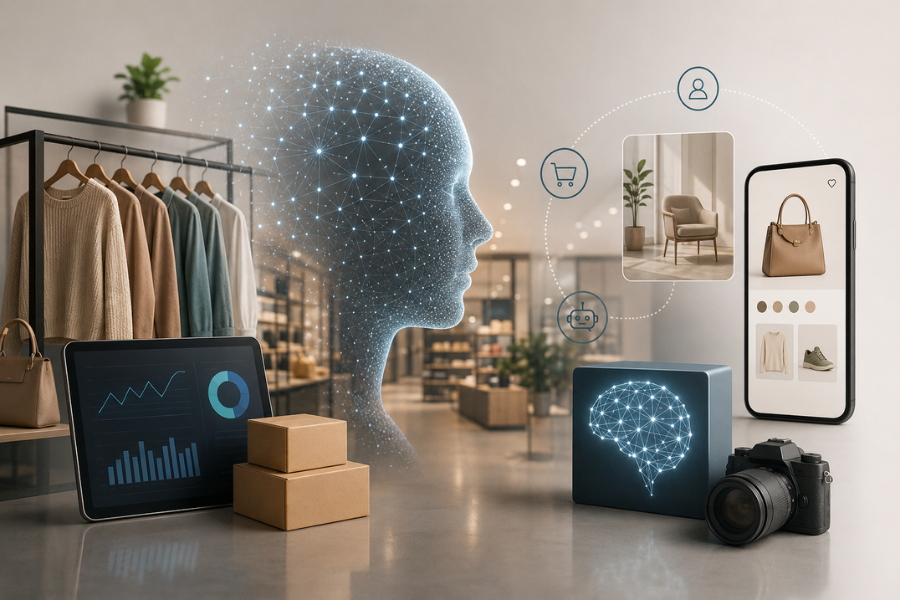
For years, the conversation around artificial intelligence in retail has been dominated by speculation and pilot projects. That era is ending. In 2026, AI is rapidly shifting from an experimental novelty to a core component of operational infrastructure. Retailers are moving beyond proof of concept and are now embedding intelligent systems into the very fabric of their businesses, from forecasting and pricing to customer engagement and content creation.
The numbers tell the story of this transformation. The global artificial intelligence in retail market was valued at approximately $14 billion in 2025 and is projected to reach nearly $20 billion in 2026, with some forecasts suggesting growth to over $130 billion by 2031 at compound annual growth rates exceeding 30 percent. According to a Levin Management survey of more than 150 retail operators, two-thirds of retailers are now actively using, testing or exploring AI within their operations, with more than one-quarter already actively using the technology.A separate study by FMI found that 68 percent of food retailers now employ AI in their business, up sharply from 47 percent just a year earlier.Food retailers allocated an average of nearly 2 percent of their total sales to technology spending in 2025, a figure that doubled from 2024.The share of respondents that said they expect AI and other emerging technologies to “change the way businesses are run” rose to 46 percent in 2025, up 9 percentage points.
Yet for all this momentum, the industry remains in the early stages of its AI journey. A TCS study of more than 800 senior retail executives across 18 countries found that while AI ranks among the top enablers for retailers, most have made limited progress in deploying it at scale.Fifty-one percent of retailers still cite chatbots and virtual assistants as their leading AI initiative, and 85 percent have not yet begun implementing—or are even planning for—multi-agent AI systems.Only 24 percent are currently using AI for autonomous decision-making.As one industry observer put it, retailers are united in their belief that AI will define the next era of competitiveness, yet most have only scratched the surface of its potential.
Smarter Forecasting, Smarter Decisions
One of the most significant shifts is in how retailers understand and anticipate demand. Traditional forecasting methods, which often rely on historical sales data and manual analysis, are being supplemented and in some cases replaced by AI powered predictive analytics. These systems can process vast amounts of data, from weather patterns and social media trends to local events and macroeconomic indicators, to generate highly accurate demand forecasts. This capability allows retailers to optimise inventory levels, reduce waste and ensure that the right products are in the right place at the right time.
The impact is measurable. BCG’s 2025 India Retail Report found that AI-driven forecasting cuts excess inventory by 28 percent and reduces lost sales by 35 percent.Demand forecasting engines that lift accuracy by 15 percent and cut overstocks by 10 percent are delivering immediate working capital improvements.AI and machine learning alone are expected to provide positive results for 76 percent of retailers through optimisations in demand planning and forecasting.Currently, 39 percent of retailers are deploying AI-powered demand sensing for supply chain resiliency.
This intelligence extends to pricing as well. Advanced machine learning algorithms can now analyse customer behaviour, competitor pricing and market conditions in real time to recommend optimal price points. Retailers can move beyond rigid markdown schedules to implement dynamic pricing strategies that maximise both sales and margins. The ability to predict demand and optimise pricing with such precision was once the domain of only the largest players; now, it is becoming accessible to a much broader range of retailers.
Personalisation at Scale
AI is also transforming how retailers interact with their customers. Consumers today expect brands to understand their individual preferences and deliver personalised experiences. AI powered personalisation engines are making this possible at scale, analysing browsing history, purchase data and even real time in-store behaviour to tailor product recommendations, promotions, and content to each shopper. The goal is to move beyond generic marketing to create meaningful, one to one connections that drive loyalty and sales.
Yet there remains a significant gap between consumer expectations and brand delivery. According to VML’s ninth annual Future Shopper report, which surveyed over 25,000 shoppers across 16 countries, 63 percent say personalised recommendations help them discover new products, but 45 percent of consumers think most brands do a poor job of personalisation.Forty-five percent of global shoppers often abandon purchases because the digital experience offered by major retailers is too frustrating.The same study found that 68 percent of consumers have used AI tools like ChatGPT to shop, and 52 percent are excited by the prospect of having their own AI agent to shop on their behalf.
In the beauty sector, for example, AI is enabling a new level of personalisation through computer vision. Tools that can analyse skin or hair type and recommend appropriate products are becoming increasingly sophisticated, allowing brands to offer a tailored experience that was previously impossible without in person consultations. This same technology is being applied across other categories, from apparel fit recommendations to personalised nutrition advice. The global computer vision AI in retail market was estimated at $1.66 billion in 2024 and is projected to reach $12.56 billion by 2033, growing at a CAGR of 25.4 percent.
The Rise of Generative Content
Perhaps the most visible application of AI in retail today is in content creation. Generative AI is revolutionising how retailers produce product photography, marketing visuals and campaign content. What once required a professional photographer, a studio, and days of post production can now be accomplished in minutes. Retailers can take a single product image and generate dozens of on brand lifestyle shots or create entire campaigns tailored to different customer segments. This capability not only reduces costs and speeds up time to market but also allows for unprecedented creativity and personalisation in visual marketing.
The economics are staggering. Traditional product photography costs between $75 and $150 per image, while AI generation costs between $0.05 and $0.25 per image.Time per image drops from two to five days to just 30 to 90 seconds.Forty percent of e-commerce product images are projected to be AI-generated by the end of 2026.Seventy-nine percent of e-commerce brands already use AI for product showcase content. According to Snowflake’s “The ROI of Gen AI and Agents 2026” report, 66 percent of retail respondents are already using generative AI and large language models, compared to 58 percent across other industries.FMI’s research found that 59 percent of food retailers now use generative AI, compared with 43 percent a year ago, and the percentage of retailers that have implemented an organisation-wide generative AI tool more than doubled year over year, to 40 percent.
The global AI image editor market is valued at $88.7 billion in 2025 and is expected to grow significantly in the coming years. Across North American retailers, AI is currently being used for marketing (70 percent), IT and digital functions (62 percent), digital commerce (56 percent), and merchandising strategy and pricing (54 percent).
Where Innovation Meets Opportunity
These technologies, predictive analytics, AI driven personalisation and generative content, are not isolated trends. They are converging to create a retail environment that is more responsive, efficient and customer centric than ever before. The AI revolution in retail is not a distant future; it is happening now, reshaping everything from how products are sourced and priced to how they are marketed and sold.
Yet the journey is far from complete. While adoption is accelerating, many retailers are still navigating the transition from isolated experiments to enterprise-wide intelligence. The retailers that master this transition will become more perceptive enterprises, capable of learning, adapting, and responding in real time.
For retailers looking to explore these capabilities firsthand, dedicated spaces at major industry events are offering the chance to see these solutions in action. One such destination is the House of Innovation Pavilion, a dedicated area at NRF 2026: Retail’s Big Show Europe in Paris from September 15 to 17 where emerging technologies in AI, robotics and advanced retail tech are being showcased. It represents a unique opportunity to witness the future of retail intelligence and understand how these tools can be applied to real world business challenges.
Planning to be in Paris for NRF Europe 2026?
- Find out more about the House of Innovation: Paris Connect
- Request your invitation: Registration Form

You may also like
Physical AI Brings 24/7 Robotic Shelf Replenishment to Retail