The Visual Commerce Revolution
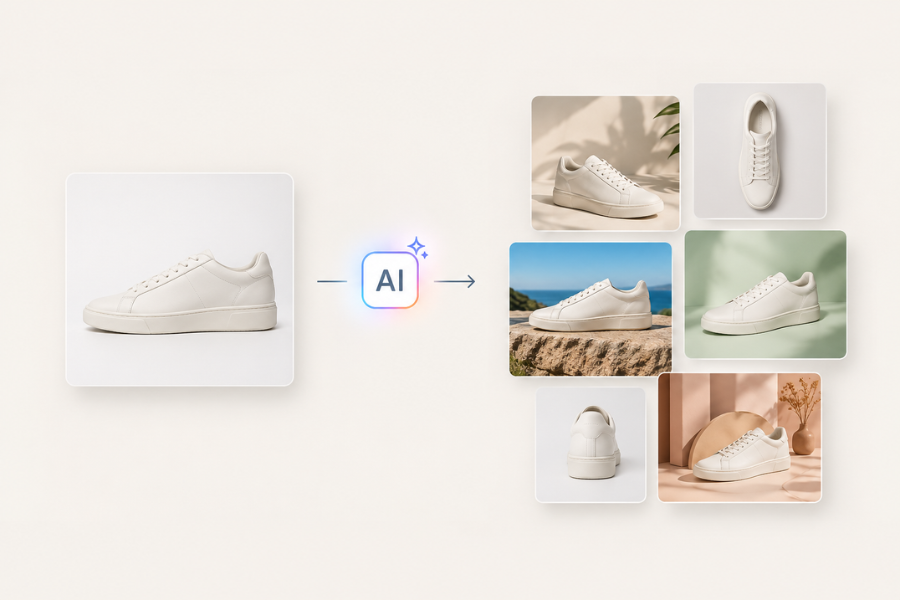
For most of e-commerce history, product photography followed a simple formula: book a studio, hire a photographer, ship samples, wait days or weeks for proofs and pay hundreds of dollars per image. That formula is now obsolete.
In 2026, generative AI is fundamentally reshaping how retailers create visual content. The global AI image generation market for e-commerce reached $274 million in active merchant spending, according to Statista’s AI Image Generation Worldwide outlook. The retail visual AI vertical is growing at a compound annual rate of 22.8 percent through 2034. The AI product photography market is projected to grow from approximately $450 million in 2024 to roughly $5 billion by 2035, a compound annual growth rate near 24.5 percent.
The economics alone tell the story. Traditional product photography typically runs $25 to $170 or more per finished image depending on complexity, with lifestyle scenes at the top of the range. Studio rates from industry pricing benchmarks show that for a 50-SKU catalogue needing five images each, a studio shoot runs $6,250 to $42,500 plus shipping and weeks of lead time. The same 250 images via AI generation cost $5 to $50 in API fees from existing reference photos. The cost per image dropped from $75 to $150 for traditional studio photography to $0.05 to $0.25 for AI generation. Time per image dropped from two to five days for scheduling, shooting and editing to 30 to 90 seconds. Listing creation time drops by 73 percent when sellers switch from traditional photo shoots to AI-assisted workflows, according to Shopify’s commerce research.
The adoption curve has gone vertical. Forty percent of e-commerce product images are projected to be AI-generated by the end of 2026. Seventy-nine percent of e-commerce brands use AI for product showcase content. According to a 2026 industry survey, 78 percent of brands generate at least a quarter of their customer-facing content with AI, across product descriptions, images and alt text; 28 percent have crossed the point where AI produces most of it. Generative AI adoption had surpassed 50 percent globally by early 2026, making it one of the fastest adopted technologies in history. According to Snowflake’s “The ROI of Gen AI and Agents 2026” report, 66 percent of retail respondents are already using generative AI and large language models.
What AI Replaces in the Product Photography Workflow
Three line items disappear: studio time, reshoot cycles and per-variant photography. One clean reference shot becomes unlimited backgrounds, angles and seasonal campaigns. Background swaps, seasonal variants and channel-specific crops that once required a reshoot now generate in minutes from one source image. The average time to produce a marketplace-ready product image using AI has dropped to under five minutes per SKU, based on benchmark testing.
The implications for catalogue size are substantial. A mid-size seller with 2,000 SKUs requiring five images per product faces $500,000 to $1,000,000 in traditional photography costs. With AI, the same job costs $1,000 to $2,500. For a 50-SKU catalog needing 250 images, a studio shoot runs $12,500 to $25,000; the same images via AI cost $25 to $62.
Beyond Cost
The transformation is not just about cost. Direct-to-consumer brands using AI-generated product photography are cutting traditional shoot costs by an average of 73 percent while reducing production timelines from three to four weeks to under 24 hours. Data from Conversion Analytics shows that AI-generated product images are achieving 12 percent higher click-through rates on average compared to traditional photography, particularly for lifestyle and contextual product shots. Products featuring 3D visualisation and AI-enhanced imagery have experienced measurably lower return rates compared to static imagery. According to an annual consumer research, 84 percent of online consumers consider product photos more important than reviews, product descriptions or seller ratings when deciding what to buy. Poor image quality is the top reason shoppers abandon a listing they would otherwise have purchased.
Fashion retailers are deploying generative AI systems that produce over 10,000 new product images daily without booking a single human model or renting studio space. Their systems, trained on licensed photography, create diverse body types, ages and ethnicities. Major e-commerce platforms including Shopify, Amazon, and eBay have not banned AI-generated product images. According to one DTC brand case study, a seller relaunched 340 product listings with AI-generated images. Total cost for all 340 products with five images each: $127. The year before, they had paid a photography studio $18,700 for the same product line. Same SKUs. Same angles. Same white background hero shots and lifestyle scenes. The conversion rate difference between the old professional photos and the new AI photos was less than 2 percent.
Quality and Consumer Perception
The quality has crossed a critical threshold. According to an agency survey, 78 percent of creative agencies use AI-generated imagery commercially, with product and campaign visuals leading the use cases. New AI composition engines analyse product dimensions, lighting angles and material textures to automatically generate contextually appropriate backgrounds. Advanced platforms can generate images at 4K resolution with precise brand colour matching and customisable lighting scenarios.
However, consumer perception remains nuanced. A 2026 survey found that 55 percent of UK consumers believe poorly executed AI-generated or heavily edited product images make them trust an online marketplace less. Only 33 percent said they are comfortable with AI-enhanced product images even when clearly labelled. Another survey found that 72 percent of consumers are concerned about AI-generated product recommendations, while 31 percent said visible AI-generated marketing makes them trust brands less. A Fortune report found that despite one in six models uploaded to its platform being AI-generated, those assets accounted for just $1 out of every $90 in generated revenue, and just 2.6 percent of sales. A separate study found that AI-generated product images achieved only 25.3 percent accuracy in matching the real product without any correspondence failures, with logo and text distortion in 20.1 percent of cases, elements disappearing in 12.5 percent, and pattern alteration in 11.4 percent.
For retailers navigating margin pressure and rising customer expectations, the economic case for AI-generated visual content is clear, though quality control and consumer trust remain important considerations.
For those looking to explore these capabilities firsthand, the House of Innovation Pavilion at NRF 2026: Retail’s Big Show Europe in Paris (September 15–17) is showcasing emerging technologies in AI-powered visual content creation and advanced retail tech.
Planning to be in Paris for NRF Europe 2026?
- Find out more about the House of Innovation: Paris Connect
- Request your invitation: Registration Form

You may also like
Facial Recognition Payments Launch in the UK with 0% Merchant Fees