Why Retail’s $540 Billion Problem Is Becoming Its Greatest Technology Opportunity
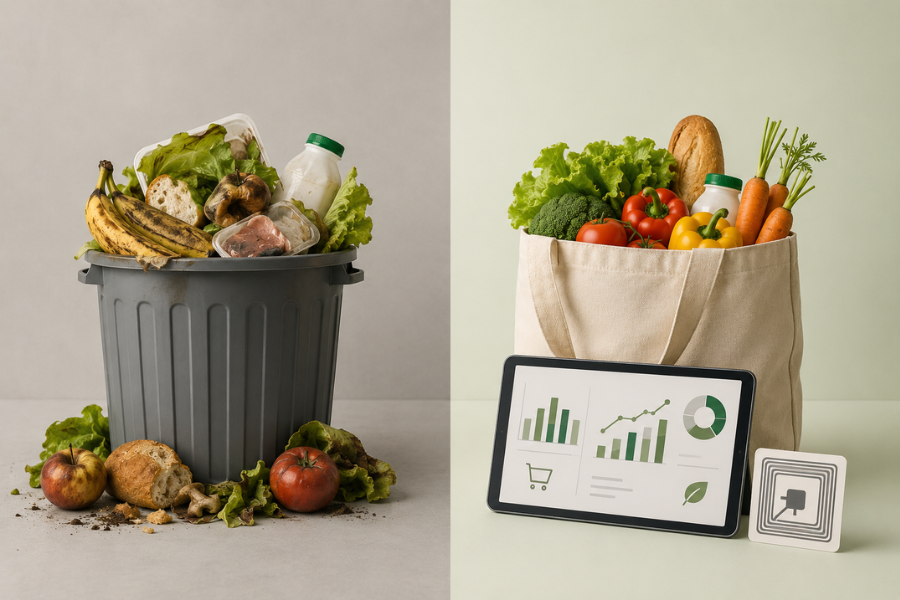
Food waste is not a sustainability story anymore. It is a margin story, a supply chain story and increasingly a competitive story. In 2026, the economic cost of food waste across the global supply chain is projected to reach $540 billion, up from $526 billion the year before, with retailers absorbing a disproportionate share of the damage. New research from Avery Dennison and the Centre for Economics and Business Research, based on a survey of 3,500 global retail and supply chain leaders, found that food waste costs are now equivalent to 33% of total revenues in the food retail supply chain from post-farm to point-of-sale. If current trends continue, the cumulative cost between 2025 and 2030 is expected to reach $3.4 trillion, coinciding with the UN’s Sustainable Development Goal deadline to halve global food waste.
The numbers by category are staggering. In 2026 alone, meat waste is projected to cost the global economy $94 billion—nearly one-fifth of the total global waste bill—with fresh produce close behind at $88 billion, and baked goods at $67 billion. Half of retail leaders identify meat as their most difficult category to manage, followed by fresh produce at 45% and baked goods at 28%. In the United States, grocery stores throw away roughly 30% of their food each year, with experts estimating that translates to nearly $18.2 billion in lost value. Afresh, a startup deploying AI tools across more than 12,500 grocery store departments nationally, estimates that American grocery stores waste around four million tons of food annually—most of it fresh.
What has changed in 2026 is that the response to this problem is no longer confined to corporate sustainability reports or charitable donation programmes. It has moved into operations, into pricing systems, into the RFID tags being tested in Walmart meat departments and into the AI models now deciding how much bread to bake at each Albert Heijn store across the Netherlands. The war on waste is being fought with technology because the economics finally make sense. As Julie Vargas, Vice President and General Manager at Avery Dennison, said: “Food waste has become an accepted cost of doing business, but it doesn’t have to be. Innovation exists today to help overcome the complexity of food waste by unlocking new possibilities and transforming a historic operating cost into measurable value across the global retail supply chain.”
Why 61% of Retailers Cannot See Their Own Waste
Before any technology can fix food waste, it has to measure it. And measurement is precisely where the retail industry remains weakest. 61% of organisations acknowledge they do not have complete visibility into where food waste happens in their operations and 56% of companies lack a clear grasp of the waste volume generated during transit. More than half of business leaders cite overstocking and poor inventory control as major contributors to waste within their organisations.
The visibility gap is particularly acute in fresh departments. At NRF 2026, Scandit reported that retailers consistently described a common problem: expiry date checks vary by person, by time and by store. Products close to expiry are hard to spot at scale, and markdown timing is often based on habit rather than insight. The practical approaches discussed included capturing both barcodes and printed expiry dates automatically so that checks can cover more items in less time, aggregating expiry data to identify patterns, which SKUs or stores consistently drive higher waste, and triggering markdowns or removals from actual expiry data rather than rough rules of thumb. The fundamental shift, as Scandit noted, is from “walk the aisle and eyeball dates” to “capture expiry once, then use it for both daily decisions and longer-term planning.”
This operational blindness is not just an inconvenience. It means that retailers are routinely ordering too much, discounting too late and discarding sellable inventory, while simultaneously absorbing higher input, labour and logistics costs. As the World Economic Forum observed in its April 2026 analysis, food waste represents a double loss: “Retailers are absorbing higher input, labour and logistics costs, yet still discarding sellable inventory. They pay more to put food on shelves, then lose its full value when it goes unsold.” More than half of business leaders say the costs associated with food waste have increased over the past three years.
Predicting Demand Before the Order Is Placed
The first major front in the war on waste is upstream: using AI to prevent over-ordering in the first place. Fresh food ordering has historically been a pen-and-paper process, with produce managers using printed spreadsheets to estimate inventory and write orders. Produce sold by weight might literally be evaporating as it loses water. Customers in the self-checkout aisle might pay for a non-organic apple when they are actually buying organic. Food that goes bad on the shelf, raspberries to salmon fillets, is often not accurately counted when it is thrown away.
A software solution provider uses data from each grocer, in some cases, hundreds of billions of transactions, and analyses pricing, promotions, where food is shipped from and other factors to understand the perishability of each product. Deep learning models forecast demand based on factors ranging from the timing of food stamps to the weather. An optimisation algorithm then suggests how much of each product to order. The company announced $34 million in new funding in April 2026 to expand its AI tools that help supermarkets cut food waste, in a round co-led by Just Climate and High Sage Ventures. “We typically see 20% to 25% reduction in shrink when we go live with our system,” said Schwartz. The technology is now used in more than 12,500 grocery store departments nationally, including Safeway and Albertsons.
In Europe, Albert Heijn has taken a similarly data-driven approach to its bakery departments. The Dutch supermarket introduced an internal tool called the Bak application in the summer of 2025. Using AI-driven forecasts, the application calculates how much bread each store needs throughout the day, allowing the assortment to be adjusted accordingly. In the second half of 2025 alone, this led to 815,000 kilograms less bread being wasted across the company’s own stores. In May 2026, Albert Heijn extended the approach by combining smart baking with dynamic pricing: AI predicts demand per store, and unsold bread products are discounted in stages(up to 70%) with prices visible via the AH app under “Last Chance Deals” and on electronic shelf labels in-store. The nationwide rollout began on May 4, and the retailer expects the combined approach to prevent more than 2 million kilograms of food waste annually. Sjoerd Holleman, Director of Product, AI & Speciality Brands at Albert Heijn, said: “By combining technology and AI with attractive prices for customers, we are making an impact by both reducing food waste and improving affordability for customers.”
In Finland, Kesko reported that its K-Food stores cut food waste by around one million kilograms in 2025, driven by more accurate demand forecasting and strong uptake of discounted red-label products.
Bringing Inventory Accuracy to the Fresh Perimeter
The second front is on the shelf itself: using intelligent labels and RFID technology to bring the same inventory accuracy that exists for packaged goods into fresh departments like meat, bakery and deli, which have historically been considered too difficult for electronic tracking.
At NRF 2026, Avery Dennison mounted two dedicated sessions and an interactive booth programme showing how item-level digital identity can give store teams faster, more accurate visibility from source to shelf. One session, “Revolutionizing Fresh Operations: Embracing RFID in Grocery to Reduce Waste and Drive Sales,” brought together Julie Vargas of Avery Dennison and Jonathan Olsen of Kroger to explain how sensor-enabled tags are being used in-store to manage fresh inventory and lift availability. Kroger discussed translating RFID use cases into operational efficiency and sales gains as part of its Zero Hunger | Zero Waste ambitions. Kroger had already implemented an RFID initiative in bakery departments across 2,750 stores, improving inventory visibility and cutting waste. The company has been working toward diverting more than 90% of operational waste and 95% of food waste from stores.
Walmart has gone further into one of the hardest categories of all: meat. The retailer partnered with Avery Dennison to develop a first-of-its-kind sensor technology that brings RFID-enabled labels to the meat department, a challenging environment where high moisture and metal surfaces have historically made RFID unreliable. By using RFID solutions in meat, along with bakery and deli departments, Walmart associates can track inventory faster and more accurately, ensuring products stay stocked and ready when customers want them while reducing the spoilage that occurs when items are lost in back-of-house or overlooked on the shelf. Walmart is also deploying an AI-enabled system in its e-commerce fulfilment centres that measures empty space in shipping cases and dispenses the precise amount of paper void fill required, reducing material use while streamlining packaging operations.
The strategic logic behind these investments is straightforward. As Julie Vargas put it: “The biggest challenge is what we can’t see. From transit to shelf, blind spots are silently eroding margins. With the right innovation we can turn this loss into measurable value and shift the conversation on food waste into a business-critical one.”
Turning Near-Expiry Into Revenue
The third front is the one that most directly transforms cost into revenue: using AI to dynamically price products approaching their best-by dates so they sell before they must be discarded. This is not simply about putting a red sticker on a package. It is about precise, disciplined markdowns, executed at the shelf edge with speed and accuracy and aligned with the point of sale so that the price the customer sees is the price they pay.
The traditional markdown routine is built for good intentions, not good outcomes. In most stores, someone walks the aisles, checks dates, prints stickers, applies them and hopes customers notice. This competes with everything else happening in a busy store – picking online orders, replenishing shelves, handling returns. As a result, markdowns drift later in the day, some products never get touched and the discounts end up blunt. A big, late cut means fast sell-through but also means margin that did not need to be sacrificed. There is also a silent problem of price integrity: if the sticker price does not match the POS price, the checkout becomes a negotiation and stores learn the wrong lesson – “better to avoid markdowns than create conflict.” Waste rises.
AI-based markdown tools split the problem into decision and execution. The decision is “how much discount, and when.” The execution is “get that price onto the shelf and into the POS, fast, with minimal errors.” Electronic shelf labels make the execution part real: prices can be updated centrally in seconds, across thousands of SKUs, without printing, sticking, and re-checking labels. Once that infrastructure exists, the AI can run a discount path, starting smaller when there is still time, then stepping deeper only if the product does not move. This is the opposite of the panic markdown. It is closer to inventory control than to promotional pricing. When AI sets expiry-led markdown steps and electronic shelf labels publish them instantly with POS alignment, retailers can boost near-expiry sell-through, reduce store-level food waste and protect margin by avoiding late, overly aggressive discounts.
Another retail tech startup connects shoppers with local grocery stores to purchase food nearing its best-by date at a discount. In April 2026, Kroger expanded its partnership with the startup to its entire Mid-Atlantic division, bringing the solution to more than 100 stores across Virginia, West Virginia, Ohio, and Kentucky. The partnership began with a pilot in 16 Richmond, Virginia, stores in July 2025. In that pilot alone, Kroger shoppers saved nearly $700,000 on groceries and kept more than 290,000 pounds of food out of landfills. The platform currently focuses on items reaching their best-by dates in fresh departments, including meat, produce, bakery, and deli goods.
On the other side of the Atlantic, the world’s largest marketplace for surplus food continues to scale its model. In January 2026, Circle K expanded its partnership with the marketplace to more than 120 participating stores in Ireland, with plans to bring all Irish stores onto the app by the end of the first quarter. During the trial, customers gave the Circle K Surprise Bag an average rating of 4 out of 5. Separately, SPAR’s Appleby Westward group, after rolling out the platform across its stores, reported a 7.8% increase in revenue from surplus food using AI-powered discounting, without requiring a heavy IT overhaul.
Computer Vision and AI Waste Characterisation
The fourth front is the most technologically ambitious: using computer vision and AI to understand exactly what is being wasted, in what quantities, and why. This moves waste management from reactive disposal to predictive quality management.
In April 2026, Google announced a partnership with a startup to build an AI-enabled visual waste characterisation system. The collaboration draws on Google’s Project Delta, an internal research effort that used cameras and annotation to identify what is food and what is not and applies it commercially. The startup’s system uses integrated computer vision to identify what food is being discarded, in what quantities and why, translating that stream of data into procurement and operational intelligence for large food service operators. The United States alone wastes approximately 30% to 40% of its food supply annually, around 70 million tons with an economic value of approximately $380 billion.
The broader category of AI-powered waste tracking, shelf-life modelling and digital twins is shifting food waste reduction from a post-hoc accounting exercise to a real-time operational capability. As the Institute of Food Technologists noted in April 2026, AI is “shifting waste reduction from reactive disposal to predictive quality management, especially for perishables.”
The Low-Tech Insight That Changes the Math
Amid the investment in AI, RFID, and computer vision, one of the most striking research findings of 2026 is how much waste can be eliminated without any new technology at all.
A peer-reviewed study published in the INFORMS journal *Management Science* in February 2026 found that grocery retailers can increase profits by an average of 6% and cut food waste by more than 21% through small operational decisions already under their control: where perishable items sit on the shelf, when discounts appear and how deep those discounts go. The researchers examined how product display, discount timing and discount depth interact for perishables with declining quality over time, fresh produce, dairy and meat. Their conclusion: where a product sits on the shelf matters almost as much as its price.
The study found that the best strategy depends on the product. Items that deteriorate slowly, like dairy, benefit most from displaying older products more prominently and offering modest discounts. Products that deteriorate quickly and are costly to discard, such as meat or prepared foods, perform better when fresher items are emphasised and discounts are used more aggressively. For fast-decaying, low-cost items like fresh bread, it can still make sense to clear shelves entirely when new stock arrives. Even for everyday-low-price retailers that avoid discounting altogether, simply adjusting how products are displayed can reduce waste and improve profitability when customer traffic is unpredictable—which is the reality for most stores. “Retailers don’t have to choose between profitability and sustainability,” said Zumbul Atan of Eindhoven University of Technology, one of the study’s authors. “In many cases, the same decisions that improve profits also dramatically reduce waste.”
A separate analysis from the University of Texas and collaborating institutions, published in April 2026, found that donation is consistently cheaper than disposal. While it typically costs retailers around €0.27–0.36 per kilogram in waste and handling costs to dispose of food, donation costs on average about €0.14–0.23 per kilogram.
The Regulatory Accelerant
Technology adoption in waste reduction is not happening in a regulatory vacuum. Governments are tightening the rules and the compliance clock is ticking.
The European Union has introduced binding 2030 food waste reduction targets requiring a 10% reduction in processing and manufacturing waste and a 30% per-capita reduction across retail and consumption. It is not surprising, as the World Economic Forum noted, that 73% of retail leaders now cite legislation and regulatory compliance as a key driver of food waste reduction.
Perhaps the most symbolically significant regulatory shift is the EU’s ban on the destruction of unsold apparel, clothing accessories and footwear, which takes effect for large companies from 19 July 2026, with medium-sized companies to follow in 2030. The ban forms part of the Ecodesign for Sustainable Products Regulation and targets a long-standing industry practice where unsold textiles are discarded to protect brand value or manage surplus inventory. Companies will also be required to disclose information on the volume of unsold goods they discard and the reasons for doing so. The ban is likely to reshape inventory management across the retail sector, forcing businesses to find alternatives to disposal, including resale, donation, recycling, or redesign, and may accelerate investment in circular business models such as recommerce and textile recycling. While small companies are exempt, global brands operating in the EU market must comply, which may drive changes in supply chains and stock management practices worldwide.
The Bigger Picture
What connects all of these developments, AI demand forecasting, RFID in fresh departments, dynamic markdowns, computer vision waste characterisation and tightening regulation, is a fundamental shift in how the retail industry thinks about waste.
For decades, food waste was treated as a sustainability goal and a charitable-giving opportunity. That framing helped build awareness but did not deliver results at scale. Food waste was routinely written off as “the cost of doing business.” In 2026, that framing is collapsing under the weight of the economics. With inflationary pressure, supply chain disruption, and geopolitical uncertainty driving sustained volatility, businesses can no longer afford silent margin leakage.
IGD’s Global Retail Trends 2026 report crystallised this shift by naming “the war on waste” as one of its seven defining retail trends. In the coming years, IGD expects retailers to increasingly prioritise reducing food and packaging waste both in the supply chain and within stores. The report frames sustainability not as a separate workstream but as a structural driver of operational resilience, efficiency, and margin protection. The retailers treating waste reduction as core to their commercial strategy (not a corporate affairs afterthought) are the ones best positioned to recover the $540 billion in value that the industry loses each year.
Sources:

You may also like

Pay Later Moves From the Shopping Basket to the Shop Counter
Pavement Robots Move From Pilot Projects to Grocery Delivery