How Unified Commerce Is Rewiring Retail
Omnichannel Is Now the Floor, Not the Ceiling
For more than a decade, omnichannel was retail’s defining ambition. The goal was simple to describe and hard to execute: be consistent everywhere, publish the same product story across every touchpoint and remove the friction between online and offline. Click‑and‑collect, endless aisle, ship‑from‑store, all of it represented genuine progress.
By 2026, the industry has absorbed that ambition so thoroughly that it no longer confers any competitive advantage. Omnichannel has become the baseline expectation, not a differentiator. Customers seamlessly move between online shops, mobile apps, marketplaces and physical stores and they expect consistency, personalisation and transparency at every touchpoint. Retailers that fail to connect their channels risk losing customers to competitors who offer smoother, more human‑centred shopping experiences.
The real problem is not the ambition but the architecture underneath it. Most retailers built their omnichannel capabilities by layering integrations on top of legacy systems – separate inventories, fragmented customer data, inconsistent pricing and disconnected experiences. The result is operational friction at every touchpoint, lost sales and customers migrating to competitors. According to the NRF’s 2026 data, 73% of consumers use three or more channels during a single purchase journey, yet only 11% of retailers consider their omnichannel strategy to be truly integrated. The gap between what customers expect and what most retail operations can actually deliver has become the sector’s greatest competitive risk.
The Unified Commerce Difference
The structural answer to this fragmentation is unified commerce. The distinction between connected commerce and unified commerce is not semantic. Connected commerce allows channels to coexist; unified commerce allows the business to act through them with one commercial truth. Inventory, customer data, price, promotion and order information exist only once, in a centralised platform. Channels, physical and digital, cease to own the rules and instead become interfaces of interaction.
The most comprehensive measurement of this shift comes from the 2026 Global Unified Commerce Benchmark for Speciality Retail, conducted by Incisiv for Manhattan Associates. It evaluated more than 400 speciality retailers across North America, EMEA and Latin America on 330 capabilities spanning Shopping, Checkout, Fulfilment and Service. The findings are stark: only 7% of retailers have achieved true unified commerce leadership, while 33% remain stuck in the “Basic” category. Leaders are translating connected, data‑driven experiences into nearly twice the revenue growth rate of their basic peers, in a market where scale, assortment and brand presence alone no longer guarantee growth. Meanwhile, 38% of the capabilities that differentiated leaders in 2024 have become table stakes by 2026, including basic real‑time inventory visibility, digital wallets and cross‑channel support.
Gartner research reinforces the economic case: companies with unified commerce strategies achieve 25% higher customer retention and a 30% reduction in fulfilment operational costs. The benchmark also shows that real‑time inventory visibility and dynamic allocation drive 50% higher inventory turns in North America, 45% in EMEA and 27% in Latin America, all helping to reduce stockouts and markdowns.
Why the AI Moment Demands Unified Data
The urgency for unified commerce is being accelerated by artificial intelligence. AI is only as powerful as the operational data it can access. If inventory data sits in one silo, customer history in another, and pricing logic in a third, AI cannot deliver on its promise; it can only multiply the fragmentation that already exists.
The 2026 Connected Retail Experience Study by Verizon Business and Incisiv, which surveyed retail executives across grocery and speciality segments, reveals the gap in blunt terms: 83% of retailers say AI is a necessity to compete, but only 6% rate their current AI capabilities as “mature.” Most are stalled in the “Exploring” or “Planning” phases. The top three obstacles cited are poor or siloed data (55%), system integration challenges (48%) and lack of specialised talent (44%).
The same study found that the path forward lies not in any single technology, but in building a unified, connected digital platform supporting three core pillars: empowering a mobile‑first workforce, closing the AI ambition‑to‑execution gap and modernising the network as the bedrock for both. Deployment of mobile tools for associates has doubled in the last two years, and 61% of retailers report revenue loss from slow digital experiences while 55% cite losses from in‑store mobile app crashes. The infrastructure has moved from background utility to competitive bottleneck.
A Gartner prediction underlines the direction of travel: up to 40% of enterprise applications will include task‑specific AI agents by 2026, up from under 5% in 2025. Unified commerce matters because AI is only as good as the operational data it can access.
From Omnichannel to Intent‑Driven Commerce
The most forward‑looking framing emerging from 2026’s industry discourse goes further than the technology architecture. It argues that the very concept of a “channel” no longer reflects how customers actually move. Shoppers no longer move neatly through channels; they move through intent. Intent shows up in bursts, a spark of discovery on TikTok, a scan of a QR code in‑store, a comparison on a marketplace, a question asked to an AI assistant, a last‑minute reassurance on a product detail page. Each of those moments demands a different piece of product truth.
If omnichannel was about presence, intent‑driven commerce is about precision, a shift from “where will we sell” to “what question is the customer trying to answer right now?” In practice, most purchase journeys compress into a handful of recurring intents: inspire me (discovery), help me choose (evaluation), prove it (reassurance) and make it easy (execution). A product record that is perfect for one intent can fail badly in another.
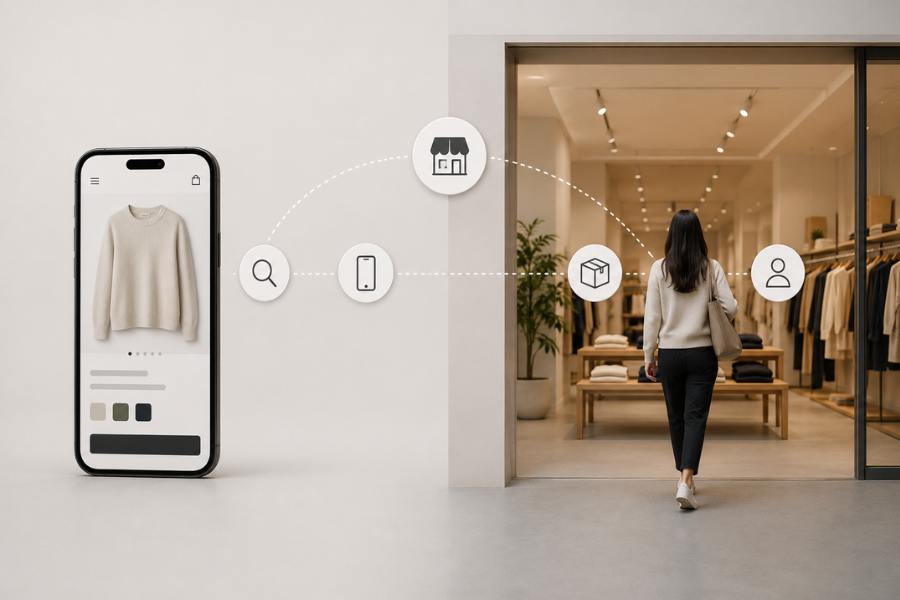
This framing aligns with what emerged at NRF 2026, where the theme “The Next Now” signalled that retailers can no longer afford to talk about what is coming someday, they have to execute in the present. Retail has moved past loosely connected omnichannel setups into true unified commerce. When a customer browses a sweater online, that action instantly shows up on an associate’s device in‑store without lag. Everything stays in sync. The financial logic follows: supply chains run more smoothly, manual work drops off, margins are protected and teams focus on higher‑value work.
True unified commerce was one of the clearest themes at NRF 2026. Both customers and store teams now expect seamless journeys across POS, e‑commerce, customer service, loyalty, order management and inventory. The industry has moved from asking what AI can do to confronting what it changes structurally and where humans still matter most.
The Store as a Data Node, Not Just a Sales Floor
This recasting of the store’s role is central to the unified commerce thesis. The store is no longer just a selling location. It is a fulfilment node, a service point, and a data‑rich operating asset inside a larger commerce system. Forrester’s retail outlook continues to show that physical retail matters because shoppers still value immediacy, confidence and flexibility, but the role has fundamentally changed.
Optimove’s 2026 retail trends analysis captures the operational consequence: unified commerce and real‑time inventory will shape what marketers can promise and when. Campaigns must not ignore stock‑outs; personalisation must only recommend items that can actually be fulfilled; promised delivery dates must be kept. Stores matter not only as fulfilment nodes but also as relationship engines, and many online journeys start with store intent.
The Execution Gap
Despite the clear strategic direction, execution remains difficult. Only 7% of retailers have reached unified commerce leadership. More than 66% of consumers now use two or more channels before completing a purchase, moving fluidly between marketplaces, social platforms, messaging apps and retailers’ own sites and stores, yet most retail architectures still treat those channels as separate systems.
The barriers are not solely technological. Many organisations still operate as channel fiefdoms, where physical and digital operations compete internally for inventory, pricing and revenue attribution. Most AI initiatives fail due to people and process issues rather than technical limitations. Success requires cross‑departmental collaboration with shared KPIs, exactly what traditional channel‑based organisational charts actively discourage. As Manhattan Associates’ CMO Katie Foote put it, retailers are being asked to do something incredibly hard right now: deliver faster, more personalised experiences while also protecting margin. The retailers pulling ahead are not doing it with one standout channel or a single capability; they are doing it by reimagining the entire customer journey and connecting the business end to end.
Technologically, unified commerce is sustained by modern architectures. The move is away from isolated, monolithic systems toward unified and composable commerce: API‑first platforms, modular systems for POS, OMS, ERP, CRM and payment, and flexible integrations. This approach enables faster innovation, easier scaling, and a single source of truth across all channels.
What This Means for Retail Leaders
The structural shift from omnichannel to unified commerce carries several operational implications.
First, the measurement framework must change. Traditional channel‑level KPIs, online conversion rate, store sales per square foot are no longer sufficient when customers move fluidly across touchpoints. The Manhattan benchmark assesses retailers across unified Shopping, Checkout, Fulfilment and Service pillars, recognising that the customer experience is a single journey regardless of where individual steps occur.
Second, inventory visibility is no longer a differentiator, it is a prerequisite. Capabilities that were cutting‑edge in 2024 have become table stakes by 2026. Retailers without transparent, accurate inventory data across all customer‑facing touchpoints cannot participate in the unified commerce conversation at all.
Third, AI investment must be built on unified data foundations. The 83% of retailers who believe AI is a necessity but have not yet matured their capabilities face a sequencing challenge: deploying AI on fragmented data amplifies operational inconsistencies rather than resolving them. Data unification must precede AI acceleration.
Fourth, the geographic playing field is uneven but converging. The Manhattan benchmark reveals that North American retailers benefit from deep e‑commerce foundations and mature data infrastructure; EMEA retailers stand out in operational consistency and cross‑border fulfilment; and Latin American retailers are closing the gap faster than any other region, driven by rapid adoption of alternative payments, messaging‑led service, and mobile‑first fulfilment models. There is no single blueprint.
The post‑omnichannel era is not a rejection of everything omnichannel achieved; it is a recognition that omnichannel was a stepping stone, not a destination. The retailers pulling ahead in 2026 are those that have moved from stitching channels together to operating one commercial system with one version of the truth.
The data tells a stark story: 7% of retailers are unified commerce leaders and they are growing at nearly twice the rate of their basic peers. More than 66% of consumers use multiple channels before purchase, yet most retail architectures still treat those channels as separate systems. The gap between expectation and reality is where market share is being won and lost.
What is emerging is not just a technology upgrade but a structural rethinking of retail architecture: one where inventory, customer data, pricing and fulfilment exist once and operate everywhere; where the store is a data node as much as a selling floor; and where competitive advantage flows from the ability to act on intent in real time, across every touchpoint, without fragmentation.
Omnichannel was about being everywhere. Unified commerce is about being one business wherever the customer shows up.
Sources:

You may also like

Pay Later Moves From the Shopping Basket to the Shop Counter
Pavement Robots Move From Pilot Projects to Grocery Delivery