The Rise of Multimodal Emotion AI in Physical Stores
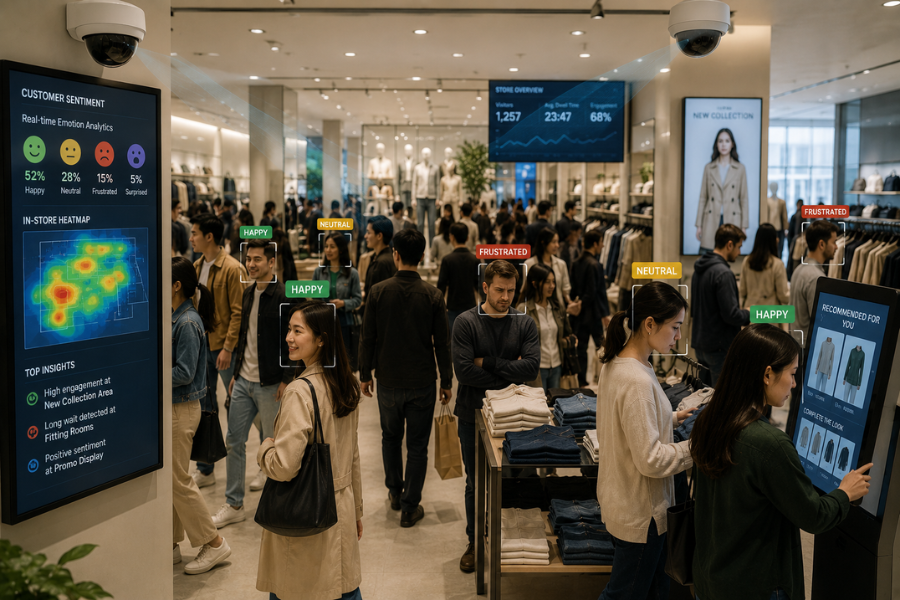
In physical retail environments, a new class of artificial intelligence is moving beyond demographic analysis into the detection of human emotion. By processing facial micro‑expressions, vocal tone, body language and in some cases, biometric signals, systems described as “multimodal emotion AI” are being deployed to interpret how shoppers feel during their store visits. The stated goal is to transform static retail spaces into environments that can respond in real time to customer mood, potentially preventing frustration and improving the shopping experience before a problem escalates.
This technology falls under the broader field of multimodal affective computing, defined as systems that interpret human emotions by analysing multiple input sources such as facial cues, vocal patterns, physiological data and textual content. While much of this deployment remains invisible to the average shopper, industry reports indicate that it is quietly reshaping store operations and customer interactions.
The Multiple Signals That Feed Emotion Detection
Unlike earlier single‑sensor systems, multimodal platforms draw from a suite of signals to build a picture of a customer’s state. In physical retail, the most common data sources include facial expression analysis, which scans for cues such as happiness, sadness, anger, surprise and fear; speech and voice analysis, which assesses sentiment trajectory, agent tone classification and frustration detection from live conversations; and gesture and body language analysis, which interprets posture and movement to gauge engagement or hesitation.
The ambition is to create a seamless customer journey where a system can identify a confused look while a shopper examines a new product or detect rising frustration in a customer’s voice as they wait at a long checkout line. Proponents argue that this allows retailers to shift from reacting to problems after they happen to preventing them before they escalate.
Instances of Deployment in Real Stores
Several documented pilots have tested emotion AI in physical retail settings. One widely reported implementation replaces traditional cardboard marketing displays along store shelves with LCD strips equipped with small optical sensors and cameras. As shoppers walk past, the system reads their facial expressions in real time, classifying them into categories such as joy, sadness, anger, fear and surprise and uses that classification to instantly change the content appearing on the display. According to a 2026 report, early retail pilots of such smart shelf technology showed double‑digit sales uplifts. The same report noted that the system also captures demographic data like age, gender, and major ethnic group, though it states that it does not store identifiable personal images. Several consumer goods and technology brands have reportedly tested this technology to analyse customer faces in front of store shelves.
Beyond shelf displays, emotion AI has appeared at other touchpoints. A software development kit for real‑time facial expression analysis on mobile devices and order kiosks has been made available. Using edge‑based AI architecture, video frames are processed directly on the device without requiring raw images or recordings to be uploaded to external servers, delivering faster performance, offline functionality and stronger privacy protection.
In customer service and sales interactions, vocal tone analysis has become more sophisticated. Voice AI systems in 2026 are being used to detect customer frustration before a sale falls apart and contact centres flag calls that need coaching. These systems analyse the acoustic properties of speech, pitch, tempo, energy, voice quality and rhythm, and combine them with speech content and word choice to determine customer sentiment.
Documented Pilots Across Retail Formats
Various retail formats have hosted emotion AI pilots over the past several years. In the fashion sector, a clothing retailer launched an in‑store neural experience that helped consumers select from over 600 T‑shirts by identifying their mood using a neuro‑headset that reads their brainwaves while they view a series of visual stimuli.
A beauty retailer has been an early adopter of AI, showcasing at a major industry event in 2026 an AI skin analysis technology for personalised service. Its AI beauty chat has engaged millions of customers, and the retailer’s AI‑powered personalised experiences include virtual try‑on, skin tone recognition via on‑device computer vision, and QR‑based augmented reality try‑ons without uploading biometric data to the cloud.
In the quick‑service restaurant sector, a fast‑food chain in China opened a smart restaurant using image recognition technology to scan customers’ faces and recommend menu items based not only on estimated age and gender but also on their inferred mood.
In the grocery sector, a 2026 industry report claimed that the use of emotion AI at self‑checkout lanes resulted in a 41 percent reduction in checkout abandonment, based on an analysis of more than one million transactions.
Practical Applications in Store Operations
Emotion recognition in retail can be deployed for several practical applications. Retailers can monitor customer reactions to new product displays to optimise merchandising strategies. Customer satisfaction face emotion APIs can detect and analyse human facial expressions from images or video streams, classifying them into categories such as happiness, sadness, surprise and neutrality.
Companies can analyse customer interactions with sales associates to identify moments of dissatisfaction or delight, providing feedback for improving service quality. In queue management, emotion detection can identify rising frustration levels in long lines, allowing staff to open new registers proactively. Digital signage can dynamically change content based on detected emotions. Understanding emotional responses in high‑traffic areas can help retailers identify confusing layouts or bottlenecks and make adjustments to enhance customer flow.
The underlying technology relies on sensor fusion, machine learning, and biometric inference, integrating hardware sensing layers (cameras, RFID, IoT sensors, biometrics) with data processing architectures (big data pipelines and edge computing) and predictive modelling stacks (machine learning, deep learning, psychometric inference). The goal is to convert anonymous shopper activity into actionable predictions about purchase intent, loyalty, churn, and category preferences.
The Scientific Debate Over Accuracy
Despite commercial momentum, a significant debate continues within the scientific community regarding the fundamental validity of emotion detection technology. A systematic review found that how people communicate even basic emotions varies substantially across different situations, cultures, and individuals. The same internal state does not produce the same facial expression reliably, and the same facial expression does not indicate the same internal state reliably. A smile is not always joy, and a furrowed brow is not always anger; these are culturally shaped, context‑dependent, personality‑modulated performances, not legible readouts of an inner condition.
Many emotion AI systems are built on the premise that facial configurations map reliably onto emotional categories, a premise that has faced substantial challenge. In contact centre audio analysis, the accuracy of discrete emotion labels (happy, sad, angry) on real call audio sits in the 55 to 65 per cent range across all six basic emotions, a level described as “too low to be actionable”. Sarcasm and complex affect such as irony or passive‑aggression are not at production quality in any tested language, with best results around 55 per cent, barely above chance.
More accurate and reliable features do exist. Customer sentiment trajectory, tracking whether a customer becomes more positive, neutral or negative across a call, works well with demonstrated accuracy ranging from 80 to 89 per cent across multiple languages. Agent tone classification, assessing whether an agent is warm, flat or impatient, has shown moderate but production‑ready accuracy across several languages. Experts note that the accuracy gap between trajectory tracking and discrete emotion labelling is enormous and retailers should ask vendors which specific capability they mean when they say “emotion detection”.
Adaptive Store Environments and Real‑Time Feedback
Beyond detection, the technology is driving stores toward adaptive environments, physical spaces that change in response to customer feelings. With emotion AI capabilities, systems can learn more about customers’ emotional states to provide more personalised interactions and offers. Retailers can use real‑time emotion recognition as a dynamic feedback loop to adapt quickly to customer needs and preferences.
When integrated with customer relationship management systems, emotion data can provide a more complete customer profile by capturing behavioural information extracted from biometric data and facial expressions across different store touchpoints. The insights gathered from sentiment analysis algorithms can empower retailers to enhance customer experiences and drive sales growth. However, industry leaders emphasise that this technology must be introduced with a focus on responsible AI that respects regulations and privacy concerns. The data used to detect emotions is very rich, and a one‑size‑fits‑all approach may not work well across different cultural contexts.
Ethical Questions and Legal Frameworks
The deployment of emotion AI in retail has ignited intense debate about ethics, privacy, and consent. Unlike standard data collection, emotion AI does not merely collect data but decodes human emotion through micro‑expressions and tone of voice to read stress, loneliness or hesitation in real time, sometimes acting before the user has finished scrolling.
Legal experts argue that when a system can identify and exploit a user’s emotional state faster than the user can register the interaction, “informed consent” becomes a legal fiction. This moves beyond data collection into cognitive interference, potentially undermining the very basis of legal liability. The next wave of high‑stakes litigation may not turn on who owns the data, but on who used data to identify the precise moment a user’s rational agency was at its lowest.
Leading privacy law frameworks, including the European Union AI Act and California’s privacy laws, are increasingly being examined for their applicability to emotion recognition. The Illinois Biometric Information Privacy Act and the California Consumer Privacy Act regulate “biometric identifiers” such as the pixels of a face or the geometry of a voiceprint. Even the 2026 CCPA amendments introduced opt‑out rights for automated decision‑making. Retailers are urged to ensure clear signage and privacy policies to build trust and ensure compliance with regulations such as the GDPR, and to prioritise the secure storage and processing of emotional data. The fundamental risk is that passive tracking collects intimate data without consent, potentially alienating customers. Some participants in privacy research studies have expressed that they would prefer to forego doing business with stores that monitor their emotions entirely.
Market Growth and Future Directions
The commercial push behind emotion AI continues to accelerate. The global multimodal affective computing market, which includes these integrated systems, stood at $7.04 billion in 2025 and is expected to reach $8.11 billion in 2026 at a compound annual growth rate of 15.2 per cent. By 2030, it is projected to grow to $14.41 billion. Similarly, the artificial intelligence in emotion recognition market, a closely related segment, will grow from $1.44 billion in 2025 to $1.69 billion in 2026 at a CAGR of 17.7 per cent, and is expected to reach $3.26 billion by 2030.
Major trends shaping the forecast period include AI‑based emotion recognition, facial and voice emotion analysis, gesture and posture recognition, sentiment analysis from text and speech, real‑time emotional response tracking, and multimodal fusion systems that combine multiple signals. Beyond retail, these technologies are spreading into customer service, training, and employee coaching. Digital humans, real‑time AI‑powered characters, can read conversational cues, respond with emotional nuance, and simulate the unpredictability of real customer interactions. By practising in emotionally responsive simulations, store associates can begin to recognise subtle cues and adjust their approach with greater confidence.
The Shopping Experience of Tomorrow
The integration of multimodal emotion AI into physical retail represents a fundamental reimagining of the store environment, shifting from static displays and passive security to dynamic, responsive systems that attempt to understand and adapt to shopper sentiment. The store of the near future may not just listen to what customers ask for; it may watch for what they truly feel.
The path forward is fraught with as many ethical and scientific questions as commercial opportunities. Can a machine truly interpret a smile, or does a system simply reduce a complex, culturally mediated behaviour to a data point? At what point does the attempt to provide service cross an invisible line into manipulation? As these systems become more sophisticated and widespread, retailers and regulators alike will be forced to answer these questions. The one certainty is that the age of the emotionally aware store has already begun, quietly scanning for the tell‑tale signs of a satisfied customer or a lost sale.
Sources:

You may also like

Pay Later Moves From the Shopping Basket to the Shop Counter
Pavement Robots Move From Pilot Projects to Grocery Delivery