From Retail Robotics Pilots to Everyday Operations
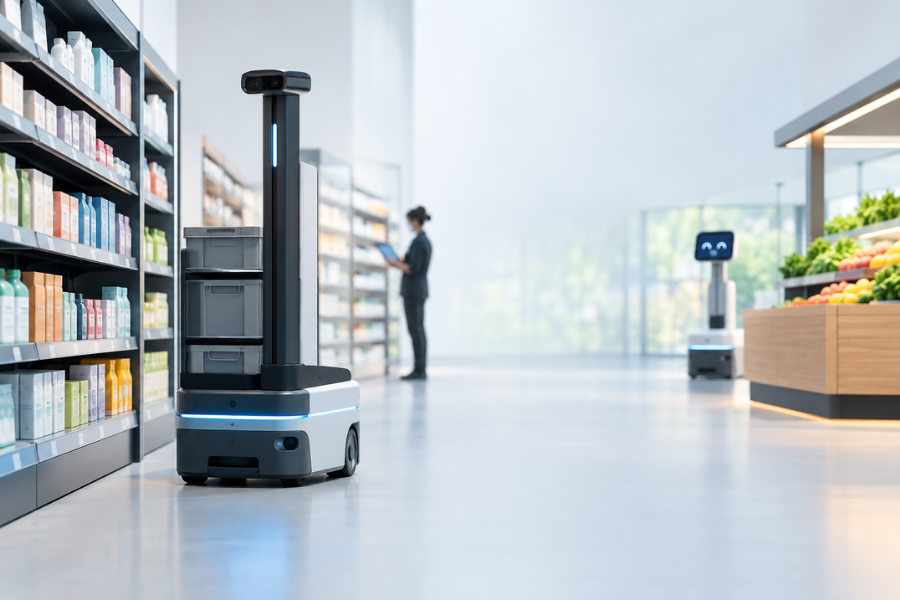
For years, robotics at retail trade shows leaned toward the theatrical. Humanoid machines designed to impress, not to integrate. That era is ending.
In 2026, a fundamental shift is underway. Robotics is becoming more task-oriented, more predictable and more aligned to specific operational needs rather than just being new and exciting. The conversation has moved from “look what robots could do” to “here’s what robots are doing in the field”.
The Market Reality
The numbers reflect this transformation. The retail robotics market grew from $34.04 billion in 2025 to $46.64 billion in 2026, a compound annual growth rate of 37 percent. By 2030, the market is expected to reach $163.63 billion. According to Coresight Research’s State of In-Store Retailing 2026, 97 percent of retailers have deployed or plan to deploy store intelligence within the next year, and 60 percent have already scaled or are actively scaling, up 18 percentage points year over year.
Yet in-store inefficiencies now cost U.S. retailers 6.4 percent of gross sales annually, totalling $196.4 billion across key retail sectors. The gap between ambition and execution remains wide.
From Human-Like to Work-Like
Robots that focus on repeatable tasks such as inventory scanning, basic food preparation and automated pickup are more valuable than machines trying to replicate human behaviour. With labour remaining retail’s largest cost, the goal is not replacing people. It is ensuring staff are used where they add the most value: customer-facing engagement, selling, real-time problem-solving and brand experience. Machines handle the friction. People handle the connection.
This pragmatic approach is reshaping how retailers deploy robotics. Autonomous mobile robots are transforming shelf compliance by identifying out-of-stocks, pricing errors, misplaced products and planogram deviations with greater frequency than manual audits. The value is not novelty; it is frequency and consistency. Robots dramatically increase how often shelves are audited, surfacing execution issues long before shoppers encounter empty shelves.
The Shelf Intelligence Gap
The challenge robotics addresses is acute. Research reveals that fewer than one in four retailers achieve 80 percent or higher accuracy in key shelf metrics such as on-shelf availability, planogram compliance and promotional execution. Fifty percent report lost sales and 47 percent cite customer dissatisfaction as a result of inventory execution failures. Sixty-seven percent of retailers report daily or weekly relationship challenges with consumer brands due to inventory inaccuracy.
Robotics ranks as the number one solution to improve inventory accuracy, ahead of handheld RFID, mobile image capture, fixed cameras or barcode scanners. Seventy-two percent of retailers are ready to deploy in-store robots, with 60 percent already planning deployment by the end of 2027. The industry has moved from isolated automation assets toward connected robotic ecosystems that integrate with warehouse management systems, point-of-sale data, enterprise resource planning, computer vision platforms and demand planning tools.
Real-World Impact
The results are measurable. At an online furniture and home décor retailer operating across an 80,000 m³ warehouse, autonomous robots scan over 10,000 locations per hour, around the clock, without disrupting live operations. Inventory accuracy rose from 92 percent to 98 percent within three days, with up to 99.9 percent consistently maintained thereafter. Stock shortages fell by 74 percent and inventory costs dropped by 30 percent.
Autonomous robots utilise vision scanners to navigate warehouses continuously while reading inventory levels against live stock records, driving complete inventory accuracy and enhanced decision-making. The robots scan up to 10,000 pallets per hour, day or night, with data feeding a real-time digital twin that surfaces discrepancies as prioritised exceptions.
Retailers face $400 billion in annual revenue loss due to 65 percent inventory accuracy, driven by stale warehouse management system data. Autonomous robots enable real-time scanning and exception-based cycle counting, addressing this problem at its source.
Robotics in Customer-Facing Roles
The application of robotics is also extending to customer-facing retail, where robots can guide shoppers, provide product information, support queue management and assist with routine service tasks. At NRF 2026, service robots are demonstrating how autonomous navigation and intelligent following can transform retail operations and enhance customer interactions.
Robotics is also reshaping fulfilment inside the store. Retailers using micro-fulfilment automation are turning stores into hybrid retail fulfilment nodes. Robotic picking systems improve speed, accuracy and cost per order for click-and-collect and same-day delivery. Fully automated formats are emerging, with robotic convenience concepts using robotic arms and AI to retrieve products in unattended stores, demonstrating how robotics can unlock new locations, hours and economics where labour simply does not work.
The Strategic Imperative
The real breakthrough is not labour substitution but data density. Robots continuously generate structured, machine-readable data about shelf conditions, availability and execution. This data increasingly feeds AI systems that inform merchandising decisions, ranging from assortment and pricing to replenishment and allocation. As a senior leader in the space put it: “2026 is the year of robots at scale. Robotics are helping retailers change shelf productivity, change people’s productivity, and change the shopping experience”.
Automation and AI are transforming supply chains and store operations and innovation is creating new roles rather than replacing workers. From data analytics to robotics maintenance, retailers are investing in upskilling employees so they can work alongside new technologies, supporting productivity, growth and long-term opportunity.
The Next Phase
In 2026, retail robotics will move from pilots to infrastructure in five clear ways: micro-fulfillment will become the default extension of the store; robotic data will become a primary merchandising signal; retail decisions will increasingly happen machine-to-machine; shelf conditions will be monitored and acted on automatically; and FMCG brands will need to perform not just for buyers and shoppers, but for machines.
The robotics conversation has shifted. The industry has moved from “look what robots could do” to “here’s what robots are doing in the field”. Retailers are no longer asking whether robotics works; they are asking how fast they can scale it.
For those looking to explore these capabilities firsthand, the House of Innovation Pavilion at NRF 2026: Retail’s Big Show Europe in Paris (September 15–17) is showcasing emerging technologies in robotics and advanced retail automation. It offers a glimpse into how retailers are moving from pilots to infrastructure and provides a platform to explore the solutions that will define the next era of store operations.
Planning to be in Paris for NRF Europe 2026?
- Find out more about the House of Innovation: Paris Connect
- Request your invitation: Registration Form

You may also like
The Future of Energy Management in Food Retail
The Visual Commerce Revolution