The Future of Energy Management in Food Retail
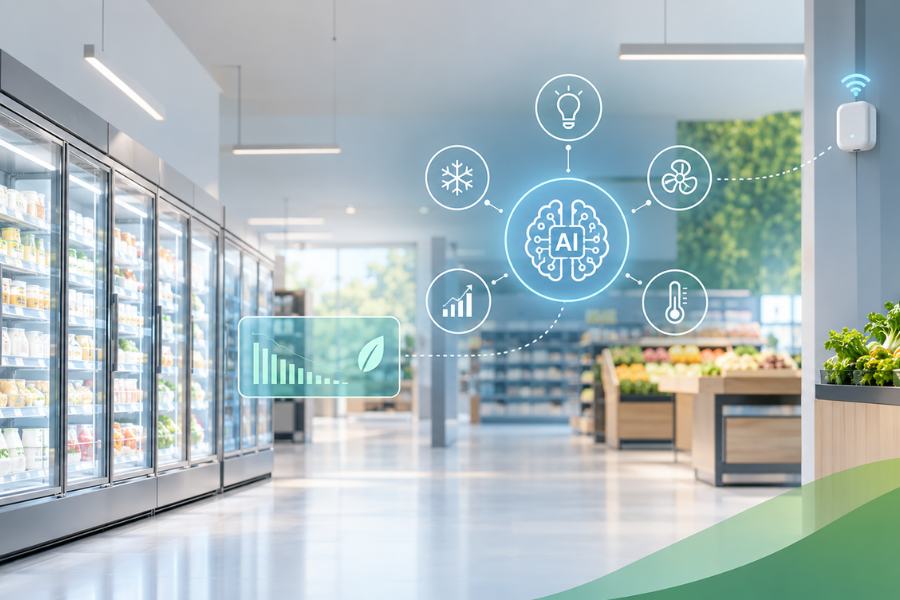
For food retailers, energy is not a peripheral expense. It is foundational to how stores operate and serve communities. Lighting, HVAC systems and refrigeration units are essential to trading safely and profitably. In food retail, refrigeration alone accounts for approximately 52 percent of energy consumption, making it the single largest electricity user in the sector. When energy prices increase, the impact is both immediate and impossible to ignore.
The pressure on retail margins is intensifying. The British Retail Consortium has identified rising energy costs as a leading cause behind increasing food prices. Fresh food products reliant on refrigeration, such as meat, fish and produce, have experienced the highest inflation, with prices rising 3.4 percent year-on-year. Passing costs directly to consumers is not a sustainable solution, particularly amid continued cost-of-living pressures. Retailers have both a commercial imperative and a social responsibility to protect value for customers while safeguarding their own profitability.
The convergence of AI and IoT presents the opportunity to significantly impact the dynamics of operational costs. The global AI for energy optimisation software market was valued at USD 4.8 billion in 2025 and is projected to reach USD 30.2 billion by 2035, growing at a compound annual rate of 20.1 percent. AI-enabled energy management software alone is expected to expand from USD 4.12 billion in 2025 to USD 4.85 billion in 2026, with a CAGR of 19.38 percent through 2031.
From Reactive to Predictive
Traditional approaches to energy management often identified problems only after alarms, customer complaints or abnormal energy bills. This reactive model is being replaced by something far more intelligent. IoT-enabled systems generate vast streams of operational insight and when combined with advanced AI, that data becomes a powerful decision-making engine, enabling retailers to anticipate risk, eliminate inefficiency and actively optimise performance.
The computational potential of AI to process vast amounts of data and consistently diagnose performance creates significant opportunities for retailers to transform operational effectiveness, particularly in energy-intensive environments such as food retail. By gaining an overarching view of IoT-connected equipment performance, potential degradation and exposure to changing environmental pressures, AI-driven models can predict and prevent equipment problems and failures.
Crucially, performance degradation does not only increase the risk of failure. It also leads to excess energy consumption as struggling machines work harder to maintain required outputs. Identifying these inefficiencies early ensures that equipment operates at optimal performance, preventing unnecessary energy waste before it compounds into higher operating costs. Predictive insight therefore reduces not only the likelihood of breakdowns, but also the hidden energy drain caused by underperforming assets.
Real-World Impact
The results are measurable. A major New Zealand supermarket chain expects to save more than $3 million a year through an analytics-driven energy management programme that uses artificial intelligence and predictive modelling to optimise refrigeration, lighting and HVAC systems across its network. The system analyses approximately two million data points every five minutes, more than 570 million data points daily, to identify energy waste, equipment faults and operational inefficiencies. The programme has achieved more than 95 percent data availability across approximately 2,700 electrical submeters and maintained data accuracy above 95 percent across more than 23,000 connected assets.
The environmental impact is equally significant. A Spanish retail group has cut its Scope 1 and 2 carbon footprint by over 50 percent since 2017, preventing 172,503 tonnes of CO2 equivalent emissions annually. The European Investment Bank has granted the company a €40 million loan to modernise its technology and further reduce energy consumption.
A major UK retailer successfully reduced its energy bills by 10 percent across eight distribution centres by implementing AI technology that increased fridge temperatures by just one degree. The trial saved over 835 tonnes of CO2e and 4GWh in energy over 21 months. A home improvement retailer, in collaboration with a technology partner, used machine learning and predictive analytics to reduce energy consumption by 20 percent in one year, saving 7,300 tonnes of CO2e and over £3 million.
In Japan, a major convenience store operator launched a trial across 48 stores using AI to control air conditioning equipment, targeting a 30 percent reduction in power consumption. A technology partner subsequently deployed its AI air conditioning control service in 33 of the operator’s stores, achieving maximum energy savings of 28.1 percent and an estimated annual CO2 reduction of approximately 84 tonnes.
In Europe, retailers face increasing pressure to reduce energy use, minimise waste and ensure refrigeration reliability. By shifting from reactive maintenance to a predictive, data-driven approach, food retailers are delivering measurable improvements in efficiency, uptime and sustainability while supporting compliance with evolving energy and refrigerant regulations.
The Strategic Imperative
As energy pressures are likely to persist, the ability to optimise operations through technology will differentiate those retailers who thrive from those who struggle. Leveraging AI and IoT will enable food retailers to mitigate the impact of rising energy costs, unlock operational efficiencies and protect margin profits.
The strategic question is no longer whether retailers collect data, but how effectively they use it. Unlocking the full computational power of technology is what turns operational data into measurable commercial impact. Rather than operating on static schedules or manual oversight, AI can evaluate equipment performance within the broader operational context in real time, intelligently optimising refrigeration performance and aligning energy consumption with actual demand while maintaining food safety and compliance.
For retailers navigating the twin pressures of margin erosion and rising customer expectations, the adoption of AI and IoT for energy management is not a distant trend but an immediate strategic necessity.
For those looking to explore these capabilities firsthand, the House of Innovation Pavilion at NRF 2026: Retail’s Big Show Europe in Paris (September 15–17) is showcasing emerging technologies in AI-driven energy management and advanced retail tech.
Planning to be in Paris for NRF Europe 2026?
- Find out more about the House of Innovation: Paris Connect
- Request your invitation: Registration Form

You may also like

Facial Recognition Payments Launch in the UK with 0% Merchant Fees