Facial Recognition Payments Launch in the UK with 0% Merchant Fees
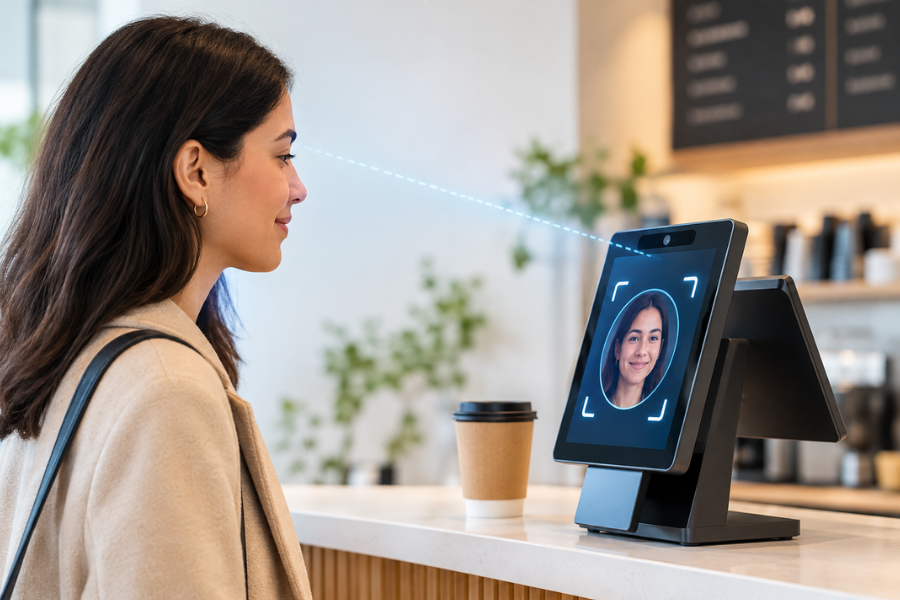
In September 2026, a UK-licensed bank launched what it described as the UK’s first in-store facial recognition checkout system, allowing customers to pay for goods with a glance rather than a card or phone. The pilot, which ran from 24 to 26 September at three London cafés, included a notable commercial dimension: all transactions processed through the system carried 0% processing fees for merchants. The combination of biometric authentication and zero merchant fees marks a significant development in the evolving landscape of in-store payments.
The Pilot in Detail
The facial recognition payment system was piloted at three branches of a London speciality coffee chain, in Bloomsbury, Soho and Chelsea, from 24 to 26 September 2026. The service operates through a new hospitality point-of-sale hardware system, a modular two-screen register designed to combine payments, banking and floor operations.
The pilot was limited to the three participating cafés. Customers who used the facial payment method were offered a £1 speciality coffee from a special menu and earned triple loyalty points on each transaction.
How the Technology Works
The payment process relies on identity verification established at account opening. When a customer first signs up for the bank’s account, they complete a selfie ID check. This biometric reference is then used at the point of sale.
At the till, the customer taps “Pay with Smile” on the terminal screen and looks at the camera. The system compares the live face image with the selfie identity check completed during account opening. If the match passes, the payment is processed as an account-to-account transfer, with no card or phone involved.
Customers must actively opt in through the bank’s app, the feature is off by default and no customer is enrolled without their knowledge. Consent can be withdrawn at any time through the app settings.
The bank states that facial embeddings used to complete a payment are deleted immediately after the sale is confirmed and participating merchants store no personal data. Transactions are authenticated using end-to-end encryption managed within the bank’s app.
The 0% Merchant Fee Proposition
The most commercially significant element of the pilot is the pricing model. All transactions processed through the facial payment method carry 0% processing fees for merchants. This rate is specific to that facial-payment method and does not apply to every transaction handled by the point-of-sale system.
The bank framed the 0% fee offer as a response to the cost burden facing independent venues. Research published alongside the launch indicated that independent UK venues spend an average of £875 per month on payment processing and infrastructure, rising to over £950 per month for pubs and bars. The same research found that terminal outages cost venues an average of £2,495 in direct lost revenue annually. The point-of-sale hardware includes a built-in eSIM backup to maintain connectivity during network failures.
The bank’s merchant payments executive stated: “With over half of Brits reporting delays or failures due to merchants dropping internet signals, checkout friction is driving customers out the door. By combining high-performance processing with facial recognition technology, we’ll replace outdated, fragmented tills with a hyper-efficient checkout experience designed to solve consumer and merchant pain points.”
Merchant Hardware Incentives
The 0% fee offer is tied to the point-of-sale hardware system. Merchants who sign up for their first terminal before 31 December 2026 were offered the register at a discounted price of £349.50 plus VAT, compared with a stated recommended retail price of £699 plus VAT.
The discount reflects how aggressively payment providers are pricing hardware as they seek to win payment volume and broader software usage from small businesses. The two-screen register is designed to unify payments, banking and floor operations, combining hardware with software in a single system.
Consumer Incentives
For consumers, the bank paired convenience with a loyalty incentive. Users who paid with the new feature received triple loyalty points on each transaction. The £1 coffee offer at participating cafés provided a tangible inducement to try the system during the short pilot window.
The bank’s existing user base, which it said exceeded 80 million personal and business accounts, provides a substantial pool of potential enrollees. Its business services division serves more than 800,000 businesses. That scale matters because biometric payment systems depend on participation from both sides of the transaction: merchants need enough enrolled customers to justify new checkout methods, while consumers need enough places to use them for the option to become routine.
Privacy and Data Handling
Facial recognition at the checkout remains a sensitive area in payments because it combines convenience claims with questions about consent, data handling and trust.
The bank’s approach relies on existing identity checks gathered during account onboarding rather than requiring merchants to build or hold separate biometric databases. The bank states that merchants do not store or see any personal data. The facial embeddings used to complete a payment are deleted immediately after the sale is confirmed.
However, privacy considerations remain. The original image captured during account onboarding is retained in the bank’s cloud under its standard retention policies and may be accessible for fraud investigation purposes. The bank has also experienced a past data security incident in which an impersonator obtained customer information through fraudulent requests.
The bank’s privacy notice states that consent is obtained explicitly when customers first join the service in the app and confirmed again at the payment terminal. Customers can disable the feature or withdraw consent at any time.
Research suggests UK consumers are broadly open to biometric payments but want firmer guarantees around how their data is collected, stored and protected before adopting it more widely. One UK respondent to a survey on biometric payment privacy stated: “I think it would have to be regulated and proven to be trustworthy before I use it.”
Broader Industry Context
The launch positions the UK-licensed bank as the first in the UK and Europe to launch an in-store facial recognition payment system. Banks have generally moved more cautiously than specialist biometric or retail technology providers in this area.
Similar facial payment systems have been deployed elsewhere. In China, facial recognition payment systems have been in operation since 2017, when a major payments platform launched “Smile to Pay” at a restaurant. Other markets, including South Korea, have tested face-based payments at cinema kiosks.
The pilot is not a citywide launch or a payment option available at all of the bank’s merchants. The participating café chain has indicated plans to expand to all 12 of its locations later in 2026 if the trial goes well.
The bank indicated it would expand the point-of-sale system to other businesses in the future.
Potential Benefits and Limitations
Documented benefits include a frictionless payment experience that eliminates the need for a card, phone or wallet at checkout. The system may reduce checkout time and address payment failures caused by dropped internet signals, a problem the bank’s research found affects more than half of Britons. The 0% merchant fee reduces the cost burden on independent venues, at least during the pilot period. The built-in eSIM backup provides connectivity resilience. Loyalty incentives encourage consumer adoption.
Documented limitations and considerations include the limited scale of the pilot, only three locations over three days, which provides a narrow basis for assessing real-world performance at scale. The 0% fee is described as specific to the facial-payment method and may be a temporary promotional measure. The retention of original onboarding images in the bank’s cloud raises questions about data handling, particularly given the bank’s past data security incident. Consumer trust remains a barrier: research indicates UK consumers want firmer guarantees around data protection before adopting biometric payments more widely.
The commercial logic of 0% fees also warrants scrutiny. Payment providers have historically used subsidised hardware and discounted fees to win merchant relationships, with the expectation of generating revenue through higher transaction volumes or additional services. Whether 0% processing fees are sustainable as a permanent model or represent a customer acquisition strategy during the pilot phase remains to be seen.
Conclusion
The September 2026 facial recognition payment pilot represents a notable development in UK in-store payments, combining biometric authentication with a pricing model that eliminates merchant processing fees. The technology relies on identity verification established at account opening, with the bank managing authentication and merchants storing no personal data.
The pilot is small in scale, but its combination of biometric authentication and 0% merchant fees signals a potentially significant shift in how payment providers compete for merchant relationships. Whether the model proves sustainable and gains broader adoption will depend on consumer trust, merchant uptake, regulatory clarity and whether the fee structure can be maintained beyond the pilot period.
Sources:

You may also like
Pay Later Moves From the Shopping Basket to the Shop Counter
Pavement Robots Move From Pilot Projects to Grocery Delivery