How Insurance Gaps Are Stalling UK Warehouse Automation
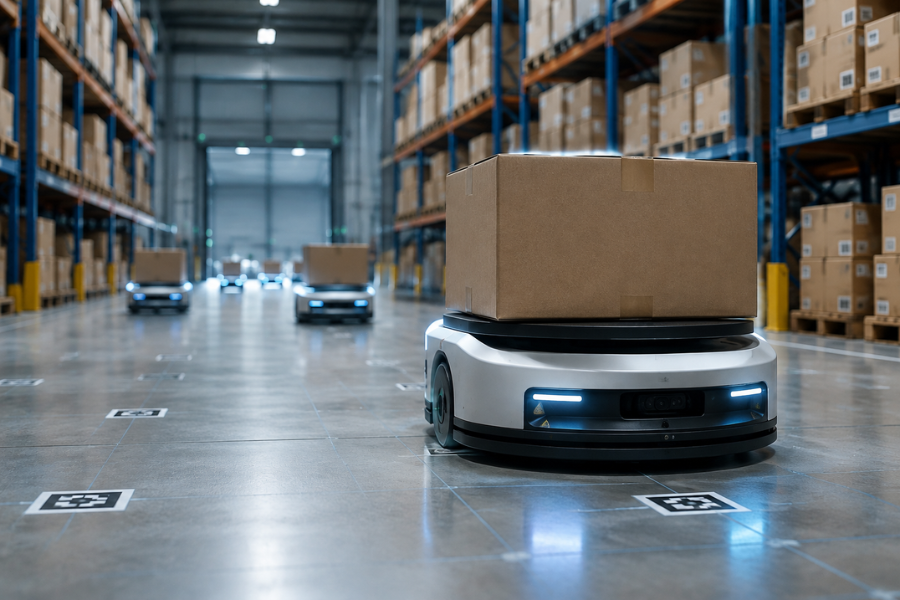
Walk into a large UK distribution centre today, and there is a good chance you will share the floor with a squat, waist-high robot that has never met a human boss. According to a BBC News investigation published in late July 2026, more than 2,000 autonomous mobile robots from a Chinese robotics manufacturer are now working across ten British warehouse sites, deployed through a UK partner for retailers. Britain has already become the manufacturer’s biggest market in Europe.
The robots require no fixed conveyors or permanent infrastructure, just a QR-coded floor and some safety fencing so they can be installed and moved almost as easily as they arrived. “Customers want fast deployable solutions,” a company account director told the BBC, describing a setup that lets retailers add storage density and picking speed without expanding their footprint or headcount.
However, a recent roundtable convened by The Entrepreneurs Network, bringing together robotics founders and the government’s Regulatory Innovation Office, found that insurance rather than regulation is becoming one of the biggest brakes on how fast warehouse automation can scale in the UK.
The Technology at the Heart of the Problem
Almost every mobile warehouse robot on the market relies on the same basic lidar sensor, a laser that stops the machine dead the moment something crosses a fixed distance. It is a blunt tool, but insurers and certifiers understand it, so it is easy to price.
Vision-based systems that use cameras and AI to judge distance and behaviour are often far more capable, but their decision-making is probabilistic rather than fixed, so they do not fit existing safety certification frameworks. Founders at the roundtable said customers were blunt about the result: no laser, no cover.
One participant said the regulation, and the insurance market sitting behind it, effectively discourages firms from doing anything at all.
The Gap in Standard Policies
Does standard warehouse insurance cover robots? Not automatically. Property, stock, employers’ liability and public liability sections in a typical UK warehouse policy were not written with autonomous mobile robots in mind.
For insurers and brokers, whether the robots work is not really the interesting question. What matters is what happens to risk once thousands of them share floor space with warehouse staff, move racks that weigh more than a small car and increasingly run on cameras and AI rather than a simple laser trip-wire.
This is a live underwriting question for any UK insurer with exposure to logistics, manufacturing or retail distribution and the kind of grey area that tends to end up in a coverage dispute rather than a clean claim. It is already playing out at the small end of the market, with case studies emerging of robotics businesses struggling to find appropriate coverage.
Broader Industry Context
The insurance gap for warehouse robotics is part of a wider challenge facing the insurance industry as physical AI enters factories, warehouses and other real-world settings. Insurers are reassessing coverage amid complex layered liabilities and limited claims data, pushing businesses to enhance risk management strategies.
The global robot insurance market was valued at approximately $150 million in 2025 and is projected to reach $711 million by 2032, with a compound annual growth rate of 24.9 per cent from 2026 to 2032. The broader robot commercial insurance market was estimated at $1.18 billion in 2025, expected to grow to $2.22 billion by 2032 at a compound annual growth rate of 9.4 per cent.
In the UK specifically, the autonomous mobile robot market was valued at $289 million in 2026 and is expected to reach $792.77 million by 2035, growing at a compound annual growth rate of 11.87 per cent. The UK warehouse automation market was valued at approximately $2.4 billion in 2025 and is projected to reach $5.6 billion by 2034. Yet as these technologies scale, the insurance framework to support them remains incomplete.
The Regulatory Landscape
The UK does not currently have a bespoke legislative framework governing robotics or AI in warehouse settings. The revised EU Product Liability Directive applies from December 2026 and significantly expands civil liability exposure for defective products. The UK’s own product liability framework, established under the Consumer Protection Act 1987, was drafted before the widespread deployment of interconnected cyber-physical systems and self-learning algorithms, leading some legal experts to conclude that the existing framework is inadequate.
The Regulatory Innovation Office, established in October 2024 under the Department for Science, Innovation and Technology, is intended to speed up regulatory decisions by acting as an intermediary between government, regulators and businesses. Its remit includes artificial intelligence, drones and other autonomous technology. However, as the roundtable discussion revealed, the insurance market—rather than regulation itself—is emerging as the primary constraint on scaling warehouse automation.
Several participants at the roundtable reported being unable to deploy robots commercially because they simply cannot get insured, or because the insurance market fails to make distinctions that the regulatory system itself has already drawn.
Implications for Retailers
For retailers adopting warehouse automation, the insurance gap presents practical challenges. As one industry analysis noted, warehouse insurance in 2025 increasingly intersects with cyber insurance and engineering cover, particularly for highly automated sites. Standard property insurance rarely covers cyber-triggered equipment damage and most cyber policies focus on data confidentiality rather than machinery downtime or physical loss.
The problem is compounded by the lack of claims history. As one insurance publication noted, the disagreement among market researchers over the scale of the UK warehouse automation market “is itself a useful data point for underwriters: this is too new a category for the market to have settled on a shared view of its scale, let alone its claims history.”
For retailers, the consequence is uncertainty. Without clear insurance frameworks, businesses face potential gaps in coverage that could leave them exposed to significant liabilities if something goes wrong. As one participant at the roundtable observed, the current situation effectively discourages firms from adopting more advanced technologies.
Looking Ahead
The insurance gap for warehouse robots reflects a broader challenge facing the retail industry as automation accelerates. The technology is advancing faster than the frameworks, regulatory, legal and commercial, that govern its deployment.
The manufacturers of vision-based systems face a particular hurdle: their technology may be more capable, but it does not fit the existing certification and insurance models built around simpler, more predictable systems. Until insurers develop frameworks to assess and price the risks of probabilistic AI decision-making, the market may continue to favour older, less capable technologies simply because they are insurable.
The UK government’s Regulatory Innovation Office has signalled its intent to address regulatory barriers to technology adoption. However, as the roundtable discussion made clear, the insurance market, not just regulation, will need to evolve if warehouse automation is to scale at the pace that retailers and logistics operators are seeking.
As one industry observer put it, the regulation and the insurance market sitting behind it “effectively discourages firms from doing anything at all.” The question for 2026 and beyond is whether insurers, regulators and technology providers can close the gap before it becomes a brake on innovation.
Sources:

You may also like

Facial Recognition Payments Launch in the UK with 0% Merchant Fees