Shoppers Call for Help With a Scan as Store Teams Go Connected
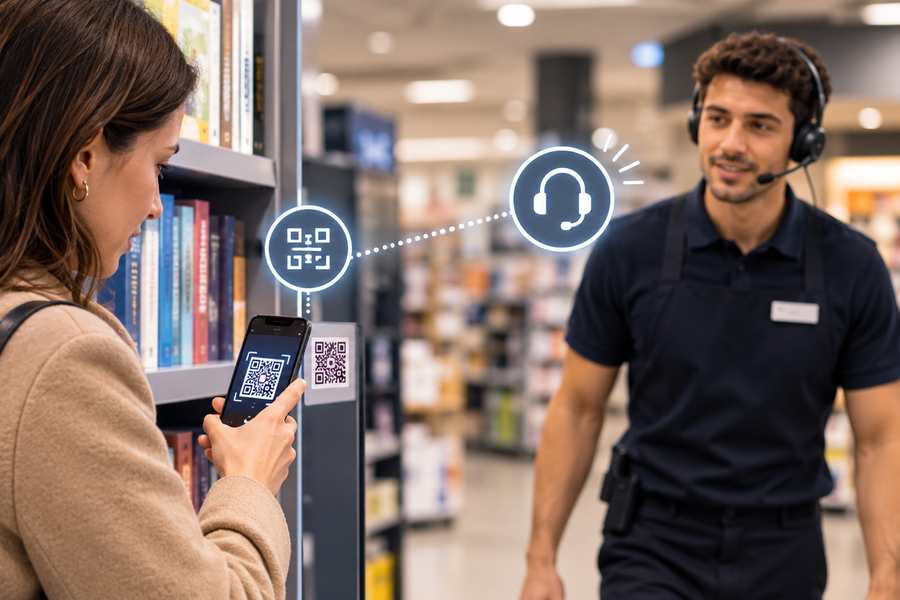
A shopper stands at a shelf with a question. Instead of hunting the aisles for a member of staff, they scan a small code on the fixture. Seconds later a colleague hears the request in their headset and walks over. That simple loop is now being rolled out across more than 300 shops in the United Kingdom by a British retailer of books, news and travel essentials. It marks a wider change in how stores connect their people. The radio clipped to a belt is giving way to a network that links staff, managers, head office, fridges and customers in one place.
A scan that summons help
The rollout was reported on 27 October 2026. It starts with 32 priority locations and has already gone live at the retailer’s flagship shop in a terminal at London’s busiest airport. There, smaller satellite shops now hear the same airside broadcast as the main store team. Colleagues wear wireless headsets. Head office uses a web app to reach stores. An AI assistant sits inside the platform, and managers receive data on store activity.
The decision followed a pilot that began in late 2025 at a busy railway station shop in Manchester. During the trial more than 43,000 notifications reached colleagues’ headsets. Customers made almost 1,000 requests for help through the codes. The retailer says sales rose by up to 22% in key categories compared with the period before the system was installed. Its director of operations said colleagues need to help customers quickly, especially when stores are busy.
The codes also serve delivery drivers. A driver arriving with stock can scan and reach the store team directly instead of waiting at a back door. The retailer chose the system partly for the comfort and clarity of the headsets. The customer codes were a major factor in the decision.
From radios and tannoys to headsets
For decades a store team talked in two ways. Urgent calls went out over the public address system to the whole shop. Everything else travelled by handheld radio or by walking to find someone. Both were noisy. In 2016 a noise campaign group in the United States gave a large American discount chain one of its annual awards for loudness after two of its stores in Durham, North Carolina gave staff walkie talkies. A local columnist asked why the chain did not simply use headsets.
Headsets came next. One large British convenience chain has run a headset system since 2017. In the United States the biggest change came through the smartphone. In 2021 a major American retailer said it would give free smartphones to more than 740,000 store workers. Their work app included push to talk that let colleagues speak directly, much like a walkie talkie. Some staff kept their traditional radios alongside it.
What has changed now is the reach of the network. Today the headset is one end of a system that also hears from the customer, the delivery driver, the freezer and head office. Requests no longer depend on a shopper finding a person. Alerts no longer depend on someone noticing a problem.
How the connected store works
The system rolling out in the UK combines four layers. Headsets carry voice between colleagues, who can join store broadcasts or call a specific person. A web app lets head office schedule messages and send broadcasts to many sites at once. Codes placed at the till and on the shop floor let customers request help on the spot. Smart notifications push alerts straight to the ear.
Those alerts cover routine store events, scheduled team updates and fridge and freezer monitoring. A temperature warning that once waited for a manual check can now reach a colleague the moment it happens. The platform connects with the retailer’s existing alert and IT systems. Colleagues also use it for shift handovers.
The data layer matters as much as the voice layer. Every scan and every alert leaves a record. Managers can see when requests arrive, where they cluster and how teams respond. That turns a stream of radio chatter into information a store can plan around.
Where stores are wiring up their teams
The UK has become a busy testing ground. A large cooperative convenience chain began a pilot of upgraded headsets across 114 stores in February 2026. It is now deploying them to more than 2,300 stores under a five year agreement, with completion expected next year. Almost nine in ten pilot colleagues said they preferred the new headsets. Staff use them to help shoppers, check stock, manage parcel collections and process online orders. They can also reach the chain’s security operations centre quickly.
A convenience symbol group has rolled out more than 3,000 headsets to about 500 stores across the UK and Ireland. That is roughly one in five of its shops in the two markets. Its system links to alerts that tell colleagues when a known repeat shoplifting offender enters. Staff exchange thousands of messages each day.
In the United States a large grocery cooperative introduced wireless headsets at 30 of its supermarkets in May 2025. Any headset user can answer, transfer or hold store phone calls, so one person no longer handles every line. Two further features were not part of that rollout: alerts linked to cameras for deliveries, empty shelves and security, and an AI tool that answers staff questions.
The largest American retailer has pushed further into AI for its staff. In June 2025 it added translation in 44 languages to its associate app so workers and customers can talk across languages. Its conversational AI tool handles about three million questions a day from 900,000 weekly users.
In Japan the focus is on what reaches the headset in the first place. A Japanese robotics company is developing an AI store manager for suburban supermarkets that rely on many part time workers. It is designed to set daily tasks for each person, adapt head office instructions to each store and help staff handle customer complaints. The company aims to begin trials in individual stores during 2026.
What retailers gain
The first gain is speed. A shopper with a question is a sale at risk. A code that summons help removes the search for a colleague. In the UK pilot that path was used almost 1,000 times, and the retailer links it to higher sales in key categories.
The second gain is quiet. Messages move to the ear instead of the ceiling speaker or the crackling radio. Shoppers hear less noise and colleagues hear only what concerns them.
The third gain is safety. Two large UK chains now tie headsets to security teams and to alerts about known offenders. A colleague facing a difficult situation can ask for help without raising their voice.
The fourth gain is reach. Head office can speak to hundreds of stores at once. Satellite shops at an airport hear the same updates as the main shop. Fridge alarms and delivery arrivals reach the right person without a manager acting as switchboard.
The hard parts
A request is only as useful as the answer. A code on a shelf sets an expectation that someone will come. In a thinly staffed store at a busy hour that promise can be hard to keep. A system that logs every unanswered call also makes those gaps visible.
Integration takes time and effort. The US cooperative needed about six weeks of preparation before a few hours of installation in each store. Its camera alerts and AI tool were held back from the first rollout. The UK chains are phasing their deployments over many months or years.
Alert fatigue is a real risk. Tens of thousands of notifications in a single pilot site show how much traffic a connected store can generate. Colleagues need the right messages, not every message.
Comfort and habit also matter. Staff wear these devices for whole shifts, which is why chains test fit and sound quality with colleagues before committing. Old tools linger too. Even at the largest American retailer some staff kept their walkie talkies after the smartphone app arrived.
Where the shop floor goes next
The plans on the table point in one direction. The UK travel retailer is moving from 32 priority sites towards more than 300 stores and plans to connect more of its existing store alert systems to headsets. The cooperative convenience chain expects to finish its 2,300 store deployment next year. In Japan trials of an AI store manager are due to begin within 2026. In the United States camera alerts and AI answers are the next features waiting for store teams.
For retailers the lesson is practical. Store communication is no longer a radio budget line. It is a data system that touches customer service, food safety, security and sales. The retailers moving fastest are pairing a simple customer action with a clear staff response, then measuring the result. The next test is whether that loop holds up in hundreds of stores at peak hours, when help is needed most.
Sources
[1] Retail Gazette
[2] Retail Times
[3] Retail Technology Innovation Hub
[5] Grocery Gazette
[6] RetailWire
[7] The Grocer
[8] Grocery Dive
[10] Newswitch

You may also like
The Checkout Supervisor Moves to a Control Room
Drone Delivery Takes Off Across an Entire US Metro