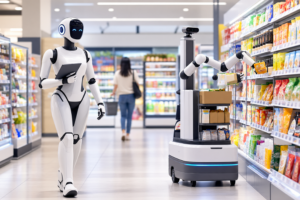
AI Agents Step Into the Store Manager’s Office
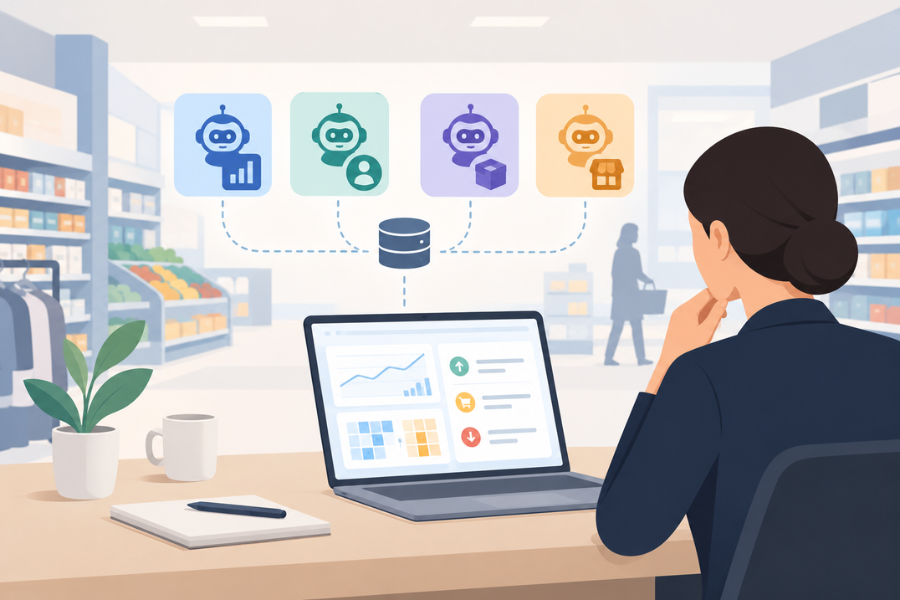
Every week, retail managers compile sales figures, build reports and decide what to move, reorder or drop. A Japanese technology group now wants software to carry much of that load. On 6 October it opened a trial environment for four artificial intelligence agents that analyse retail data and recommend specific actions, from shelf changes to stock transfers between stores. Seven Japanese retailers will test them in phases ahead of a planned commercial launch in June 2027.
The trial is small. The question behind it is global. How much of the daily judgement that runs a store can be handed to software, and how fast can retailers make that shift work?
What is being tested
The four agents split the work of a retail head office and a store manager between them. The first breaks sales down into their components and shows where a store or region is underperforming or has room to grow. It then recommends measures and forecasts their effect. Managers can also use it to compare stores and areas.
The second studies customer data to find purchase motives and the reasons shoppers drift away. The developer says these patterns stay hidden when retailers look only at visit frequency and loyalty points. The third helps merchandisers build product and store sales plans. It recommends how much stock each store should receive, monitors sales after launch and suggests transfers before shelves run empty.
The fourth is aimed squarely at the store manager. It combines a store’s own sales with outside signals such as the local market, the character of the store, the weather and social media. It then suggests changes to the range and to the shelf display.
All four run on a shared execution platform that stores and processes data and controls who can see it. The agents were shown to the industry at a convention for Asia Pacific retailers held in Tokyo from 7 to 10 October. The developer plans to add more agents over time.
The design keeps a person at the end of the chain. An agent reads the data, identifies a gap and proposes an action. A merchandiser or store manager decides whether to act. The developer’s head of industry for Oceania says the practical value of AI agents is their ability to shorten the distance between insight and action. He adds that people remain responsible for final decisions.
A Japanese convenience chain shows how this division of labour plays out in a neighbouring task. Its AI analysed point of sale data to find the traits of popular and weak products. It proposed a sweet potato canelé priced at 285 yen after finding that shoppers became less willing to try unfamiliar items above 300 yen. The product went on sale in September. Human staff still handled ingredients, formulation, food safety, production and the decision to launch. The chain says the system cut idea generation work by about 20 per cent.
The store manager agent in the Tokyo trial applies similar logic at shelf level. It is designed to weigh a store’s surroundings, its character, the weather and the conversation on social media. The aim is a set of changes for that one store rather than a single plan pushed to every branch.
From spreadsheets to recommendations
Retail planning has long depended on people and spreadsheets. Analysts compile the figures. Category managers interpret them. Store managers add local knowledge that rarely reaches any system. The developer of the Japanese agents describes the problem plainly. Retailers fail to make full use of their sales and customer data. Deeper analysis needs specialist skills. Staff lose hours to compiling data and preparing reports, and the cycle from spotting an issue to testing a fix has grown too slow for fast moving markets.
The same pattern shows up far from Tokyo. This month a British supermarket chain began replacing what a UK retail technology publication called time consuming manual spreadsheets with central software that defines the work each store requires and turns it into workload plans. In South Korea, convenience chains have so far used AI mainly for ordering and inventory, according to a Korean news outlet, with product planning only now emerging.
The difference with the new agents is that they are designed to carry the work from analysis through to a concrete recommendation and a forecast of its effect. The path to the October trial is visible in Japan itself. In July a Japanese supermarket operator began a field trial in one physical store of an AI agent for store strategy and shelf layout planning. Engineers built four prototypes and the trial evaluated two. It measured time saved, how often managers adopted the plans the AI produced and whether the tool helped train new managers. The shelf function generated detailed shelf plans and layout images from the store’s characteristics and head office instructions. The October environment widens that idea to seven retailers and four agents.
Where else it is happening
Japan is not alone. In the United States a large retailer introduced an AI task management tool for store managers and team leads in June 2025. It started with overnight stocking shifts, where the retailer says shift planning time fell from 90 minutes to 30. It is piloting the tool on other shifts in selected stores and has also introduced an AI assistant for its merchants. The tools reach about 1.5 million store workers through the company’s staff app, according to a Canadian human resources publication.
In Europe a German wholesale group began rolling out AI category management software in 2023 across more than 8,000 locations in Eastern Europe. These include cash and carry stores and owner operated franchise shops. The software optimises the range for demand at each location and produces market specific planograms, the diagrams that tell staff where every product sits on a shelf. Deployment began in Romania, with the Czech Republic, Poland and Slovakia planned next.
The Japanese developer also plans to offer its agents in Australia and New Zealand from June 2027, according to an Australian ecommerce publication. That would carry this model of AI assisted store management into a second part of the Asia Pacific region.
The case for agents
The most immediate gain is time. The US planning figure shows how quickly routine scheduling can shrink when software prepares the first draft. A wholesale club chief executive told a US technology publication that AI can model inventory replenishment for stores with very different revenue levels in about ten seconds. He described that as a task human planners find hard.
Speed also changes the decision cycle. The Japanese developer argues that faster analysis shortens the loop from spotting a problem to testing a response. Its merchandise planning agent is built to watch sales after a launch and propose stock transfers before a store runs out, rather than after the gap shows up in a monthly review.
Agents can also spread expertise. The Japanese supermarket operator framed its July trial around labour shortages and store management that depends on individual experience. It tested whether an AI planning tool could help train new managers and standardise operations. Codifying the judgement of an experienced manager is valuable when that manager moves on or retires.
Local relevance is the fourth benefit. A head office plan treats branches alike. Software that reads local signals for every store can tailor the range branch by branch, and the German wholesale group’s plan for thousands of Eastern European locations shows the ambition to run this kind of localisation at scale.
The obstacles
The barriers are just as real. Agents are only as good as the data they read, and many retailers are still assembling it. A US technology publication reporting on a major retail show earlier this year found retailers far more cautious than the vendors selling to them. Fragmented data, mixed software systems, unstable margins and tariffs were all limiting spending. Most retailers that use agents deploy ones that handle a single task at a time. Many must first build a sound data foundation. One specialty gift chain standardised its entire product catalogue before attempting any AI work.
Cost and payback are a second hurdle. A technology research firm forecast in June 2025 that more than 40 per cent of agentic AI projects will be cancelled by the end of 2027 because of rising costs and unclear business value, according to a Hong Kong newspaper. The firm also warned of agent washing, the relabelling of ordinary chatbots and assistants as agents. It estimated that only about 130 of the thousands of vendors offering agentic products were genuine.
Adoption is the third. A recommendation to cut a line or move stock touches suppliers, staff hours and shoppers. Because the final decision stays with people, the value of an agent depends on how often managers accept its advice. That adoption rate was one of the measures in the July supermarket trial in Japan.
What it means for retailers
For retailers outside Japan the trial points to a practical order of work. Clean and connected data comes first: sales, customer, stock and local signals in one place with clear access controls. The Japanese platform treats that layer as its foundation, and the cautious retailers at the US show said the same. A narrow task with a measurable outcome comes next. Shift planning and stock transfers both qualify because the hours saved and the gaps avoided can be counted.
The store manager’s role shifts as well. If software drafts the analysis, the manager’s week tilts toward judging recommendations and adding the local knowledge that data misses. A sporting goods chain’s executive chairman told the US technology publication that his company sees AI as a productivity tool more than a replacement for staff. Every design described here keeps the manager in charge of the final call.
The road ahead
The seven Japanese trials will run in phases ahead of a commercial launch planned for June 2027, with Australia and New Zealand among the target markets. The developer intends to add agents and later extend the approach to manufacturers, wholesalers and logistics providers. That would link planning across the supply chain rather than inside a single retailer. In the United States the task management tool is being piloted beyond overnight shifts. In Europe the category management rollout was planned to spread from Romania to further Eastern European markets.
The direction is clear. Software is moving from producing the weekly report to proposing what to do about it. Every system in these trials still leaves a person at the point of decision. The next phase will show how often those people say yes, and what each accepted recommendation is worth on the shelf.
Sources
[1] iTWire
[2] DX Magazine
[5] Retail Technology Innovation Hub
[8] Retail Optimiser
[9] TechTarget

You may also like

Pay Later Moves From the Shopping Basket to the Shop Counter
Pavement Robots Move From Pilot Projects to Grocery Delivery