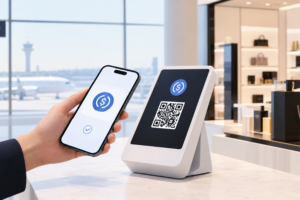
Inside Retail’s Data Clean Room Revolution
The data clean room has transformed so completely that it is already fading from view. Just a few years ago, it was a niche concept championed by data-savvy pioneers preparing for the demise of third-party cookies. Today, in 2026, it has become something altogether different: invisible, essential infrastructure. The inner workings of data collaboration have been absorbed into cloud workflows, adtech stacks and measurement systems, much as APIs disappeared into the background of everyday digital life a decade earlier. As one industry observer noted, nobody wakes up thinking they need a clean room. They are asking harder, more practical questions: how to connect with the right customers in a privacy-by-design way, how to measure campaign effectiveness without relying on outdated identifiers and how to build a richer understanding of a consumer they do not directly see. This quiet revolution is reshaping how the nearly two-hundred-billion-dollar global retail media industry measures what actually drives sales.
From Novelty to Necessity
The numbers tell a compelling story of mainstream adoption. According to the recent State of Retail Media report, 66% of organisations now use clean rooms in some capacity, a figure that underscores how rapidly the technology has moved from experimental to essential. Across the Atlantic, a pan-European study published by IAB Europe found that more than 50% of organisations across the continent are adopting or testing data clean rooms and Unified ID solutions. This is no longer an early-adopter technology; it is the default architecture for data collaboration in digital advertising.
The market data reinforces this picture. The data clean-room display market grew from $2.15 billion in 2025 to $2.52 billion in 2026, a compound annual growth rate of 17.1% and is projected to reach $4.71 billion by 2030. The broader data clean room solutions market is even larger, with Stratistics MRC valuing it at $16.34 billion in 2026 and forecasting growth to $28.91 billion by 2034. The Interactive Advertising Bureau has projected that the market, valued at $320 million in 2024, is on track to reach $1.8 billion by 2028, reflecting a compound annual growth rate exceeding 50%.
What is driving this explosive growth? Three converging forces. First, tightening privacy regulations, including GDPR in Europe and CCPA in California, restrict traditional data sharing and make clean rooms the compliance-safe path to collaborative analytics. Second, the deprecation of third-party cookies that previously enabled cross-platform measurement has made retailers’ first-party purchase data the most valuable targeting signal available. And third, the increasing strategic importance of first-party data collaboration between brands, retailers, and media owners. As the IAB’s State of Data report found, 64% of advertisers and 72% of publishers have either implemented or are actively evaluating clean room technology. Some 66% of US data and ad professionals have adopted data clean rooms due to privacy legislation and signal loss.
The Retail Media Connection
Retail media has become the primary engine of clean room adoption. As US retail media ad spending approaches $70 billion in 2026, clean rooms have become the connective tissue between purchase data, campaign measurement and privacy compliance. The IAB forecasts a 12.1% growth in commerce media spend for 2026. Clean rooms are no longer a supporting capability; they are the infrastructure that makes retail media credible.
Despite this momentum, adoption is far from uniform. Only 48% of US retail media networks currently offer clean room capabilities, according to Q2 2025 data from Mars United Commerce. This gap represents what industry analysts describe as meaningful white space for networks to differentiate amid intensifying competition. The networks that have invested, Amazon, Walmart, Kroger and Target among them, are discovering that clean room infrastructure is not merely a compliance tool but a source of competitive advantage, enabling richer audience insights and more credible measurement than networks still relying on legacy attribution models.
How Clean Rooms Actually Work and What They Solve
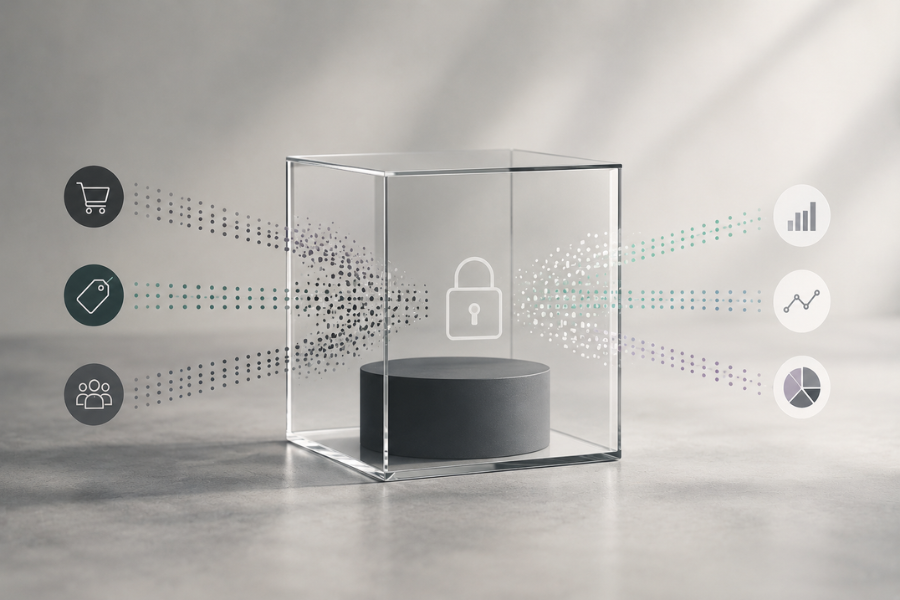
At its simplest, a data clean room is a secure digital environment where multiple parties can combine their first-party data to generate audience and campaign insights without exposing raw data to each other. The IAB Tech Lab defines it as a “secure collaboration environment which allows two or more participants to leverage data assets for specific, mutually agreed upon uses, while guaranteeing enforcement of strict data access limitations.”
In practice, the workflow follows a structured path. Each party uploads encrypted datasets into a governed environment. Data is matched using anonymised identifiers, hashed emails, for example, that are never visible to either side. Analysts or automated systems run pre-approved queries against the matched dataset, and the system enforces minimum aggregation thresholds to prevent any output from identifying individual consumers. Only aggregated, statistical results leave the environment. Nobody walks away with the other party’s raw data. Everyone walks away with insight.
This capability solves a problem that plagued the industry for decades. Consider a CPG brand that wants to understand which of its television ads drove in-store purchases at a national grocery chain. Neither party is willing to share raw customer data. Three years ago, this analysis would have required either a risky data swap governed by complex legal agreements or simply would not have happened. Today, both parties upload encrypted datasets into a clean room, statistical models match ad exposure to purchase events without either side ever seeing the other’s raw data, and the output is an aggregated report showing, for example, that households exposed to the brand’s streaming TV campaign purchased 23% more units than unexposed households, with the strongest lift among families with children.
How the Giants Are Building Their Clean Room Infrastructure
The three largest retail media platforms in the United States, Walmart, Amazon and Kroger, have each built their own clean room architecture and the approaches diverge sharply in ways that matter for advertisers.
Walmart Connect runs a Multi-Touch Attribution model unified across onsite, offsite and in-club touchpoints, with its data and insights platform sitting behind it as the clean room environment. The company has been doubling down on its retail media strategy, launching an AI advertising assistant for suppliers and, at CES 2026, opening up advertising within its generative AI shopping agent, a move that treats AI as a new commerce interface rather than merely a utility. The strategic ambition extends beyond the shelf: in a partnership announced at CES 2026, Omnicom connected Walmart customer purchase data with Meta’s influencer network on Instagram, using real transaction history to identify which creators’ audiences are most likely to buy certain products. This is a step beyond simple sponsored listings; it treats retail purchase data as a source of truth for influencer return on investment, helping brands quantify not just impressions or clicks, but purchase-probable audiences.
Amazon combines Amazon Marketing Cloud, a SQL-based clean room whose ad-traffic lookback window was expanded from 13 to 25 months in 2025, with a tag-based measurement product for non-Amazon channels. In a significant move, Amazon made its Marketing Cloud broadly accessible to all sponsored campaign advertisers in September 2025, effectively democratising clean room access across its advertising ecosystem and setting a benchmark that other networks are now racing to match.
Kroger Precision Marketing, powered by the retailer’s 84.51° data science unit, offers its own clean room environment that lets CPG brands match their customer data with Kroger’s loyalty card transactions from more than 60 million households. The offering has been positioned as a way for brands to run closed-loop measurement across Kroger’s digital properties and in-store sales, closing the loop that historically separated digital advertising from physical grocery purchases.
Target’s Roundel media network similarly provides a clean room solution that enables brands to analyse anonymised guest data against their own first-party datasets, helping measure the impact of campaigns that run across Target’s website, app and in-store channels. While each retailer’s implementation differs in technical architecture, the pattern is consistent: the largest commerce platforms have concluded that a proprietary clean room is no longer optional. It is the foundation upon which measurement credibility and, therefore, retail media revenue growth is built.
From Channel-First to Audience-First Measurement
The deeper significance of the clean room revolution lies in how it is reshaping measurement philosophy. Clean rooms are enabling a fundamental shift from channel-first to audience-first strategies, becoming the foundation of effective commerce measurement. By enabling brands and retailers to connect retail sales with media spending, upper-funnel activity, and in-store purchases, clean rooms are unlocking new retail metrics that integrate data across channels, revealing who is buying, what drives first purchases, how new shoppers differ from loyal customers and what keeps them coming back.
The industry is moving decisively beyond last-click attribution, the crude model that assigns full credit to the final touchpoint before purchase, toward multi-touch measurement models that show how each touchpoint contributes to sales and brand loyalty. This evolution is made possible by the clean room’s unique ability to match purchase data with behavioural data without either party surrendering control of their raw customer files. Riyaad Edoo, executive director of commerce at EssenceMediacom, captured this shift in an IAB roundtable: “You can get beyond simple purchase data and start to target based on a series of actions. That gets to the psychology of the consumer, their behavioural patterns or passion points.”
Legacy measurement approaches are being exposed as insufficient for the new reality. As the IAB has documented, traditional media mix modelling, designed for reach-based channels like TV and radio, structurally undervalues retail media because it cannot parse the complex, always-on dynamics of programmatic commerce. Retail media networks sit on top of fragmented commerce ecosystems that legacy models simply cannot ingest, meaning the lift from retail media campaigns is real and substantial, but has nowhere to land inside the model. Clean rooms solve this by providing deterministic purchase signals and causal lift testing that reveal true incremental value far more accurately than correlational models ever could.
The Privacy Imperative and the Rise of AI
The clean room’s ascent has been accelerated by two forces that feed each other. Privacy regulation provides the push; artificial intelligence provides the pull.
On the privacy front, the global surge in stringent data protection frameworks, GDPR, CCPA, and similar laws across multiple regions, is a primary driver of the data clean room solutions market. Clean rooms incorporate mechanisms that strengthen regulatory compliance: strict access controls, audit logging, anonymisation, masking of sensitive fields, and minimum aggregation rules that prevent any individual consumer from being isolated, even by combining multiple queries. Consent management has become integral to clean room design in 2026. If either party’s contribution includes sensitive categories under GDPR or any other applicable framework, the consent bar is explicit-consent-only, and the clean room architecture must enforce that.
On the AI front, the relationship is symbiotic and increasingly urgent. AI does not create competitive advantage in and of itself; it multiplies what already exists. If data is siloed, AI will be short-sighted, and models will underperform or amplify weak data foundations. But when AI is trained on insights generated through decentralised data collaboration, it becomes a powerful accelerant. The real intelligence comes not from a proprietary model alone but from the network effect, the depth and diversity of signals AI can learn from, while safeguarding trust and control.
This convergence is driving the emergence of a new architectural pattern: Private Data Networks. Where early clean room deployments were often point solutions built around a specific use case or campaign, Private Data Networks are strategic and built for longevity. They create an always-on layer of connectivity across multiple brands, retailers, media owners, and data providers, enabling collaboration without moving or pooling data. Each party retains full control. Privacy is protected by default. These networks represent a shift in mindset from the era of big data stockpiling to an era where intelligence is understood to grow through connection rather than collection.
Salesforce entered this space in February 2026 with the general availability of a clean room product built on a Zero Copy architecture that executes queries where data resides rather than extracting it to a central environment. The system uses a private join mechanism: data is matched using encrypted keys like hashed emails that are never visible to either party, and the system allows only specific, pre-approved queries that provide answers without exposing underlying records.
The Road Ahead
The future that is taking shape is one in which retailers and brands collaborate on anonymised segments, retail media networks form data-sharing alliances that let brands target the same audiences across multiple retailers with unified campaigns, and privacy-compliant audience sharing operates at scale. Integration between retail media and measurement infrastructure, clean rooms, customer data platforms, and AI analytics will deepen, enabling richer audience activation. Connected TV and in-store digital partnerships will become standard line items in retail media plans as retailers look to monetise non-e-commerce touchpoints.
For the 52% of retail media networks that have yet to offer clean room capabilities, the message from 2026 is unambiguous. Investing in clean-room literacy, advanced analytics, and agile measurement capabilities is no longer optional. It is essential for better targeting, maximising return on investment, and staying competitive as the measurement landscape evolves.
Clean rooms do not make marketing effective, they make effectiveness visible. As commerce media continues its rapid expansion, these secure collaboration environments will increasingly function less as a distinct category of technology and more as the invisible plumbing that makes modern retail possible. The term itself may fade from everyday use. The capability will not.
Sources:

You may also like
Digital Twin Supermarkets Go Live
How Zero-Shot AI Delivers Same-Day Proof of In-Store Marketing Execution