Why Advertising Is Overtaking Commerce in Retail

From Retailer to Media Company
Retail is no longer just about selling products. It is increasingly about monetising attention, data and digital real estate. Over the past few years, Retail Media Networks have emerged as one of the fastest-growing and most profitable segments in the industry, with artificial intelligence accelerating both their scale and effectiveness.
Retailers like Amazon, Walmart, and Best Buy are evolving beyond their traditional roles into media platforms. Retail media refers to advertising embedded within a retailer’s ecosystem, across websites, apps, search results and increasingly, physical stores. What makes this model particularly powerful is the depth of first-party data retailers hold, from transaction histories to real-time intent signals, enabling highly targeted and measurable advertising.
Why Retail Media Is Booming Now
The rapid rise of retail media is being driven by structural changes in the digital advertising landscape. As third-party cookies phase out and privacy regulations tighten, advertisers are losing access to external tracking mechanisms. Retailers, however, operate within closed ecosystems built on consented first-party data, giving them a distinct advantage.
At the same time, the economics are compelling. Retail has traditionally been a low-margin business, whereas advertising delivers significantly higher margins. Retail media allows companies to layer a high-margin revenue stream on top of their existing operations, while also offering brands the ability to directly link advertising spend to sales through closed-loop measurement. This combination of precision and profitability is what makes RMNs particularly attractive in today’s environment.
From Targeting to Autonomous Optimisation
Artificial intelligence is now transforming retail media from a targeting tool into a dynamic, self-optimising system. AI models analyse vast datasets to predict consumer intent and personalise ad placements in real time, ensuring that the right message reaches the right customer at the right moment.
Beyond targeting, AI is also reshaping how campaigns are executed and optimised. Ad inventory is increasingly priced through intelligent, real-time auctions, allowing retailers to maximise yield while improving return on ad spend for brands. At the same time, generative AI is streamlining the creative process by enabling rapid production and testing of multiple ad variations. Campaigns are no longer static; they continuously evolve based on performance data, reducing manual intervention and increasing efficiency.
Best Buy’s Strategic Pivot
A clear illustration of this shift can be seen in Best Buy. As growth in its core electronics business has slowed, the company has been investing in retail media and AI-driven monetisation strategies to unlock new revenue streams. Leadership has positioned advertising, data monetisation, and marketplace expansion as central to its future, reflecting a broader industry trend where retailers are diversifying beyond product sales.
This pivot underscores how retail media is no longer a supplementary capability but a strategic priority, particularly for retailers looking to offset margin pressures and drive long-term profitability.
The Rise of In-Store Retail Media
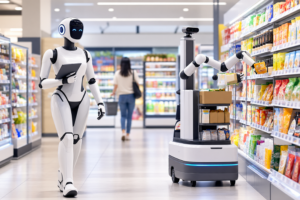
Retail media is also expanding beyond digital channels into physical environments. Stores are increasingly being reimagined as media platforms, with digital screens, smart shelves, and point-of-sale displays turning foot traffic into monetisable inventory.
Retailers are beginning to connect online and offline data to create more cohesive and measurable advertising experiences. For instance, initiatives from players like Walmart show how in-store media can be integrated with digital campaigns, extending reach and improving attribution. This convergence of physical and digital retail, often referred to as “phygital”, is further enhancing the value of retail media networks.
Challenges and Risks
Despite its strong momentum, retail media comes with its own set of challenges. The growing number of individual retail media networks has led to fragmentation, making it difficult for brands to manage campaigns across multiple platforms efficiently. At the same time, the use of customer data for monetisation raises important questions around privacy and regulatory compliance.
Measurement remains another evolving area. While closed-loop attribution is a key advantage, the lack of standardised metrics across platforms can create inconsistencies and limit comparability for advertisers.
What This Means for the Future of Retail
The rise of retail media signals a fundamental shift in how value is created within the industry. Retailers are transforming into hybrid commerce and media platforms, while brands are reallocating budgets toward channels that offer both precision targeting and measurable outcomes.
In many cases, the advertising arm of a retailer is becoming more profitable than its core retail operations. This shift is not just changing revenue models; it is redefining competitive advantage in the sector.
As competition intensifies and margins remain under pressure, retail media is rapidly becoming a core pillar of modern retail strategy rather than an optional add-on. The retailers that succeed will be those that can effectively integrate commerce, data and media into a unified, AI-driven ecosystem.
Sources:

You may also like

Pay Later Moves From the Shopping Basket to the Shop Counter
Pavement Robots Move From Pilot Projects to Grocery Delivery