The Identity Infrastructure Behind AI Shopping
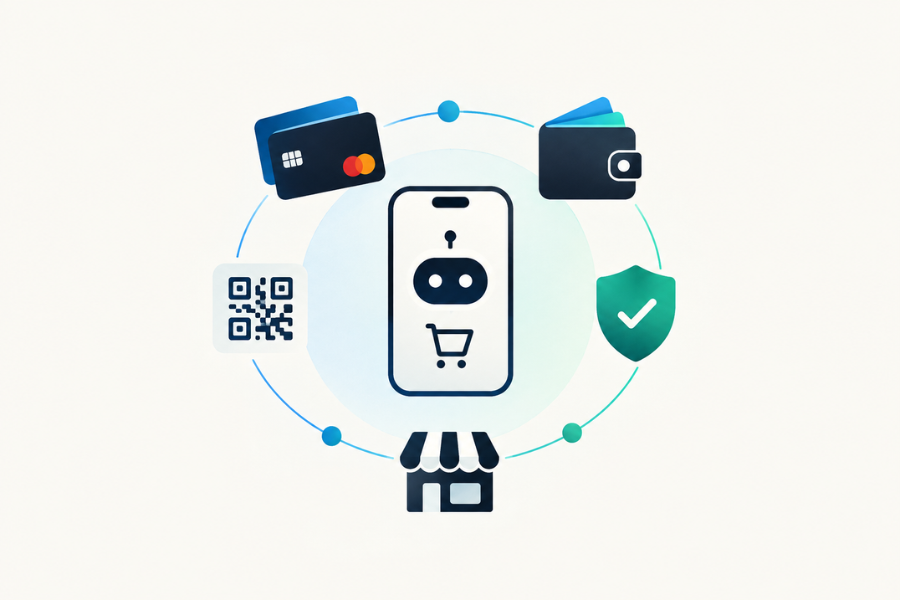
Shopping agents are easy to demo. Safe delegation across cards, wallets, QR schemes and merchants is the harder scaling problem. In September 2026, the payments industry moved decisively to solve it.
Ten digital wallets serving 1.5 billion user accounts and seven acquiring partners confirmed they will support an open agentic mobile protocol in Phase I. In parallel, three of the world’s largest payment networks began collaboration on a Know Your Agent interoperability framework designed to let payment networks verify AI agents that make purchases on behalf of people.
Why This Matters Now
AI agents are evolving from making recommendations to completing purchases. By 2030, AI agents are projected to orchestrate between $3 trillion and $5 trillion of global consumer commerce, according to McKinsey research. The US B2C retail market alone could see up to $1 trillion in orchestrated revenue from agentic commerce. Bain estimates the US agentic commerce market could reach $300 billion to $500 billion by 2030, representing 15 to 25 percent of total online retail sales. Morgan Stanley Research estimates agentic shoppers could represent $190 billion to $385 billion in US e commerce spending by 2030. Juniper Research forecasts spending through agentic commerce will reach $1.5 trillion by 2030.
The underlying infrastructure that makes this safe, agent identity, authorisation and accountability, is being built now. The protocol was launched in April 2026 and is now being deployed across a mobile payment network connecting more than 50 mobile payment partners, over ten national QR schemes and 150 million merchants to 2 billion consumer accounts globally.
The roster of partners gives the protocol distribution beyond a technical specification. The seven acquiring partners are among the largest payment processors in the world. The ten wallet partners span China, Hong Kong, Indonesia, the Philippines, South Korea, Macao, Malaysia, Thailand and Singapore.
The protocol is built to support agent led transactions across mobile interfaces such as smartphones and AR glasses without requiring users to switch applications or change existing payment habits. The company states that the protocol reduces the number of steps needed to link a payment agent to a wallet by 50 percent. The protocol has been open sourced, with source code, developer SDKs and technical documentation made available to developers, AI platforms, wallets, acquirers and financial institutions.
The Know Your Agent Framework
The KYA collaboration centres on three pillars. Cross network operator traceability links each agent to a validated operator, cardholder or business, enabling clear attribution of agent activity. Shared certification requirements assess each agent against security and behavioural standards. Continuous transaction monitoring evaluates agents using a combination of identity and transaction related signals to support ongoing assessments and certification.
The interoperable KYA framework could simplify and facilitate agentic payment transactions for service providers, agent platforms and marketplaces while upholding robust trust guardrails. Agents can benefit from KYA and identity frameworks that enable common trust signals to be recognised across the payment ecosystem. This helps reduce integration complexity and duplicative agent identity verification efforts while maintaining robust trust and risk controls. This will enable faster time to market and lower integration cost for new agentic services with greater trust and risk visibility across participating networks.
The collaboration builds on the Safeguards for Agentic Finance at Runtime framework and will be advanced through an industry platform convened by the Monetary Authority of Singapore to bring together financial institutions, technology providers and researchers to develop and scale responsible AI solutions for financial services.
The three organisations have previously rolled out their respective protocols, a trusted agent protocol from one card network, a verifiable intent framework from the other, and an agentic mobile protocol from the wallet ecosystem and will now explore opportunities to work towards common principles. The protocol includes a KYA framework that establishes an agent’s digital identity and certifies its authorised capabilities through an Agent Trust Rating, alongside a money back guarantee for merchants against agentic specific risks.
What Remains Unresolved
The “common principles” are not yet an interoperability specification. Liability, revocation, returns, delegated budget control and regional privacy rules remain unresolved. No transaction volume, merchant activation timetable, dispute flow or fraud result has been made public.
The partner roster should be treated as credible readiness evidence. Market size forecasts remain scenarios, not facts. The week’s most strategically important move was infrastructure, not adoption.
The Retailer Imperative
For retailers, the implications are direct. AI shopping agents will only be trusted to complete transactions if the infrastructure beneath them is verifiable. Product catalogues must be structured for machine readability. Inventory data must be live. Payment rails must support delegated authorisation. The retailers that prepare now will be positioned to capture demand when agentic commerce reaches scale.
The payment industry is accelerating collaboration to strengthen trust, common principles and governance in the agentic commerce ecosystem, with agent identity and trust as a key area of focus. As one executive noted, “As AI agents become a bigger part of how people discover and buy, trust must scale with them”. Another added that interoperability across Know Your Agent frameworks is essential to making agentic commerce work at scale.
Where the Conversation Continues
The infrastructure for trusted agentic commerce is being built in real time. The protocols are live. The partnerships are in place. The standards are converging. But the questions that matter most to retailers, how to prepare catalogues for machine discovery, how to balance automation with accountability, how to preserve customer trust as purchasing decisions shift from people to agents, are not resolved by specifications alone. They are resolved through conversation, debate and the exchange of experience between the people building and deploying these systems.
That conversation is happening in Paris this week.
An Evening That Matters
At 7:00 PM tonight, September 16, the industry gathers for an exclusive networking cocktail and a Fireside Chat with some of the most influential voices in global retail.
The discussion will address the forces reshaping the industry, from evolving consumer behaviour and the future of physical experiences to the adoption of new technologies across the value chain. It is a rare opportunity to hear directly from leaders who are navigating these shifts in real time and to exchange perspectives with peers who are facing the same questions.
The House of Innovation runs through tomorrow, September 17, in Hall 4 at Paris Expo Porte de Versailles. Whether you are exploring agentic commerce, retail media, in store digitisation or the infrastructure that makes AI shopping safe, this is where the technologies defining the next era of retail are being shown, tested and discussed.
For full programme details, including tonight’s networking event and the final day of tours: Paris Connect
Request your invitation: Registration Form

You may also like

Facial Recognition Payments Launch in the UK with 0% Merchant Fees