Six Humanoid Robots Ran a Shanghai Store for a Day and Two Failed
At ten in the morning on 2 November a working convenience store in Shanghai handed its shift to six humanoid robots. For the next 24 hours they greeted shoppers, ran orders, pulled coffee, served hot breakfasts, checked shelves and cleared tables while real customers came and went. By ten the next morning they had logged 1,730 tasks and served 683 customers. Four robots passed their probation. Two did not. The result matters to retailers everywhere because it is one of the first public tests of humanoid robots doing the whole spread of store work under live trading conditions, with each robot graded on its job.
A day on the shop floor
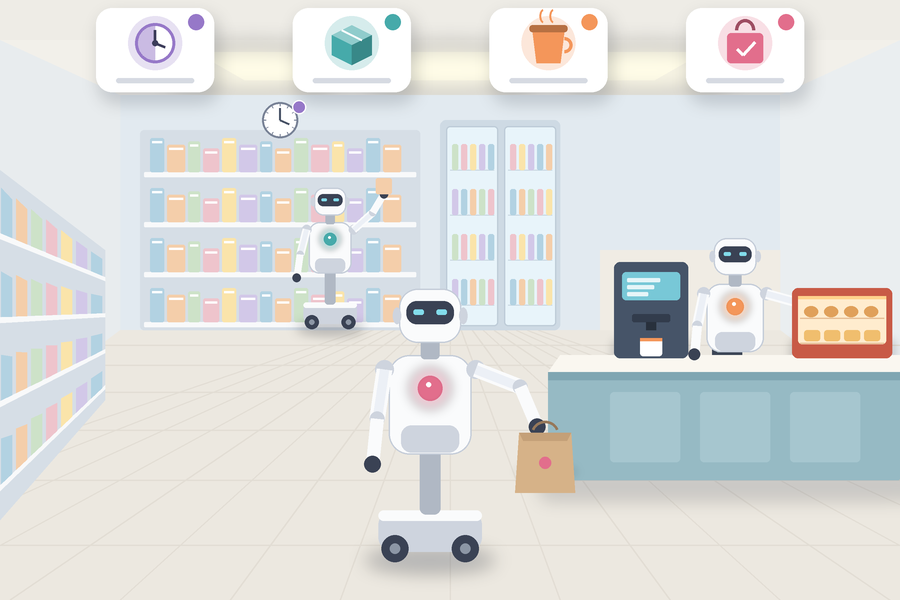
The trial ran in a fully operating store in Xuhui, a busy commercial district in central Shanghai. A Shanghai robotics company organised it as a probation test for six of its general purpose humanoid robots and streamed the full 24 hours online to more than two million viewers. Each robot was given a single role. One was the greeter. One picked and handed over pickup and delivery orders. One worked as barista, one handled hot food, one patrolled and restocked the shelves and one cleared tables.
The day was split into four periods that any store manager would recognise: the lunch rush, the evening peak, the overnight watch and the breakfast rush. The organisers also invited inspectors to create deliberate problems, so the robots faced cancellations, sudden surges and awkward requests rather than a tidy demonstration.
The output was specific. The order robot handled 369 orders. The barista made 147 coffees and the hot food robot served 126 meals. The shelf robot completed 277 patrol and restocking runs and the table robot cleared 128 tables. The company says the greeter earned the highest customer rating of the six. The order robot coped with surges and cancellations without stalling and the barista kept its quality steady through the day.
The two failures were just as telling. The shelf robot rarely acted on its own initiative and could not keep pace with the store. The cleaning robot drifted off its route during the night and left the store altogether, which the company scored as a failure of positional stability. Both were placed in an observation group rather than promoted.
From fixed arms to a robot crew
Robots have been restocking convenience store shelves for several years. In 2022 a major Japanese convenience store chain began installing robotic arms behind the drinks fridges of 300 stores. Those arms were fixed in place and did one job: sliding bottles and cans into chiller shelves from the back room. Artificial intelligence drove them most of the time. When the software met a misplaced item or failed, a remote operator wearing a virtual reality headset took over the arm. The developer said each unit replaced one to three hours of human work a day and ran without help about 98% of the time.
What has changed is range. The Shanghai robots were not bolted to one station. Each has a humanlike upper body with a head, a torso and two arms mounted on a wheeled base. That design gives up stair climbing in return for stability and longer working time, and it lets the same machine move between counter, shelf and seating area. The robots were also judged on behaviour as well as speed. Taking initiative and staying within the boundaries of the store were part of the assessment.
The pace of learning has changed too. The company says lessons from a day of operation are summarised the same evening and applied the next day at the level of task rules. Deeper changes to the underlying control models usually follow within a few days as new data is used for training. Footage from the livestream itself is expected to feed into software releases within one to two weeks.
A convenience store is one of the hardest places to put a robot. Space is tight, products are small and varied and customers move unpredictably. Many of the jobs need fine handling. Soft packs change shape when they are squeezed, so every later movement has to adjust. Goods hanging on hooks have to be lifted off without snagging the wrapper or knocking the neighbouring item to the floor.
Each robot’s behaviour is shaped by two layers of software. A layer of task rules sets out what it should do in its role and a trained control model underneath turns that into movement. In Shanghai each robot specialised in one role. A coffee machine, a hot food cabinet and a shelf of snacks each need a different skill. The robots also had to work with the store’s own ordering system.
People remained part of the system. The robots can call for human help when they need it and the company tracked how often staff stepped in, along with how much of the time the system was available. Early in the day the ordering link produced failed orders, missed status updates and moments when two robots tried to occupy the same spot. Those are the kinds of integration problems that decide whether a robot crew can run for weeks rather than a day.
A global race to staff the night shift
China is moving fastest on this kind of trial, but it is not alone. In Hong Kong a mainland robotics company unveiled plans in June for a compact shop of about nine square metres on the Hung Hom waterfront, with a two armed humanoid robot taking the overnight shift. The robot is designed to restock, retrieve products, manage inventory, process checkouts and talk to customers in several languages. The shop sells snacks, everyday goods and medicines available without prescription.
In Denmark a national retail group has been training tall humanoid robots at a supermarket just outside Copenhagen since the summer. They work at night, unboxing heavy crates and lifting bulky goods onto shelves. Through remote controlled training they have learned to handle fragile items such as cereal boxes and glass jars. The project team hopes the robots will restock shelves on their own by early 2027 and plans to add date checks, gap spotting and tidying of misplaced items.
Japan is preparing for a similar step. At an international retail industry event in Tokyo in October, a robotics company operating mainly in Thailand showed a humanoid built for convenience stores. It identifies individual products, manages stock, carries goods, refills shelves, packs bags and speaks more than 20 languages. The company plans full scale deployment in Japanese convenience stores as early as 2027, with one or more robots per store working alongside people rather than replacing them.
Behind these trials sits a fast growing supply of machines. Global humanoid shipments passed 22,000 units in the first half of 2026, nearly four times the level a year earlier, according to a market research firm. Chinese makers took the top five places with a combined share of 86%. Guided tours and retail greeting already account for about a fifth of uses.
What a robot crew offers
The clearest benefit is cover for the hours that are hardest to staff. Night shifts, early breakfasts and sudden rushes stretch small store teams. In Japan robot developers and convenience chains point to labour shortages as the main reason for their work, especially at night. A robot that restocks overnight or runs the coffee station at peak time frees people for customers and for the problems that machines cannot solve.
Consistency is a second gain. The Shanghai barista kept its quality steady across a full day and the order robot did not stall under pressure. The trial also tracked each robot’s tasks, its availability and the number of human takeovers, which gives managers a measurable record of a shift.
The improvement loop is a third. The Shanghai company says rule changes can be applied overnight and it lists the transfer of experience from one store to the next as a goal for scaling. That is a very different rate of progress from training new staff one by one.
The hard parts that remain
The same trial showed how far the technology still has to go. By the company’s own account the robots still lag experienced clerks in adapting to changes on the shop floor, in the rhythm of fine handling and in dealing with the unexpected. The two failures were not mechanical faults. They were failures of judgement: a robot that waited to be told what to do and another that did not respect the boundary of the store when its rules did not cover the situation.
Handling remains difficult. Soft packaging and hooked goods are everyday items in convenience retail, and both still trouble robot hands. Food service adds separate hygiene and safety requirements. In Denmark the robots are slower than experienced staff and still need considerable human guidance, and national safety rules would have to change before they could work alongside shoppers during the day.
Scaling raises its own questions. Retailers would need standard hardware and tools, links into every store system, remote monitoring and a way to carry experience from one store to the next. The economics will be judged on the cost of each task completed to standard over long periods of operation, and the Shanghai company expects that cost to fall as the technology matures.
What it means for retailers
For store operators the Shanghai test offers a useful template more than a finished product. Giving each robot one role, scoring it against clear tasks and putting it through a real trading day is the kind of trial a retailer can design for its own estate. The early evidence suggests that structured, repeatable jobs such as order picking, drinks, hot food and greeting are closest to ready. Open ended work that depends on initiative, such as deciding what a shelf needs, is further away.
Retailers will also need to plan for the people side. Every trial so far keeps staff in the loop to step in, guide and train. The likely near term model is a mixed shift in which robots take the repetitive and physically demanding tasks while people handle exceptions, customers and judgement calls.
The road to a permanent robot shift
The next milestones are already set. The Danish trial aims for autonomous overnight restocking by early 2027. The Thai developed store humanoid is due in Japanese convenience stores from as early as 2027. In Shanghai the four robots that passed have been promoted and the two that failed remain under observation, with software updates from the trial expected within weeks. The company has given no date for commercial service. It expects structured tasks such as sorting, restocking and cleaning assistance to scale first and complex interaction to follow later.
That sequence is the real lesson of the 24 hour shift. Humanoid robots can now hold down several store jobs through a full day of real trading. Whether they can do it every day, at a cost that beats a human shift, is the question the next year of trials will answer.
Sources
[1] Gasgoo
[2] Origin of Bots
[3] Humanoids Daily
[5] Dexerto
[6] Taipei Times
[7] eWeek
[8] Euro Weekly News
[9] News On Japan

You may also like


Smart Trolleys Retreat in America as Asia Keeps Rolling Them Out