Why Every Online Order May Soon Get a Made to Measure Box
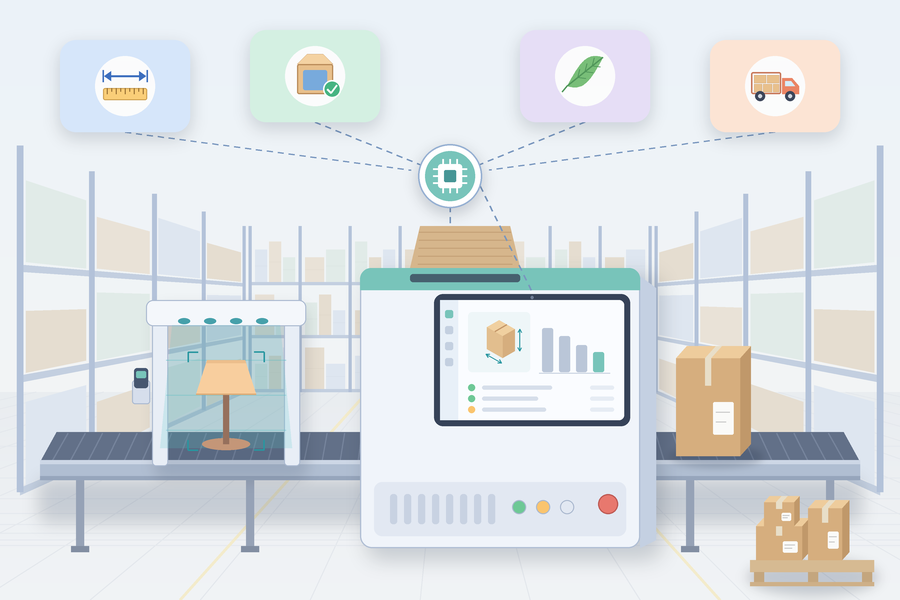
A Swedish home furnishings retailer is spending £30 million on a customer distribution centre in the United Kingdom. Much of that money goes on one simple idea. Instead of a worker measuring each item and assembling a carton by hand, a machine will measure the order and build a box around it. The upgrade at Peterborough in eastern England was announced on 20 October. It shows how online growth, freight costs and new packaging laws are pushing retailers around the world to stop paying to ship empty space.
A warehouse that makes its own boxes
The retailer is investing £31.5 million across two customer distribution centres in England. The larger share funds a two year technology programme at Peterborough. Its centrepiece is packaging equipment that makes a carton sized to the contents of each order. The company says the system reduces packaging material by up to 30% on average and void fill by up to 60%. Void fill is the paper, foam or air pillows used to stop goods moving around inside a box.
Automation will also take over far more of the site’s parcel flow. The retailer expects the share of parcels processed automatically to rise from 47% today to 75% in 2027. Three inventory drones with their own docking nests already fly the aisles in short cycles to check that stock sits in the right place. They were introduced in January. The company says staffing levels at Peterborough will not change during the upgrade.
A further £1.5 million funds a fulfilment trial at Doncaster in South Yorkshire. The site now serves customers around Gateshead, Edinburgh and Glasgow, with Sheffield to follow. Those orders previously travelled from Peterborough. The retailer estimates the shorter routes will save about 212,000 miles and 280 tonnes of carbon dioxide a year. The trial has created 80 jobs. Behind all of this sits a business that now trades heavily online. Online sales made up 43.3% of the retailer’s UK sales in its 2026 financial year.
From a shelf of stock cartons to boxes made to measure
For most of the history of online retail, a packing station worked from a shelf of standard carton sizes. A packer chose the nearest fit and filled the gap with paper or plastic cushioning. Awkward items needed more effort. Before the new equipment, staff at Peterborough measured each item and built a custom carton by hand.
Brands have sized their own product packaging carefully for decades. The newer development is making the shipping box on demand for each individual order. A US packaging trade publication reported that most adoption of on demand box making has happened within the last five years. Online order volumes and tight labour markets helped drive it. One equipment maker told the publication that delivery trucks often carry 40% air. It claimed that sizing boxes to their contents can improve load density by as much as 40%.
Regulation is now the other driver. Governments in Europe and China are setting rules on the size of the box itself.
How the technology works today
The process starts with measurement. Sensors scan a single product or a group of products in one order and capture all three dimensions. Software then works out which box would fit the contents most closely. Some systems take a partly formed box and cut it down to the height of the goods before creasing it for folding. Others start from flat corrugated board and form a new box along every dimension. A large carton can be followed immediately by one a fraction of its size.
Speed matters in a fulfilment centre. A machine built by a US packaging automation company for a major US retailer produces up to 600 boxes an hour. According to the companies, an order can be packed, labelled and ready to ship within 30 minutes. A Japanese packaging maker has developed a machine that sets the base of a corrugated box to the footprint of the product. It then cuts and seals the box to match the product’s height using a cutting process that needs no blades.
Computer vision is now moving into the steps that follow. The same US retailer is installing an automated void fill system that uses artificial intelligence to measure the empty space left in each case. The machine dispenses paper fill and then closes and seals the case. It handles nine cases a minute. Cameras that capture two dimensional and three dimensional images record each case’s size and contents. They flag boxes that have been packed wrongly and divert them to a lane for manual checks.
Where it is spreading around the world
North America has some of the largest deployments. The major US retailer is rolling out the automated void fill system across its five newest fulfilment centres in Indiana, Pennsylvania, Illinois, Texas and California. It says the system cuts paper use by up to 20% and reduces damage from boxes that are underfilled. Those centres already use machines that make right sized corrugated cases on demand.
In continental Europe and Britain, a large US ecommerce company began installing more than 70 automated packaging machines in 2025. The first went into fulfilment centres in the UK and Germany. France, Italy and Spain were also due to receive machines that year, with other countries expected to follow by 2027. Some machines measure an item and build a box around it. Others seal lighter goods into paper bags cut to size. The company says removing extra padding saves an average of more than 26 grams of packaging per shipment.
Asia is moving through both technology and law. In Japan, a domestic packaging maker has built the bladeless machine described above for ecommerce and for logistics between sites. China now has a mandatory national standard on excessive packaging in express delivery. It requires boxes to be sized to their contents. It also limits packaging for items that are not fragile to two layers, and fragile goods to four.
The European Union has set the clearest deadline. Its new packaging regulation began to apply on 12 August 2026. From 1 January 2030 no more than 50% of the internal volume of packaging used in ecommerce, logistics and distribution may be empty space. Filler such as air cushions, bubble wrap and paper counts as empty space under the rule.
What the retailer gains
The first gain is material. Less board and less filler per parcel means lower purchasing costs and less waste for customers to dispose of. The Peterborough figures of up to 30% less material and up to 60% less void fill are the company’s own estimates.
The second gain is space. Smaller boxes take up less room on pallets, trailers and vans. The US equipment maker says right sized boxes let retailers fit up to a third more parcels on a carrier trailer. More parcels per vehicle can mean fewer journeys and lower transport emissions.
The third gain is labour. Measuring items and folding custom cartons by hand is slow and repetitive. Automated lines take on that work and move staff to other tasks. Automated checks also catch packing errors before a parcel leaves the building.
Packaging costs are rising too, which raises the value of every gram saved. Retailers in the UK now pay for packaging under a new extended producer responsibility scheme worth £1.5 billion a year. British retailers also buy recycling certificates to prove packaging has been recycled. Data from the national retail trade body shows the average price of plastic certificates rose from about £180 a tonne in 2025 to more than £370 in 2026.
The limits of the box machine
The equipment is expensive. A packaging specialist quoted by the US trade publication said a proprietary machine for variable size packaging “is not cheap”. The same source warned that such machines can tie a company to a specific material format. A retailer that later wants to switch to a different board or a new reusable format may find its options limited.
Not every product suits the same format. Boxes get most of the attention, yet adoption has been easier for flexible formats such as bags of variable length. Fragile items still need protective packaging. The European rule allows extra volume where it is needed to protect goods in transit.
Growth may also slow. The same specialist expects adoption to plateau eventually because the market has already grown significantly. Work patterns change as well. One void fill supplier says its system can free between one and three full time roles for other tasks. The US retailer describes the change as a shift in work rather than a cut in jobs.
Measurement rules are still being written. The European Commission is expected to publish harmonised methods for calculating empty space by February 2028. Retailers are buying equipment before every compliance detail is settled.
Where the box goes next
The Swedish retailer aims to process three in four parcels automatically at Peterborough by 2027. Its Doncaster trial is set to extend to Sheffield. The US ecommerce company expects its packaging machines to reach more European countries by 2027. The US retailer’s phased installation of automated void fill covers all five of its newest fulfilment centres.
Regulation will set the pace after that. The European calculation methods are due by February 2028, and the empty space cap takes full effect in January 2030. China’s standard is already in force.
Packaging is turning into a measurable part of fulfilment rather than a fixed overhead. The technology suits online retail best because orders vary so widely in size and shape. A home furnishings range, with its mix of bulky and small items, is a clear example.
The technology also links three agendas that often sit in different departments. Sustainability teams want less waste. Logistics teams want fuller trucks. Finance teams want lower packaging fees. A box built around each order serves all three at once.
For retailers selling into Europe, the 2030 deadline sets a clear planning horizon. Retailers that rely on a handful of stock carton sizes and generous filler have the most to change.
Taken together, these plans and deadlines are turning the humble cardboard box into an engineered part of retail logistics. For a growing share of online orders, the box is now made only after the order is known.
Sources
[1] Retail Technology Innovation Hub
[4] Packaging Dive
[5] FreightWaves
[6] PULPAPERnews
[7] Packaging World
[8] Packaging Europe
[10] Packaging Gateway
[11] ESM Magazine

You may also like

AI Agents Step Into the Store Manager’s Office
Pay Later Moves From the Shopping Basket to the Shop Counter