Conversational AI Opens a New Retail Media Channel in Europe
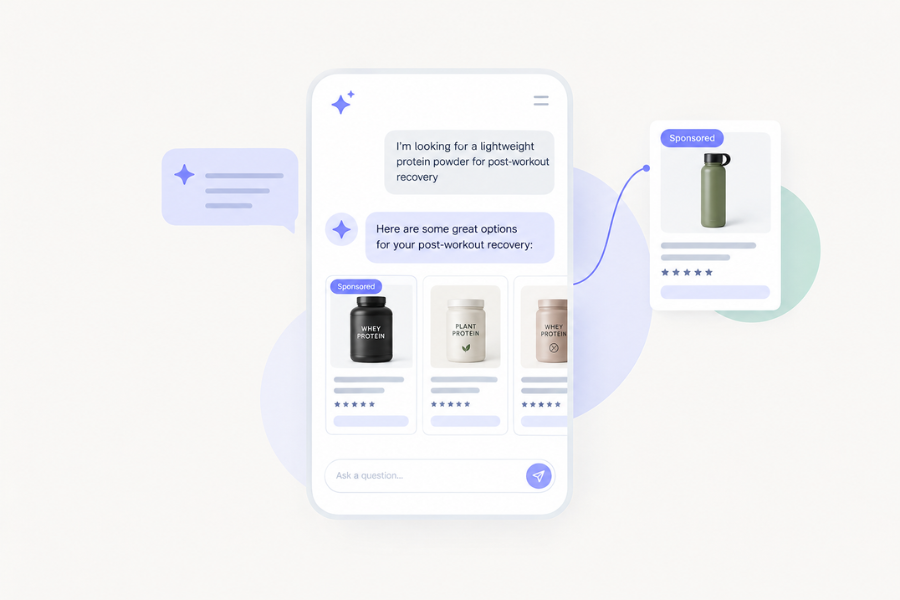
In October 2026, a European commerce technology provider integrated sponsored product advertising into an AI-powered conversational shopping assistant, marking the first deployment of its kind in Europe. The integration places paid product recommendations directly inside AI shopping conversations, allowing retailers to monetise high-intent traffic that has historically sat outside retail media channels. Early results showed sponsored products reached a click-through rate more than five times the average and a conversion rate more than double the average.
The Shift from Search Box to Conversation
The development reflects a broader change in how consumers discover products. Increasingly, shoppers are beginning their journeys by describing what they need rather than typing keywords: building a post-workout nutrition routine, finding a gift for a particular occasion or comparing products before they choose. AI shopping assistants are already generating this kind of high-intent traffic for retailers, but until now much of it has not been monetised through retail media.
A senior executive at the commerce technology provider described the opportunity: “More and more, customers start their shopping journey with a conversation, describing what they need, the occasion they’re shopping for or the problem they want to solve. That is some of the highest-intent traffic a retailer can have, and until now it has largely sat outside retail media”.
How the Integration Works
The AI Shopping Assistant draws keywords and filters from each conversation and turns them into tailored product recommendations. The assistant is built on a cloud-based enterprise AI agent platform, giving it the ability to understand customer intent, apply brand-specific rules and guide shoppers through product discovery in real time.
When a sponsored product is eligible and relevant, it appears clearly labelled within the assistant’s response alongside organic recommendations, adding to the discovery experience rather than interrupting it. The same relevance models that power the advertising platform’s search advertising, including keyword matching, semantic understanding and strict relevance thresholds apply in the conversational context. Sponsored recommendations appear only when they match what the shopper has asked for.
The executive emphasised this relevance-first approach: “By bringing this into our AI Shopping Assistant, we’re helping retailers monetise those moments using the infrastructure they already have, while making sure every sponsored recommendation is relevant to what the shopper asked for. As with all our AI capabilities, this works as a standalone service that can integrate with any commerce platform”.
Early Results
The performance data published alongside the integration provides a preliminary indication of how sponsored products perform within conversational contexts.
Sponsored products surfaced through the AI Shopping Assistant achieved a click-through rate more than five times the average and a conversion rate more than double the average. These figures are described as early results and are based on the deploying provider’s own data; independent verification has not been published.
The results align with broader industry data on AI-referred shopping traffic. Research across 500 U.S. retailers found that users referred from large language model platforms converted at approximately 1.5 times the rate of other referral channels. In categories such as consumer electronics, AI-referred shoppers converted at nearly double the rate of traditional search referrals.
The Broader Strategic Context
The integration is part of a suite of agentic commerce solutions built on the cloud provider’s enterprise AI platform. Alongside the AI Shopping Assistant, these include an AI Stylist offering AI-powered virtual try-on for beauty, apparel and footwear, and a Shopping Assistant Insights tool that helps retailers understand what their shoppers want and how the assistant is serving them. Each is delivered as a plug-and-play SaaS service, available through the cloud provider’s marketplace and able to operate independently of the underlying storefront.
A managing director at the advertising platform described the strategic significance: “Shopping discovery is moving beyond the search box, and retail media needs to evolve with it. With this brands can engage shoppers in high-intent moments with relevant, clearly labelled recommendations, while retailers retain control of the experience. This integration extends the value into conversational shopping and creates a new opportunity for retailers to monetise AI-led product discovery”.
A senior executive at the cloud provider added: “Conversational AI is transforming how consumers discover and buy products online. Built on Google Cloud’s Gemini Enterprise, the AI Shopping Assistant is setting a new benchmark for agentic retail”.
A Wider Movement in Retail Media
The European launch follows similar developments in the United States, where a major grocery retailer became the first in the advertising platform’s network to introduce sponsored products within an AI-powered shopping assistant in June 2026. That integration enabled brands to connect with shoppers as they planned meals, discovered products and built baskets. Another major US retailer expanded product listing ads into its AI shopping assistant in August 2026, allowing sponsored products to appear within AI-generated recommendations.
The trend reflects growing recognition that the conversation itself is becoming a new commerce media surface. As one industry analysis noted, “As shoppers increasingly turn to AI-powered experiences for discovery, planning and purchasing, the conversation itself is becoming a new commerce media surface”.
In Europe, AI search accounted for 4% of organic visits in early 2024, rising to 8% by 2025 and projected to reach 25% by the end of 2026. A 2026 study found that 48% of executives reported stronger customer engagement via conversational AI and 37% cited a more seamless omnichannel experience.
Challenges and Considerations
Several factors warrant attention as this technology develops.
The performance data is early-stage and provider-reported. The 5x CTR and 2x conversion rate figures come from the deploying companies and have not been independently verified. While they are directionally consistent with broader AI-referred traffic data, the magnitude of the improvement should be interpreted with appropriate caution.
Sponsored recommendations must balance commercial and user experience objectives. The integration relies on strict relevance thresholds to ensure that sponsored products appear only when they match what the shopper has asked for. If relevance filtering proves insufficient in practice, sponsored placements risk eroding shopper trust in AI assistants, a risk that industry observers have flagged as significant for the emerging category. As one analysis noted, sponsored ads that are perceived by AI agents as a credibility penalty rather than a positive signal could undermine the value of the placement itself.
Measurement and attribution remain complex. Tracking the effectiveness of ads within conversational contexts introduces new challenges compared with traditional search or display advertising. The advertising platform has introduced the ability to filter AI Assistant impressions, clicks, click-through rate, spend and return on ad spend specifically for this surface, but the broader attribution picture, including how conversational ad exposure influences later purchases through other channels is still developing.
European adoption is in its early stages. While this launch represents a first for Europe, paid advertising within chatbots has been slower to develop in European markets compared with the United States. As one industry analysis observed in mid-2026, paid advertising in chatbots in Germany and Europe remained limited, with most activity concentrated in the US market.
Conclusion
The integration of sponsored products into AI shopping conversations represents a meaningful step in the evolution of retail media. By enabling retailers to monetise the high-intent traffic generated by AI shopping assistants, it addresses a gap that has existed since conversational commerce began generating meaningful traffic volumes. The early performance data, while preliminary and provider-reported, suggests that sponsored products within conversational contexts can achieve engagement and conversion rates well above traditional benchmarks.
Whether this model becomes a standard component of retail media strategies will depend on several factors: the ability to maintain relevance and trust as sponsored placements scale, the development of robust measurement frameworks for conversational advertising and the pace of adoption among European retailers and brands. The launch represents a first step, but the path from early adoption to established practice is still being charted.
Sources:

You may also like