Digital Identity Goes Live at the Checkout
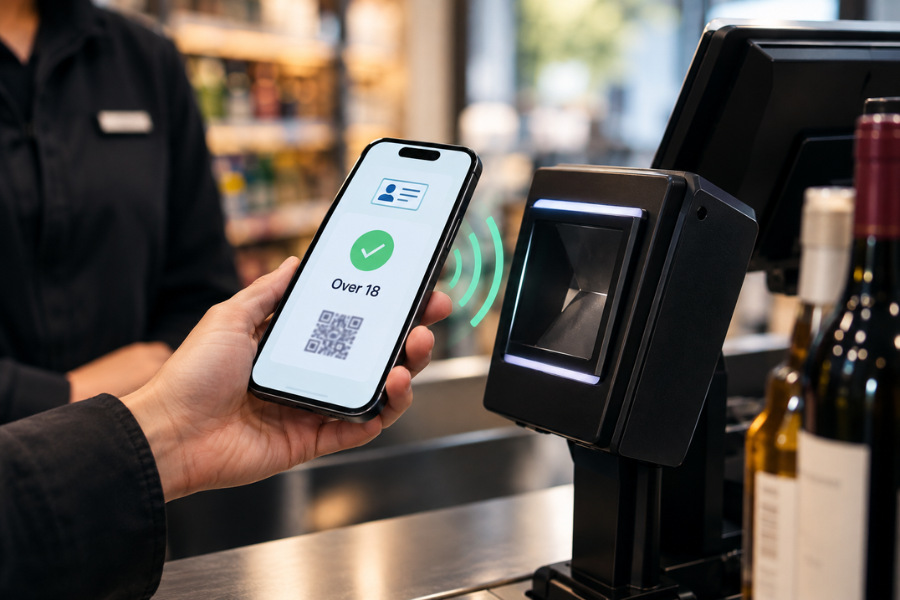
In September 2026, licensed retailers and venues across England and Wales began accepting certified phone-based proof that a shopper is over 18 without collecting name or address. The changes to the Licensing Act mark a regulatory milestone with immediate operational implications.
For the first time in a major market, a government has formally recognised digital identity as a valid method of age verification at the point of sale. The rule came into force on the same day that retail leaders from across Europe gathered in Paris for NRF 2026, placing identity squarely on the agenda of the industry’s most consequential week of the year.
How It Works
Purchasers of alcohol must complete an authentication process each time to verify the ID belongs to them. This could involve facial recognition or inputting a code via the app. A token, such as a QR code, is then generated and remains active for approximately 30 seconds to prevent fraudulent use. In certain instances, users may input a PIN for verification, with a photograph transmitted to a terminal enabling staff to compare it with the customer.
The system is expected to function offline in a similar manner to contactless payment technology. Businesses are not expected to stop accepting physical identification and there is no financial burden in continuing to accept traditional ID. Adoption is voluntary.
The design choices matter. No name, address or date of birth is transmitted to the retailer. The system confirms only the attribute required, that the holder is over 18 and nothing more. This principle, known as attribute-level verification, is what allows digital identity to be both compliant and privacy-preserving. It is also what makes it fundamentally different from simply showing a physical document, which reveals far more information than the transaction requires.
The Technology Behind It
Digital identity providers have partnered with point-of-sale and self-checkout technology providers to help retailers integrate digital age checks into existing systems. Digital age checks can be added to existing POS and self-checkout lanes, while smaller businesses can use an ID Checker app to verify digital IDs.
The government has encouraged developers to ensure their systems work together, enabling customers to maintain a single ID app on their device rather than being obliged to download several apps for use across different establishments. This interoperability requirement is significant. Without it, digital identity fragments into a patchwork of incompatible systems and the friction the technology was meant to remove is simply reintroduced in a new form.
All digital identity apps accepted under the scheme must be certified against the UK’s digital identity trust framework and appear on the statutory register. Certification is not self-declared. Providers must demonstrate compliance with standards covering security, privacy, governance and redress. This regulatory architecture distinguishes the scheme from earlier voluntary efforts, which struggled to achieve retailer confidence.
Why Trust Is Becoming a Conversion Feature
The significance of this milestone extends beyond alcohol sales. It is a signal that verification, consent and liability design are becoming conversion features rather than back-office compliance functions.
Three converging trends explain why. First, regulatory pressure is intensifying. Age assurance requirements are expanding across online and offline channels, from gambling and alcohol to tobacco, vapes and increasingly social media and adult content. Retailers that build verification capability once can reuse it across categories as regulation extends.
Second, consumer expectations are shifting. Shoppers increasingly expect the same speed and convenience at physical checkout that they experience online. Physical carding for age-restricted products is slow, inconsistent and unpopular with both staff and customers. It also carries risk: borrowed IDs, forged documents and human error all undermine the integrity of the check. Digital verification addresses each of these weaknesses simultaneously.
Third, fraud and identity risk are rising. The same infrastructure that enables trusted verification also reduces exposure to age-related enforcement action, licensing reviews and associated penalties. For multi-site retailers, the compliance risk of inconsistent ID checking is materially higher than the technology cost of doing it well.
What Comes Next
The government is looking to broaden the application of digital age verification beyond alcohol purchases in retail settings, with tobacco and vapes earmarked as the next categories. The scheme is voluntary for businesses and adoption is expected to take time.
Adoption will depend on three factors. The first is POS integration. Digital age checks only deliver operational value if they work within existing checkout flows, across self-checkout lanes, manned tills and mobile devices. Retailers will not adopt a solution that requires ripping out infrastructure. The second is staff training. Verification behaviour changes at the till and associates need to understand when to accept a digital token, how to handle exceptions and how to refuse without conflict. The third is consumer acceptance. The technology will only scale if shoppers trust it enough to use it repeatedly.
The experience of analogous rollouts suggests the adoption curve is slower than the technology readiness curve. The infrastructure is in place. The regulatory framework is live. What remains is the operational and cultural change required to make digital verification routine.
Where the Conversation Continues
The mechanics of digital identity can be described in a regulatory notice. The consequences cannot. What happens to refusal rates and queue times when verification moves to a phone. Whether shoppers trust an app more or less than they trust a human judgment call. How retailers balance compliance with the experience of a 22-year-old buying a bottle of wine on a Friday night. These questions cannot be settled by a specification or a certification register. They are resolved through debate, disagreement and the exchange of experience between the people operating the technology and the people standing at the till.
That conversation is happening in Paris this week.
An Evening That Matters
At 7:00 PM tonight, September 16, the industry gathers for an exclusive networking cocktail and a Fireside Chat with some of the most influential voices in global retail.
The discussion will address the forces reshaping the industry, from evolving consumer behaviour and the future of physical experiences to the adoption of new technologies across the value chain. Digital identity sits at the intersection of all three: it is a regulatory requirement, a consumer experience decision and a technology deployment challenge at once. It is also the kind of topic that is best understood through conversation with peers who are facing the same operational questions.
Tonight is the only evening of its kind during NRF Europe. Places are limited and requests are being handled on a first come basis.
The House of Innovation runs through tomorrow, September 17, in Hall 4 at Paris Expo Porte de Versailles. Whether you are exploring digital identity, checkout innovation, agentic payments, retail media or the infrastructure that makes trusted commerce possible, this is where the technologies defining the next era of retail are being shown, tested and discussed. The Startup Tour continues today and tomorrow, offering direct access to the founders and teams behind the solutions shaping the industry.
For full programme details, including tonight’s networking event and the final day of tours: Paris connect
Request your invitation: Registration Form

You may also like

The Identity Infrastructure Behind AI Shopping

Retail Media Follows the Decision Surface