How Computer Vision Is Transforming Seasonal In Store Displays
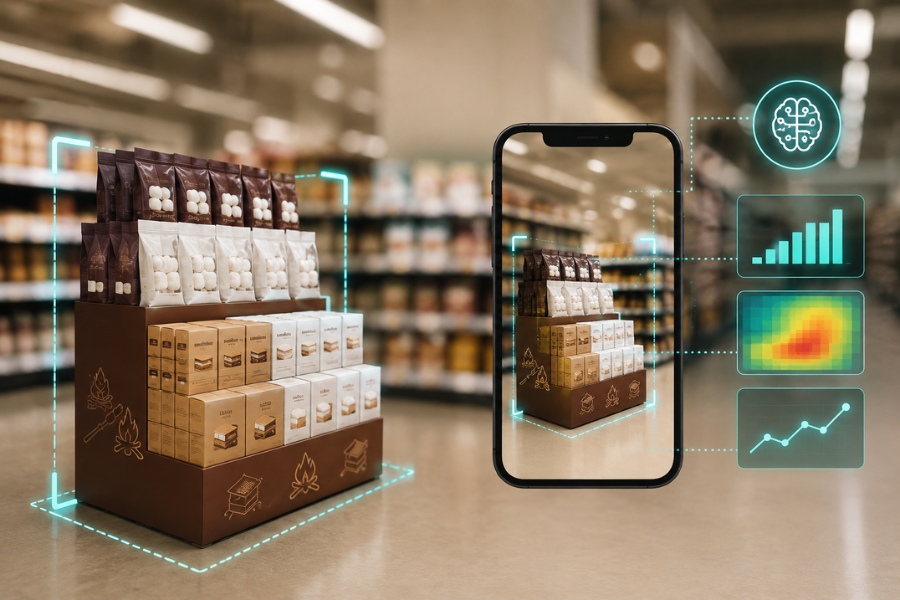
For decades, in-store merchandising has followed a familiar pattern: consumer goods companies develop seasonal promotions, design displays and deploy them across thousands of stores, hoping that the right products end up in the right locations at the right time. The process has historically been slow, reliant on manual audits and difficult to measure. In 2026, that is changing. A growing number of consumer packaged goods companies are turning to artificial intelligence, specifically computer vision and augmented reality, to identify optimal display locations, measure performance in real time and iterate faster than ever before.
The Scale of the Seasonal Opportunity
Seasonal merchandising represents a significant revenue opportunity for consumer goods companies. In the United States, the s’mores season, roughly from Easter through Labor Day, generates an estimated $200 million to $250 million in overall sales. Sales of marshmallows and graham crackers increase most around major summer holidays such as Memorial Day, Independence Day and Labor Day, with lifts as high as 300% in peak weeks.
For a company which sells chocolate products used in s’mores, these seasonal spikes represent both opportunity and complexity. Getting the right products to the right stores in the right quantities requires coordinating with thousands of retail partners, each with different layouts, traffic patterns and customer demographics. Traditional approaches to merchandising often cannot keep pace with the speed of seasonal demand.
How Computer Vision and Augmented Reality Work in Merchandising
In 2026, a leading confectionery company began using a proprietary AI tool developed in-house that combines computer vision and augmented reality to identify optimal display locations and measure performance based on consumer data. The platform has been used in several thousand stores.
The process works as follows: sales teams photograph displays in stores using mobile devices. The AI tool then uses image recognition to analyse the photos and provide insights on merchandising execution, location effectiveness and sales performance. By combining these images with point-of-sale data, the system determines where displays work best and where they underperform.
The platform also uses augmented reality to visualise digital 3D product displays in real-world retail environments. This allows merchandising teams to preview how a display will look in a specific store before it is physically installed, reducing the trial-and-error that has historically accompanied in-store merchandising.
The Performance Gap Between Display Types
The data generated by these AI tools has revealed significant performance differences between display types. During s’mores season, standalone displays featuring a company’s products alongside complementary products from other brands outperformed traditional end caps by 101%.
This finding illustrates the importance of context and placement. As one industry analyst observed: “The retailers seeing the strongest returns are those that place displays where they naturally align with shopper missions and seasonal occasions rather than simply allocating more square footage”.
The AI tool has also helped identify specific placement issues. For example, displays placed in low-traffic parts of the store or near incompatible products, such as non-organic displays in an organic aisle, negate the benefits of a larger display. Conversely, the company found that s’mores displays placed near camping products had a high level of consumer interaction.
Beyond Display Placement
The application of AI extends beyond in-store display placement into marketing optimisation. The same company deployed AI in its marketing-mix model to track real-time consumer data and adjust advertising spending faster.
The AI marketing-mix model pulls and standardises data from social media, search and streaming platforms to inform advertising decisions based on current market conditions rather than months-old data. What once took five months of manual spreadsheet work was reduced to an overnight process.
For the seasonal s’mores campaign, the company found a roughly 20% year-over-year increase in retail media return on ad spend. The company also used social media to gauge consumer preferences, running a poll asking whether people prefer their s’mores “more toasty” or “more gooey”; 70% said toasty. This real-time consumer insight informed promotional timing and product development decisions.
Broader Industry Trends
The use of AI for in-store merchandising is not limited to a single company or category. Across the retail and consumer goods industries, AI-powered assortment and space optimisation platforms are gaining traction.
In June 2026, a vertical AI company announced an AI-powered assortment and space platform for consumer packaged goods that closes the loop between assortment strategy, planogram execution and in-store compliance. The platform compresses the category review cycle from four to six weeks to a matter of days.
A key feature is the photo-to-planogram loop: a merchandiser takes a mobile photo of a shelf and computer vision identifies every SKU, facing and out-of-stock condition, routing corrective tasks to the right associate. The platform is underpinned by a demand AI model trained across 25 years of retail data and validated across more than 500 global CPG deployments.
A UK retailer achieved a 5.2% category sales uplift using the assortment optimisation capability. A global European retailer runs planogram automation across 32 countries and 32 banners.
Benefits of AI-Driven Merchandising
Speed and efficiency. Traditional category review cycles that took weeks can now be completed in days. Marketing decisions that once required months of manual spreadsheet work can now be made overnight.
Real-time data and iteration. As one executive noted: “It’s been about real-time data, it’s been about getting closer to the consumer in more real time, and it’s about partnering with our retailers on how we see the consumer behaving, so that we can iterate faster and more meaningfully with the consumer”.
Measurable performance improvements. The data allows companies to quantify the performance of different display types and locations. The 101% outperformance of pallet trains over end caps, for example, provides a clear signal for future merchandising decisions.
Closing the execution gap. Historically, there has been a lag between headquarters planning and store-level execution. AI tools that combine computer vision with point-of-sale data help close that gap, ensuring that what is planned is actually executed.
Challenges and Considerations
Data quality and integration. AI tools are only as good as the data they receive. Inconsistent photography, incomplete point-of-sale data or poor integration with retailer systems can limit effectiveness.
Retailer partnership. AI-driven merchandising requires cooperation from retail partners, who must allow photography of displays and share point-of-sale data. Not all retailers are equally willing or able to participate.
Technology adoption. While large consumer goods companies have the resources to develop proprietary AI tools, smaller brands may struggle to access similar capabilities. The emergence of third-party platforms may help address this gap.
The human element. As one industry analyst noted, “Featuring occasion-based use-cases can tap into emotional needs that unlock the value of your products beyond the pack”. AI can optimise placement, but it cannot replace the human understanding of consumer emotion and occasion.
Privacy and data use. The use of in-store photography and consumer data raises privacy considerations. Companies must ensure that data collection and use comply with applicable regulations and consumer expectations.
Looking Ahead
The use of AI in in-store merchandising is still in its early stages, but the early results are significant. Companies that have deployed computer vision and augmented reality tools have achieved measurable improvements in sales performance, faster decision-making and better alignment with consumer behaviour.
As one industry analyst observed: “This illustrates how powerful the combination of seasonality, occasion and visibility can be”. The combination of real-time data, AI-powered analysis and rapid iteration is enabling consumer goods companies to move from reactive seasonal planning to proactive, data-driven merchandising.
The companies that succeed in this new environment will be those that treat AI not as a one-time investment but as an ongoing capability, one that allows them to learn from each season, iterate faster and build deeper partnerships with retail customers.
Sources:

You may also like
Why Every Online Order May Soon Get a Made to Measure Box
AI Agents Step Into the Store Manager’s Office