AI Shopping Adoption Crosses the Halfway Mark in the U.S.
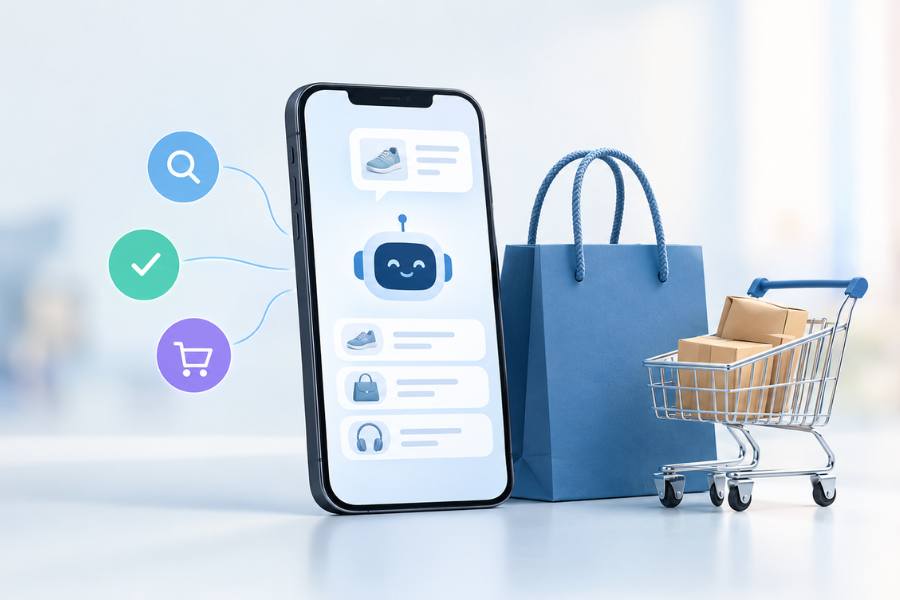
In September 2026, new research revealed that for the first time, a majority of American consumers have used artificial intelligence to assist with shopping. The finding marks a significant threshold in the evolution of retail: AI has moved from an emerging technology used by early adopters to a mainstream behaviour shaping how products are discovered, evaluated and purchased.
A Defining Milestone
The data, from a monthly tracking survey of U.S. consumers, showed that 51% reported using at least one AI-powered tool to support their shopping in the past month. This was the first time adoption had crossed the halfway mark in the survey’s tracking. Adoption had grown steadily over the preceding two quarters, signalling a shift from early-adopter behaviour to mainstream use.
An executive at the research firm described the threshold as “a defining moment for the industry,” noting that “just months ago, AI-assisted shopping was viewed as an emerging behaviour among early adopters. Today, it is now mainstream”. The executive added that with a majority of consumers now using AI to help them shop, the U.S. has reached a tipping point where AI is shaping how products are discovered, evaluated, and ultimately purchased.
How Consumers Are Using AI to Shop
The research revealed distinct patterns in how consumers are applying AI to their shopping journeys.
AI-powered product recommendations were the most widely used application, with 20% adoption. AI-powered personal shopping assistants followed at 16% adoption, reflecting growing demand for personalised guidance and decision support.
Critically, adoption spans the full path to purchase, from product discovery through final purchase decisions, rather than being concentrated at a single touchpoint. Consumers reported using AI to compare options, evaluate value and narrow choices during the shopping journey. Rather than replacing shopping, AI is “compressing decision-making”.
Generational and Demographic Differences
Adoption patterns vary significantly across demographic groups.
Younger consumers lead the way. Among those who have used AI to inform a purchase decision, 40% of Gen Z and 42% of millennials reported doing so, compared with 28% of Gen X and 13% of baby boomers. When the broader category of AI and generative AI is considered, use among Gen Z and millennial shoppers reached 74%, with a fast-rising 45% of boomers also engaging.
Parents with children at home were nearly twice as likely as those without to use AI shopping tools, at 48% compared with 25%. Millennials showed the highest levels of interest in AI-assisted shopping, with 62% expressing combined interest, followed by Gen Z at 51%.
The Trust Gap
While AI-assisted product discovery has become mainstream, a significant gap remains between using AI to shop and trusting AI to buy.
A separate survey of 1,000 U.S. adults found that just 11% had used AI at the transaction stage, completing a purchase through an AI interface. Only 3% described AI as a personal shopper they would trust to manage every stage of the journey and 10% said they would currently be comfortable giving AI full control over a particular purchase.
This gap between adoption and authorization was described as “the real story of agentic commerce today”. Consumers are increasingly comfortable with AI as an assistant, researcher and deal finder, but have not embraced AI as an autonomous buyer. The closer AI gets to their money, the more cautious they become.
Consumer resistance to autonomous purchasing is pronounced. More than half of consumers (53%) reported being uncomfortable with allowing an AI assistant to make purchases on their behalf, while only 7% said they would allow autonomous purchasing under predefined conditions. Only 14% of consumers trust AI to execute purchases without manual verification.
Persistent Privacy and Security Concerns
Privacy and security concerns remain central barriers to deeper AI adoption in shopping.
Roughly half of consumers (50%) worry about payment security, 46% about privacy and 42% about AI making the wrong purchase. More than a third of consumers (32%) remain reluctant to share personal or payment information with AI systems, and 45% said they would be more open to AI-powered commerce if they had stronger assurances around payment security.
Trust in AI to handle sensitive functions remains low. Only 18% of consumers trust AI to act in their best financial interest, just 17% trust it to keep personal and payment data secure and only 15% trust AI to handle problems when something goes wrong.
What This Means for Retail
The crossing of the 50% threshold has significant implications for how brands and retailers operate.
As AI tools take on a growing role in product discovery and decision-making, product content quality, digital discoverability and structured product information are becoming as critical to sales performance as traditional merchandising and search visibility. The path to purchase is rapidly evolving from search-driven to AI-driven and that change is happening faster than many organisations realise.
The research firm indicated it would begin measuring AI-driven commerce as a distinct channel within its retail measurement suite, reflecting the growing influence of AI on the path to purchase. This will give brands and retailers visibility into how AI tools are reshaping category performance, brand discovery and purchase conversion, insights that have historically been difficult to isolate from traditional retail and search channels.
As one executive observed, “the brands and retailers that succeed in this next era of commerce will be those that optimise not only for consumers, but also for the AI systems helping consumers navigate their choices”.
Conclusion
The crossing of the 50% adoption threshold represents a genuine milestone in the digitisation of retail. AI has moved from the periphery of the shopping experience to its centre. A majority of American consumers now routinely use AI to discover products, compare prices, evaluate options and inform purchase decisions.
Yet the data also reveals a clear boundary. Consumers have embraced AI as a shopping assistant but remain deeply hesitant to delegate the final act of purchasing. The gap between discovery and transaction, between using AI to shop and trusting AI to buy, remains wide. Privacy and security concerns, rather than technological capability, appear to be the primary constraints on deeper adoption.
The coming months and years will determine whether this gap narrows. If it does, the retail landscape will look fundamentally different from the one that existed before AI crossed the halfway mark.
Sources:

You may also like

Facial Recognition Payments Launch in the UK with 0% Merchant Fees