Stablecoin Payments Enter Physical Retail
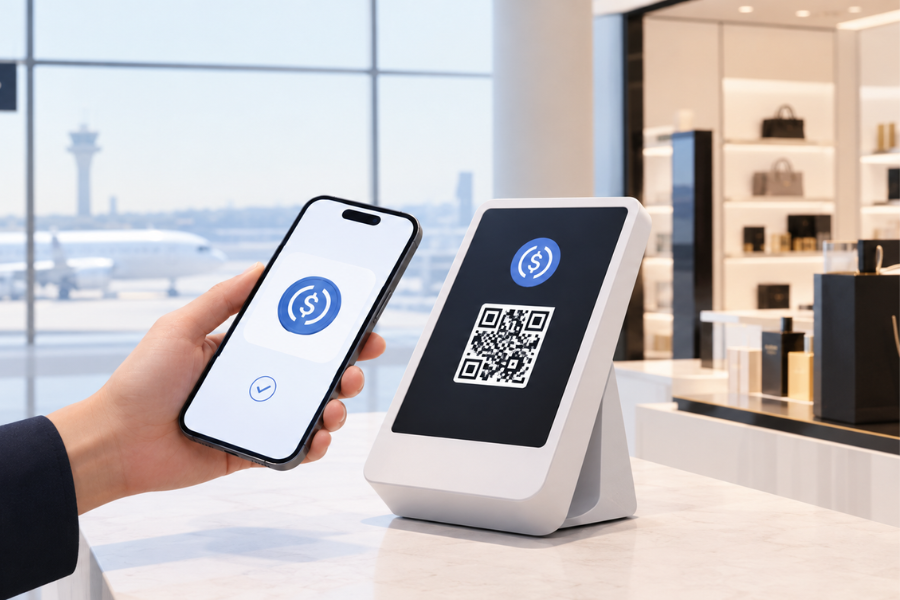
In September 2026, a global travel retail operator launched the first direct wallet-to-wallet stablecoin payment pilot at Zurich Airport, marking one of the first live deployments of blockchain-based settlement in a physical retail environment. The pilot ran from 9 to 25 September 2026 at the operator’s Duty Free store, allowing travellers to pay directly from their digital wallets through a QR-code payment process.
The Pilot in Detail
The pilot introduced a payment model in which transactions are settled directly between the customer and the merchant, without relying on traditional card networks or intermediary payment providers. Funds were transferred within seconds using blockchain technology.
The payment solution was designed and developed by the travel retailer in collaboration with a specialist in stablecoin payment infrastructure. Customers paid using USDC, a U.S. dollar-denominated stablecoin, which is available in nearly 200 countries and regions.
The retailer’s Chief Financial Officer framed the pilot as a test of a fundamentally different approach to payments: “For decades, the consumer payment experience has evolved, but the underlying principle remained largely unchanged. This pilot tests a fundamentally different approach: direct value transfer between customer and merchant. Wallet-to-wallet payments have the potential to meaningfully change the payment infrastructure and we look forward to learning from customers in a live retail environment”.
The operator described the pilot as part of a broader innovation agenda exploring how emerging technologies can enhance the traveller experience and shape the future of retail payments. It was positioned as one of the first stablecoin acceptance trials by a major global airport retail operator at a physical point of sale.
A Parallel Development
The airport pilot did not occur in isolation. In the same month, a U.S. bank and a global payments network announced that stablecoin settlement had gone live across the bank’s debit and credit card programme, bringing stablecoin settlement to the payments network following a partnership announced in March 2026.
As part of the launch, the bank migrated its entire $25 billion card programme to stablecoin settlement of transactions using a bank-issued stablecoin, described as the first stablecoin issued by a nationally chartered bank. The launch expanded how card issuers, acquirers and merchants can manage settlement and liquidity, while providing a path to broader adoption of bank-issued stablecoins in payments.
The two companies indicated they would explore additional opportunities for stablecoin settlement on the payments network, including cross-border payments, remittances and other money movement use cases. The development illustrates how bank-issued stablecoins can operate alongside existing payment infrastructure, bridging traditional financial systems and blockchain-based networks.
Earlier Retail Pilots in Convenience Stores
The airport duty-free pilot follows earlier physical retail trials in convenience store environments. In August 2026, a Japanese payments technology company completed a proof of concept for its stablecoin payment service at a convenience store in Tokyo. The pilot verified real-world point-of-sale payments using both Japanese yen-denominated and U.S. dollar-denominated stablecoins, including USDC and USDT, integrated with an existing retail POS system.
Payments across multiple stablecoins and blockchain networks were successfully processed, confirming the operational feasibility of stablecoin payments in a real convenience store environment. The company also verified payment speed, user operability, store operation impact and behaviour across multiple payment patterns, including error cases.
The ability to support widely used dollar-backed stablecoins alongside yen-denominated digital currencies highlights the potential for future payment options for international travellers visiting Japan, while representing a step toward bringing blockchain-based payments into everyday retail commerce.
Separately, a global payment acceptance company partnered with a wallet connectivity provider in January 2026 to enable stablecoin payments directly at checkout, with the integration made available to acquirers and payment service providers and first pilot rollouts beginning in the following weeks. The wallet provider also partnered with a smart business device manufacturer to bring stablecoin payments to physical point-of-sale terminals, demonstrated live at Money20/20 Bangkok in April 2026.
The Broader Context
The September 2026 pilots form part of a broader trend of stablecoin adoption decoupling from crypto trading. According to an analytics firm, stablecoin usage reached approximately 300 million unique on-chain addresses over the 12 months to August 2026, as payment companies and consumer apps pushed dollar-pegged tokens into mainstream banking across 122 countries. An executive at the analytics firm described the figure as “absurdly high,” noting that “if you told this to someone five years ago, they would look you dead in the eyes and say you’re bluffing”. The figure counts unique on-chain addresses transacting in stablecoins, not verified individuals, one person can control many wallets, but the direction is clear.
The firms moving the tokens are increasingly payment companies and consumer apps rather than crypto exchanges. One payments company paid approximately $1.1 billion for stablecoin infrastructure, a major card network moved to acquire a payments company and another card network is building settlement on the same rails that issuers run.
However, the actual volume of stablecoin payments remains a small fraction of total transaction activity. A joint report by McKinsey and Artemis found that only about 1% of the annual $35 trillion in stablecoin transaction volume represents real payments. Monthly stablecoin payment volume was only $5 billion in January 2024; by early 2026, this figure had exceeded $30 billion, a sixfold increase in less than two years, with the steepest acceleration occurring in the second half of 2025
Adjusted retail-sized volume was approximately $1.4 billion, or 0.6% of total adjusted volume, with 28.8 million retail transfers representing 67% of adjusted transaction count.
Consumer Awareness and Merchant Acceptance Remain Barriers
Despite growing infrastructure, consumer awareness of stablecoins remains low. An S&P Global Q2 2026 survey found that stablecoin awareness among U.S. consumers stood at just 16% , with primary concerns including fraud risk (48%), fund security (46%) and “no need for it” (39%). In contrast, 67% of consumers had used digital wallets in the past 90 days, with 45% using them weekly, while 68% of consumers had never encountered cryptocurrency.
Merchant acceptance at physical points of sale also remains limited. A European Central Bank report found that crypto and stablecoin acceptance at physical locations in the euro area remained below 1% in both 2024 and 2026. Nearly half of surveyed consumers cited limited merchant acceptance as a barrier.
Yet demand from stablecoin holders appears to exceed current supply. A survey of more than 4,600 stablecoin holders across 15 countries found that 52% chose a business specifically because it accepted stablecoins. Approximately 27% of holders directly used stablecoins to pay for goods and services, while 45% converted tokens to local currency before spending. 71% of stablecoin holders said they would use a linked debit card to spend stablecoins, and 42% said they wanted to use digital assets for major purchases, though only 28% currently did so.
Regulatory Frameworks Shape the Landscape
The regulatory environment for stablecoin payments is evolving, particularly in Europe. Under the Markets in Crypto-Assets Regulation, stablecoins are regulated as either Electronic Money Tokens or Asset-Referenced Tokens, with holders having a direct claim against the issuer for redemption in fiat currency and issuers required to maintain reserve assets covering the full outstanding value.
MiCA contains strict limits on the use of Asset-Referenced Tokens and non-EU currency-denominated EMTs as a means of exchange, meaning they cannot be used widely in the EU for retail payments. As of August 2026, MiCA had authorised 23 e-money token issuers, with USDC remaining the only USD stablecoin of scale among them.
The regulation currently prohibits interest paid to coinholders of EMTs and ARTs. A formal review and consultation on MiCA 2.0 was launched by the European Commission in May 2026, with responses due by 31 August 2026.
Conclusion
The September 2026 airport duty-free pilot represents a step toward testing stablecoin payments in a real retail environment. The wallet-to-wallet model, settling transactions directly between customer and merchant without traditional card networks offers a fundamentally different approach to payment infrastructure. The simultaneous launch of bank-level stablecoin settlement across a $25 billion card programme suggests that the infrastructure is maturing.
However, significant barriers remain. Consumer awareness of stablecoins stands at just 16% in the U.S., merchant acceptance in physical retail remains below 1% in the euro area and only about 1% of stablecoin transaction volume represents real payments. As one industry observer noted, stablecoins “are just about starting” and “compared to traditional payments, stablecoins do very little volume”.
Whether the airport pilot represents the beginning of a broader shift in physical retail payments or remains a niche experiment will depend on whether consumer trust, merchant acceptance and regulatory clarity can catch up to the technology’s capabilities.
Sources:

You may also like

Digital Twin Supermarkets Go Live

How Zero-Shot AI Delivers Same-Day Proof of In-Store Marketing Execution