The Physical Store Gets a Digital Brain
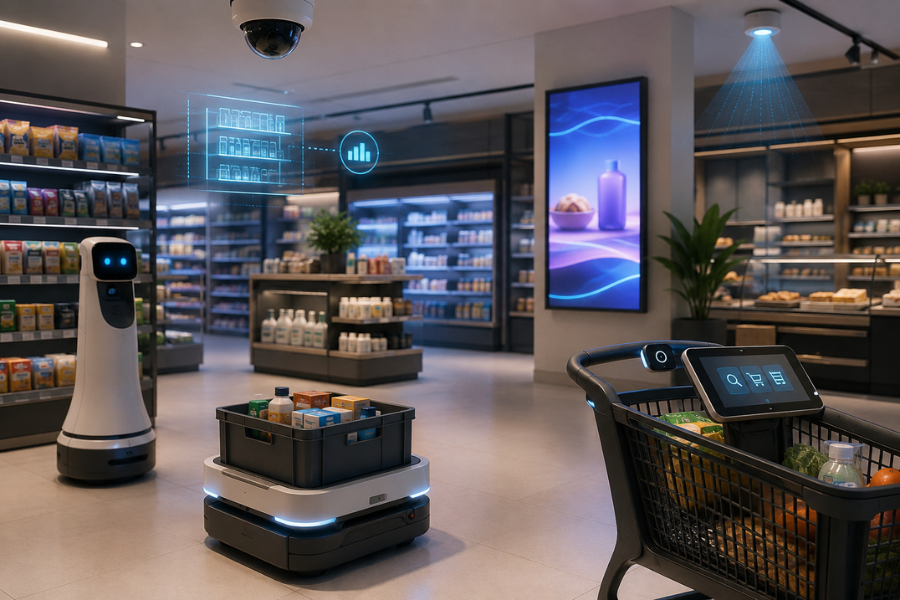
For decades, the physical store has been something of a blind spot in retail analytics. While e-commerce offered a wealth of data on customer behaviour, the brick-and-mortar environment remained largely opaque. That is changing rapidly. A new wave of technologies, robotics, computer vision, and in-store media, is transforming physical retail spaces into intelligent, data-rich environments that can compete with the digital channel.
The scale of this transformation is striking. The global retail robotics market was valued at approximately $34 billion in 2025 and is projected to reach nearly $47 billion in 2026, representing a compound annual growth rate of 37 percent. By 2030, the market is expected to exceed $163 billion. The computer vision for retail market is following a similar trajectory, growing from $4.23 billion in 2025 to $5.24 billion in 2026 at a CAGR of 23.8 percent, with forecasts reaching $12.19 billion by 2030. These numbers reflect a fundamental shift in how retailers approach their physical operations.
The transformation is also evident in adoption trends. A report from IHL Group and Brain Corp found that retailers self-reported an average inventory accuracy of just 58 percent, with only 22 percent achieving 80 percent or higher accuracy in any single category. Retailers that exceed 70 percent compliance have 18 percent higher brand trust ratings and are twice as likely to achieve brand trust ratings over 75 percent. With 41 percent of retailers wanting inventory checks weekly, 35 percent preferring multiple checks per week, and 13 percent wanting daily checks, manual processes simply cannot meet current accuracy demands, let alone future expectations. As the report concludes, “Inventory accuracy is the bedrock of retail success. It has been eroding for the last five years. AI robotics and other solutions offer a great opportunity to turn this around.”
Robotics Moves from Pilot to Infrastructure
Robotics in retail is no longer a futuristic concept. It is becoming a critical part of operational infrastructure. In warehouses and distribution centers, autonomous mobile robots are streamlining fulfilment, retrieving goods from storage and bringing them to pick stations with remarkable efficiency. The impact is measurable. A study of a Malaysian retail pharmacy chain found that AMR integration increased picking accuracy from 94 percent to 99.95 percent, with a 50 percent reduction in peak manpower requirements. The same study reported a 30.7 percent increase in inventory value stored within the same footprint and improved throughput during campaigns, reaching up to 22,000 order lines daily.
Broader industry data reinforces these findings. Companies deploying advanced robotics systems have achieved an average 58 percent reduction in fulfilment costs while improving order accuracy to 99.7 percent. Major robotics providers report significant performance improvements: one company’s autonomous mobile robots processed over 1.2 billion order picks globally in 2025, representing a 340 percent increase from the previous year. Other metrics from recent deployments include a 73 percent increase in daily order processing capacity, an 89 percent decrease in picking errors, and a 42 percent reduction in order-to-ship cycle time. Collaborative robot settings can reduce the time required for picking tasks by as much as 33.57 percent. The return on investment typically materialises within 18 to 24 months.
The application of robotics is also extending to the store floor. Service robots are being deployed to greet customers, guide them to products, and assist with inventory management. According to industry data, global shopping guide robot shipments reached 82,000 units in 2025, representing 47.3 percent growth year over year. Yet there remains significant room for adoption: 72 percent of retailers say they would accept in-store robots, but only 17 percent use them today. As one industry observer noted, retailers are shifting from isolated automation assets toward connected robotic ecosystems that integrate with warehouse management systems, point-of-sale data, and computer vision platforms.
A notable shift is occurring in how robotics is being presented and adopted. As Forbes reported from NRF 2026, “Robotics is becoming more task-oriented, more predictable and more aligned to specific operational needs rather than just being new and exciting.” The focus is on work-like robotics that solve concrete problems rather than human-like robots that simply attract attention. Robots that focus on repeatable tasks, such as inventory scanning, basic food preparation, and automated pickup, are more valuable than machines trying to replicate human behavior. With labor remaining retail’s largest cost, the goal is not replacing people but ensuring staff are used where they add the most value: customer-facing engagement, selling and brand experience. Machines handle the friction; people handle the connection.
Giving Stores Eyes
Computer vision is another technology that is rapidly reshaping the in-store experience. By using cameras and AI to analyze shelf conditions, retailers can now monitor inventory levels in real time, identify gaps or misplaced items, and trigger restocking alerts automatically. This capability ensures that shelves are always full and products are always where they should be, reducing lost sales and improving customer satisfaction. The technology is already delivering tangible results. A pilot with Village Supermarkets using computer vision to monitor above-shelf inventory uncovered $24,000 in previously unaccounted inventory in the first month, achieved a 75 percent reduction in weekly audit labor, from four hours to just one hour, and delivered a 1 percent on-shelf availability improvement on top of an existing baseline of 97 percent, where marginal gains at that level translate to hundreds of thousands in incremental annual sales.
The potential of computer vision extends beyond inventory management. British retailer Iceland implemented an AI-powered loss prevention platform using computer vision across its store estate, slashing losses from theft and shrink by 80 percent. The SAI One platform analyses live video feeds across checkouts, aisles, and store entrances, detecting incidents including missed scans, partial payments, walkouts, concealment, and in-store consumption. Alerts are sent to colleagues’ handheld terminals within eight seconds of suspicious activity being confirmed. The number of false alerts has fallen by almost 50 percent, helping drive a 90 percent staff response rate to crime alerts. The technology has freed up staff to spend more time on shopfloor operations and serving customers. Iceland’s head of loss prevention noted: “The platform is not just helping us reduce shrink and making Iceland one of the hardest places to steal from on the High Street, it’s also helping colleagues on the shopfloor from a productivity perspective.”
Beyond inventory and loss prevention, computer vision is enabling a new level of personalisation within the store. Smart shopping carts equipped with cameras and AI can recognise items as they are placed in the basket, providing real-time recommendations, personalised offers, and even a seamless checkout experience. The store itself becomes an adaptive environment that can interpret shopper behaviour and respond in real time. Retailers are digitising their physical spaces with sensors, robotics, and AI to generate the same level of analytics that has long been available for e-commerce. At NRF 2026, the message was clear: camera and sensor technology is getting good enough to deploy, and automated retail no longer feels experimental. The industry is moving beyond experimentation and concentrating on solutions that improve store performance.
The New Frontier
As retailers digitise their stores, they are also unlocking a new revenue stream: in-store media. Retail media networks, which allow brands to advertise to shoppers within the retail environment, are expanding rapidly. The global retail media networks market was valued at approximately $24 billion in 2025 and is projected to reach $26.23 billion in 2026, with forecasts of $37.76 billion by 2030. WARC Media forecasts that global investment in retail media networks will hit $174.9 billion in 2025, rising to $196.7 billion in 2026, representing nearly 16 percent of total ad spend.
Digital screens at checkout, on endcaps, and throughout the store are becoming common, delivering dynamic, AI-tailored messages to shoppers based on real-time traffic and behavior. This represents a significant shift in how retailers view their physical space. In-store media is emerging as a major channel, offering high-impact placements that cannot be intercepted by ad blockers or AI agents. For retailers, it is a way to monetise their physical space and create a more engaging shopping experience. For brands, it offers a direct line to consumers at the critical moment of purchase.
The growth trajectory is compelling. In the United States, in-store digital retail media ad spending is projected to more than double from $430 million in 2025 to $1 billion by 2029. Year-over-year growth rates for in-store media spend are expected to reach 29.9 percent in 2025, 35.1 percent in 2026, and 38.9 percent in 2027, with total revenue increasing 2.5 times between 2025 and 2029. Yet the channel remains significantly underutilised: in-store currently represents less than 1 percent of the global retail media market, estimated at $184 billion, despite its potential being described as “drastically underexploited”.
Experiencing the Intelligent Store
The convergence of robotics, computer vision and in-store media is creating a new kind of retail environment, one that is intelligent, responsive and data-driven. These technologies are not just about efficiency; they are about creating a shopping experience that is more convenient, personalised, and engaging for the consumer. As NRF 2026 demonstrated, the industry has moved from “look what AI could do” to “here’s what AI is doing in the field”. For retail leaders dealing with labor shortages, margin pressure and rising customer expectations, that shift from looking ahead to here and now is exactly what the industry needs.
For those eager to see these innovations in person, the House of Innovation Pavilion at NRF 2026: Retail’s Big Show Europe at Paris Expo Porte de Versailles from September 15 to 17 is a dedicated space where emerging technologies in robotics and advanced retail tech are being showcased. It offers a glimpse into how the physical store is being reimagined and provides a platform for retailers to explore the solutions that will define the next era of commerce.

You may also like
The New Intelligence Behind Retail

The House of Innovation Arrives at NRF 2026 Paris