How Vision AI Is Eliminating the Self Checkout Bottleneck

For millions of shoppers, the self-checkout experience follows a familiar pattern: scan items, pay and leave. But for anyone purchasing alcohol, tobacco or age-restricted medication, the process is frequently interrupted by a flashing red light and a wait for an employee to manually verify age. This bottleneck has long been one of the biggest sources of friction in self-checkout.
In July 2026, a new generation of technology began addressing this problem. Vision AI-powered age verification is being deployed at self-checkout terminals, enabling automated age checks that take seconds rather than minutes. The technology represents a significant shift in how retailers handle age-restricted sales, one that promises to reduce wait times, optimise labour and improve compliance.
The Scale of the Problem
Age verification at self-checkout is not a minor operational issue. Industry estimates suggest there are approximately 9 billion age-restricted self-checkout transactions globally each year that currently require manual intervention by store staff. Each of these transactions represents a potential point of friction, a moment where the seamless self-checkout experience breaks down and customers must wait for assistance.
For retailers, the challenge is compounded by the growing scale of self-checkout deployment. As more stores install self-checkout lanes and as customers increasingly prefer them, the volume of age-restricted transactions requiring verification continues to rise. One industry observer noted that “age-restricted sales remain a persistent bottleneck and one that only intensifies as self-checkout fleets scale”.
Traditional approaches to age verification have relied on two options: manual checks by store associates or investments in proprietary hardware. Neither option scales efficiently, with manual checks creating bottlenecks during peak hours and hardware solutions adding significant cost and maintenance burdens.
How Vision AI Age Verification Works
The core technology behind automated age verification is vision AI, artificial intelligence systems capable of estimating a person’s age from a facial image. When a customer scans an age-restricted item at a self-checkout kiosk, the system prompts them to verify their age.
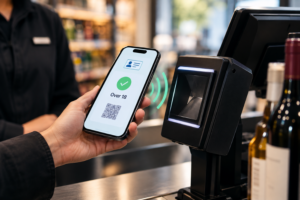
In the July 2026 solution, a QR code appears on the kiosk screen. The customer scans this code with their smartphone, which opens a secure verification page in their mobile browser with no app download required. The customer then takes a quick selfie and the on-device vision AI estimates their age.
The entire process is designed to be fast. The AI estimates the user’s age in under 10 seconds. If the estimate is above the retailer’s preset threshold, the transaction continues automatically. If the estimate falls below the threshold, the system prompts the customer to scan a government-issued ID, which is then cross-referenced with the selfie to prevent fraud.
Significantly, the system is designed with privacy as a core principle. All processing happens entirely on the customer’s device, no biometric or ID data is transmitted or stored by the technology provider or the retailer. This approach ensures compliance with key data protection standards including GDPR, CCPA and ISO/IEC 27566-1.
The German Experience
The July 2026 announcement builds on earlier deployments that have demonstrated the viability of AI age verification in real retail environments. In April 2024, a German supermarket group introduced AI-powered age verification at self-checkout in a 24/7 store at Stuttgart Airport.
The implementation was straightforward: when a restricted item was scanned, the self-checkout kiosk asked the shopper if they wanted automatic age recognition. If they accepted, a camera estimated their age and compared it to a preset threshold, allowing the transaction to continue when the estimate was above that threshold.
The results were significant. The retailer reported that the deployment reduced the need for human intervention by 75 percent and shortened the average age verification time from approximately two minutes to under 10 seconds.
By the end of 2024, there were already three locations with AI-supported age verification. As of early 2026, the implementation continues to expand, with additional sites in multiple German cities.
The Efficiency Gains
The operational benefits of automated age verification are measurable across several dimensions.
Speed. The verification process is up to six times faster for the customer compared to manual checks. What previously took up to two minutes can now be completed in seconds.
Automation. The technology resolves 80 per cent of age checks automatically without any need for associate intervention. Only the remaining 20 per cent of cases where the AI estimate falls below the threshold or where fraud is suspected require additional verification.
Transaction volume. The streamlined checks can result in a 5 per cent increase in transactions across a retailer’s self-checkout fleet, as shorter queues and reduced bottlenecks enable more customers to complete their purchases during peak hours.
Labour optimisation. By automating routine age checks, store associates are freed from repetitive verification tasks and uncomfortable situations, allowing them to focus on higher-value customer service and operational tasks.
Fraud prevention. The photo-comparison technology can detect cases where underage customers attempt to use someone else’s identification, a form of fraud that card-reader solutions cannot catch and that busy associates may miss.
Broader Industry Adoption
Across the retail industry, AI-powered age verification is gaining traction in multiple formats.
In Germany, as of early 2026, the technology is an active, expanding implementation with additional supermarket sites. A retail technology provider showcased AI-powered self-checkout solutions at EuroShop 2026, featuring age verification as one of the core capabilities.
In the convenience and kiosk sector, a major tobacco company rolled out an age-gating pilot in 2025 across 240 kiosks in Croatia, using a selfie-based system to prevent underage purchases of nicotine products. The pilot has since expanded to additional countries, with approximately 400 modernised kiosks now featuring the technology in Bosnia and Herzegovina.
In the United States, identity-based payment solutions integrating face, palm and voice biometrics were demonstrated at the NRF in January 2026, enabling age-restricted commerce without IDs, manual checks or staff intervention. These solutions are being rolled out across quick-service restaurants, sports venues, and retailers throughout 2026.
The Market Context
The emergence of AI age verification comes at a time of rapid growth in self-checkout adoption. Industry data shows that 96 per cent of grocery stores already offer self-service options and the self-checkout market is projected to reach $7.6 billion by 2030.
As self-checkout fleets scale, the challenge of age verification becomes more acute. Retailers are under pressure to deliver faster, more convenient experiences while maintaining compliance with age-restricted sales regulations. The technology addresses this tension by automating compliance in a way that is fast, secure and cost-effective.
Challenges and Limitations
Despite the promise of AI age verification, the technology is not without challenges that warrant consideration.
Accuracy and bias. AI age estimation systems are not infallible. They may produce inaccurate estimates for certain demographic groups and there are documented concerns about demographic bias in facial recognition technologies. The accuracy of age estimation depends on the quality of the training data and the algorithm’s performance across different ages, ethnicities and lighting conditions.
Privacy concerns. While a solution is designed with on-device processing and no data storage, customers may still have concerns about facial scanning in retail environments. The use of biometric data, even for age estimation, raises questions about consent, data security and the potential for function creep.
Customer acceptance. Not all customers will be comfortable taking a selfie to verify their age. Some may prefer the traditional method of showing ID to a store associate. Retailers must consider whether automated verification should be optional or mandatory and how to accommodate customers who decline.
Technology dependence. The system relies on smartphones, QR codes and network connectivity. Customers without smartphones or with connectivity issues may not be able to use the automated verification, requiring alternative approaches.
Fraud circumvention. While photo-comparison technology can detect some forms of ID fraud, determined individuals may find ways to circumvent the system. The technology is a deterrent, not a complete solution to underage purchasing.
Regulatory compliance. Different jurisdictions have different age verification requirements. The technology must be configurable to meet varying legal standards and retailers must ensure that automated verification satisfies regulatory obligations in each market where it is deployed.
Looking Ahead
The July 2026 introduction of vision AI-powered age verification represents a significant step in the evolution of self-checkout technology. For retailers, it offers a path to resolving one of the persistent friction points in the self-checkout experience while improving compliance and optimising labour.
For customers, it promises faster, more autonomous shopping, a transaction that completes in seconds rather than minutes, without waiting for assistance. As one industry observer noted, the technology addresses the fundamental tension retailers face: “Today, retailers are forced to choose between absorbing the ongoing labour cost of manual checks or investing in proprietary hardware, neither of which scales efficiently”.
Whether AI age verification will achieve widespread adoption depends on several factors: continued improvements in accuracy and bias mitigation, customer acceptance of facial scanning in retail and the ability of regulators to provide clear guidance on the use of such technology.
What is clear is that the technology is moving from pilot to deployment. The German supermarket experience demonstrates that automated age verification can deliver significant operational improvements, 75 per cent less human intervention and verification times reduced from two minutes to under 10 seconds. The July 2026 announcement suggests that the technology is now being positioned for broader retail adoption.
As self-checkout continues its expansion across grocery, convenience and other retail formats, the ability to automate age verification efficiently and securely is likely to become an increasingly important capability for retailers serving customers who purchase age-restricted products.
Sources:

You may also like
Digital Identity Goes Live at the Checkout
The Identity Infrastructure Behind AI Shopping