The $200 billion divergence defining the future of retail
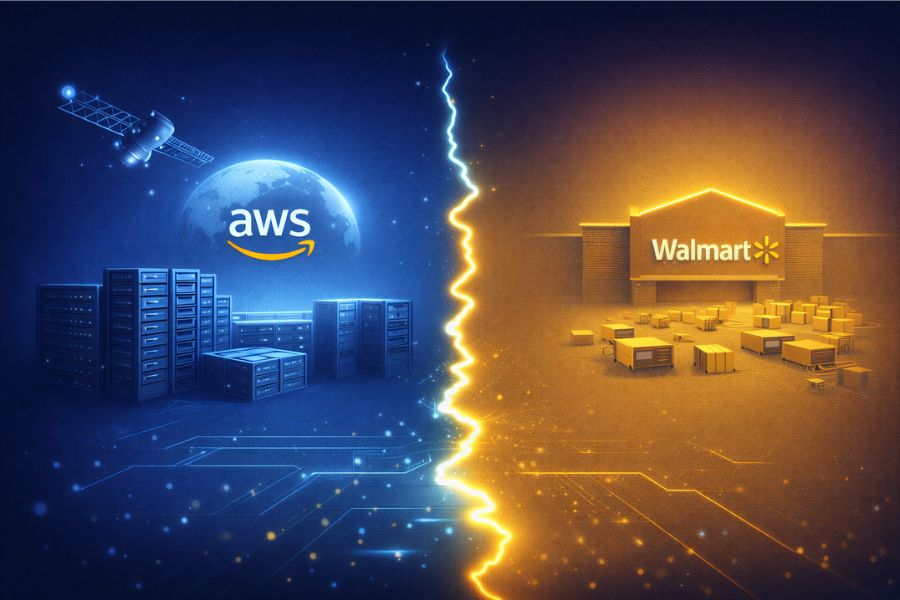
The global retail landscape has reached a definitive crossroads. While the surface-level rivalry between Amazon and Walmart remains a battle for market share, their underlying financial strategies have diverged into two radically different “profit architectures.” As of April 2026, the industry is witnessing what analysts call the “$200 Billion Divergence”, a fundamental split in how the world’s two largest retailers are betting on the future of commerce.
Silicon vs. Shelf-Space
The most striking evidence of this split lies in the 2026 Capital Expenditure forecasts. Amazon has committed to a historic $200 billion investment for the 2026 fiscal year, marking the largest single-year spend by any corporation to date. However, this capital is not being directed toward traditional retail expansion. Instead, it is fueling the backbone of the “Utility Economy”: AWS data centers, the Project Kuiper satellite network, and the production of proprietary Trainium3 AI chips. Amazon is effectively transforming into an infrastructure utility that happens to sell consumer goods.
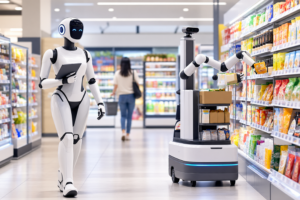
In contrast, Walmart has maintained a disciplined CapEx of $25 billion, which represents approximately 3.5% of its net sales. Their focus is tactical and localized. Rather than building the internet’s infrastructure, Walmart is digitizing the physical world. Their investment is concentrated on automating 65% of their existing store footprint to serve as high-velocity, automated fulfillment hubs, ensuring that the “physical-digital loop” is perfected.
Proximity vs. Ambient Commerce
The NRF 2026 Top 50 Global Retailers report confirms that Walmart remains the world’s largest retailer by retail-specific revenue, protected by a “Proximity Moat.” With more than 4,600 locations in the U.S. alone, Walmart now reaches 95% of households with delivery in under three hours. In this model, the store is the warehouse. By using AI-driven orchestration to pick orders from shelves alongside foot traffic, Walmart has successfully reduced e-commerce delivery costs by 15% year-over-year.
Amazon’s strategy has pivoted toward “Ambient Commerce.” Following the strategic withdrawal of “Just Walk Out” technology in large-format grocery stores, Amazon is doubling down on massive, high-automation logistics hubs and embedding shopping directly into its AI agents. The goal is to make the transaction disappear into the background of a consumer’s digital life, where an AI agent manages replenishment through Amazon’s infrastructure without the user ever visiting a “store.”
The Margin Engine
The diverging architectures are also reflected in how these giants generate profit. For Walmart, 2026 marks the year that its advertising arm, Walmart Connect and membership fees have become the primary drivers of operating income. By leveraging its physical footprint to sell high-margin digital ads, Walmart is subsidizing the thin margins of its massive grocery business.
Amazon continues to rely on AWS to provide the oxygen for its retail experiments. However, the $200 billion CapEx bet has placed a temporary strain on free cash flow, which has compressed to $11.2 billion as the company builds out its AI dominance. While Amazon’s consolidated revenue for 2026 is forecast to reach $716.9 billion, a significant portion of that is driven by non-retail services. Walmart’s forecast of $713.2 billion, meanwhile, remains almost entirely tethered to its retail and marketplace operations.
The Strategic Takeaway
The divergence of 2026 proves that scale alone is no longer a differentiator. Walmart is winning on execution and physical proximity, while Amazon is betting on computational and AI dominance. For the broader retail sector, the lesson is clear: long-term survival now requires a choice. Retailers must either become a specialized Hub that masters the physical-digital loop or integrate into a Utility that provides the invisible infrastructure of the modern economy.
Sources:

You may also like

Pay Later Moves From the Shopping Basket to the Shop Counter
Pavement Robots Move From Pilot Projects to Grocery Delivery