How Humanoid Robots Are Becoming Sales Assistants in Chinese Retail
In late September 2026, a pilot deployment of 100 humanoid robots as sales assistants across 100 offline kitchenware stores in China produced a measurable commercial result: average sales across the participating stores rose by 39% compared with the same period a year earlier, with cumulative sales reaching approximately 2.23 million yuan (about $310,000) during a three-day trial period. The pilot, which began on 28 September 2026, represents one of the largest commercial deployments of humanoid robots in a retail sales role to date.
The Deployment
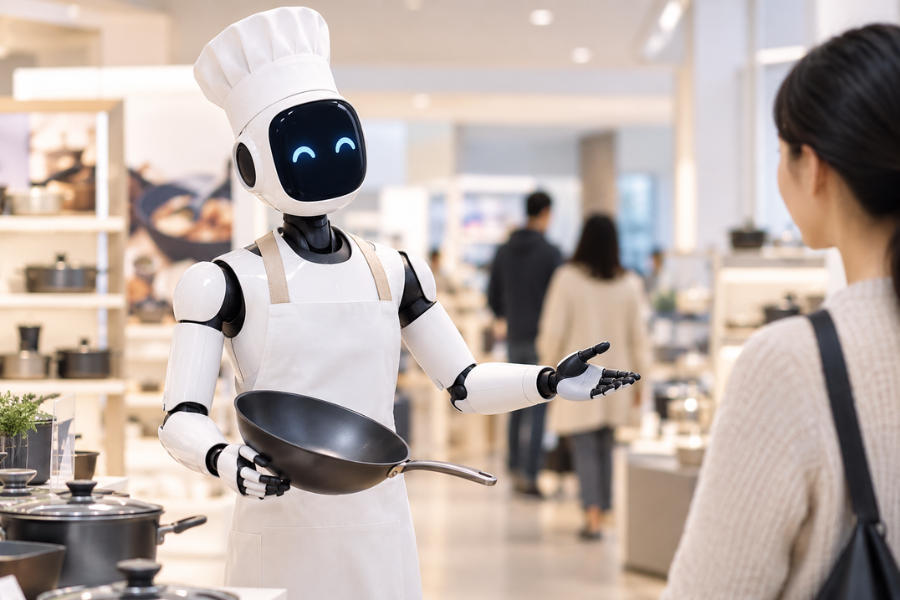
The robots, approximately 1.3 metres tall, wearing white chef hats and aprons, were placed in kitchenware stores across China, working 10 hours per day as sales assistants. The robots were developed by a Chinese embodied AI company and deployed in partnership with a national cookware brand. During the three-day pilot period, the robots were tasked with the full chain of retail service tasks: greeting customers, understanding needs, explaining products, recommending items, guiding customers to product areas and handing off complex inquiries to human staff.
What the Robots Actually Did
Reporting from the trial provides detailed insight into the robots’ capabilities and limitations.
Needs assessment. When a customer mentioned that her old pot was worn out and she wanted a replacement, the robot did not immediately recommend a product. Instead, it asked follow-up questions: “How many people are in your family?” and “Do you mainly cook stir-fries or stews?”. After learning that the customer had a family of three, preferred stir-frying, and used a gas stove, the robot recommended a specific titanium wok and guided her to the corresponding product area, explaining that the pan had no coating, conducted heat evenly and was suitable for high-heat cooking.
Product knowledge. When a store chef preparing a dish asked how much oil to use for a specific recipe, the robot answered based on the type of cookware being used and explained the non-stick mechanism of titanium pans.
Interaction and engagement. The robots demonstrated social capabilities beyond pure sales functions. They made finger hearts when asked, waved at customers taking photos and engaged in playful exchanges with staff. When a chef joked, “Is my dish this tasty because of the pot, or because I’m good-looking?” the robot praised the pot’s performance and then quipped, “Chef, you are even more amazing”.
Limitations. When a customer asked about store discounts, the robot pointed to a screen on its face and prompted the customer to scan a QR code for information. When asked how to complete payment, the robot transferred the customer to a human sales associate rather than handling the transaction itself.
Human-Robot Collaboration
The pilot was structured around a division of labour between robots and human staff rather than full automation. The robots handled the “energy-consuming and repetitive” tasks: greeting customers, answering basic questions, demonstrating products and generating foot traffic. Human sales associates were freed from memorising product parameters to focus on deeper communication, addressing customer concerns, calculating discounts and closing sales.
One employee working alongside the robots noted that “most customers deliberately come to see the robot assistants”. A customer who had purchased a pot recommended by the robot returned to thank it personally.
Technical Challenges in a Retail Environment
The company’s vice president of product line for the robot model explained that retail stores present significantly greater testing difficulty than laboratories or factories. “Robots in laboratories or factories perform predetermined tasks in controlled environments, but in stores, where both customers and products are constantly changing, the difficulty of testing is much higher”.
Two specific challenges were highlighted:
Speech recognition. In supermarket and store environments, music and human voices are interwoven, with multiple customers potentially speaking simultaneously. The team upgraded microphone hardware and collected environmental noise data from different stores to train algorithms to identify customer intent from complex background noise.
Navigation. Using a generative cerebellum engine framework, the robots were able to navigate safely through narrow aisles amid customer traffic, perceive their environment in real time and avoid obstacles autonomously.
The vice president also noted that the greater challenge was whether the robot could understand customer needs. “Currently, the robot’s capabilities are on par with a newly hired sales assistant, not yet at the level of a gold-medal salesperson,” the vice president said. “Different retail formats have their own product knowledge, service processes and communication styles. Robots need targeted scenario training before they start work”.
Industry Context
The deployment reflects a broader trend of embodied AI moving from exhibition demonstrations into commercial retail operations. The robot developer described the pilot as the first large-scale commercial test of humanoid robots in Chinese retail, running through the full chain of retail tasks from greeting to handoff for transaction completion.
The results come amid broader growth in China’s embodied AI robot market. During the 2026 Mid-Autumn Festival holiday, sales of embodied AI robots on key platforms increased by 93.1% year-on-year. The robot developer had previously delivered over 5,100 humanoid robots in 2025, capturing a 39% share of global humanoid robot shipments.
What the 39% Figure Does and Does Not Show
Several important caveats apply to interpreting the 39% sales increase.
The pilot coincided with a major holiday period. The trial ran from 28 September, immediately preceding China’s National Day holiday, a peak consumption period when retail foot traffic and sales naturally rise. As one analysis noted, “the 39% growth figure needs to be interpreted within the context of the National Day consumption peak, holiday foot traffic itself brings sales increases”.
The measurement period was only three days. A three-day trial provides a limited basis for assessing sustained performance. The robots’ novelty factor, customers deliberately visiting to see them, may have contributed to the initial traffic and sales lift in ways that would not persist over longer periods.
The robots did not complete sales independently. Payment and complex discount inquiries were handled by human staff. The robots generated traffic and handled initial engagement; the final transaction was completed by humans.
The figure is company-reported. The 39% increase and 2.23 million yuan cumulative sales figure come from the deploying company. No independent verification of the sales data has been published.
Conclusion
The deployment of 100 humanoid robots as sales assistants across 100 kitchenware stores provides a concrete data point on the commercial potential of embodied AI in retail. The 39% average sales increase, achieved over three days during a peak holiday period, demonstrates that robots can generate customer engagement and contribute to retail outcomes when deployed in a structured human-robot collaboration model.
The pilot also reveals the current boundaries of the technology. The robots handled greeting, needs assessment, product explanation and initial recommendation, but deferred to humans for complex policy questions and payment. The company itself characterised the robots’ capability level as equivalent to a newly hired sales assistant, not an experienced one.
Whether the results can be replicated outside a holiday period, sustained over longer deployments and scaled across different retail categories remains to be tested. The developer indicated it would conduct a review of the robots’ actual performance and sales data before further evaluation.
Sources: