Digital Twin Supermarkets Go Live
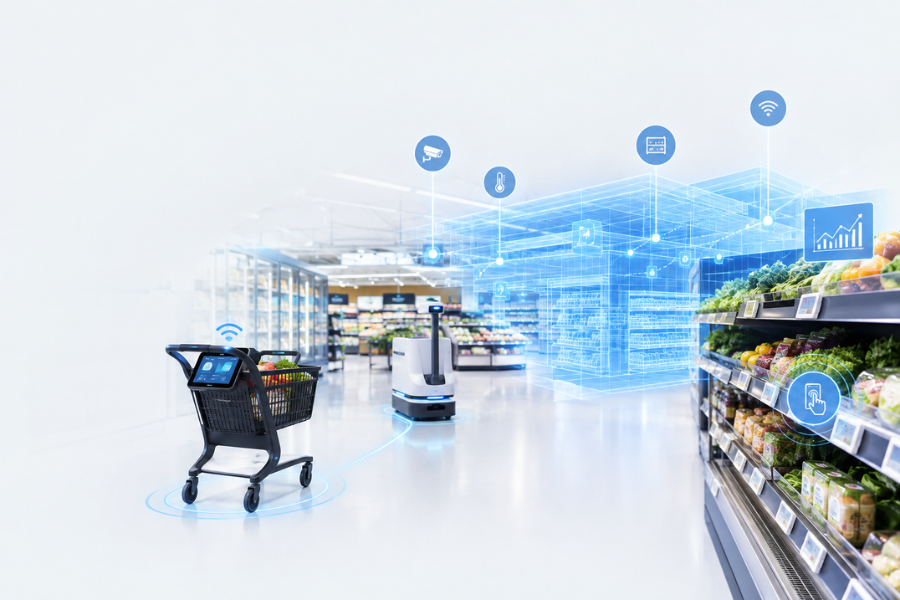
In September 2026, a Chinese omnichannel retailer opened its first Store Digital Twin-enabled supermarket in Shenzhen, deploying more than 17,000 IoT devices across the trading floor. The project, developed in collaboration with a digital store solutions provider and the retailer’s own technology subsidiary, marks the retailer’s first operational store digital twin implementation, bringing together real-time store visibility, decision support and operational execution within a live retail environment.
The store, located in Shenzhen’s Nanshan District, has served the local community for nearly 17 years. In 2026, the wider development was upgraded into an urban lifestyle destination bringing together retail, dining, services and entertainment, reflecting the retailer’s ambition to expand the role of physical retail beyond transactions.
From Physical Store to Digital Representation
The digital twin concept involves deploying a network of connected IoT devices, including electronic shelf labels, smart shopping carts, and inspection robots that serve as the store’s sensory infrastructure. These devices continuously collect data across the trading floor, which is then processed through a digital system to create a 3D model of the store that reflects its conditions in real time.
As the retailer’s first Store Digital Twin-enabled supermarket, the store brings together more than 17,000 IoT devices and AI capabilities to provide greater visibility into store conditions and support more timely operational decisions and actions.
The Perception-Decision-Execution Loop
The digital twin architecture establishes a closed loop: sensing and data collection — AI decision analysis — task generation — employee execution — results feedback — continuous optimisation. At the heart of this system is a proprietary retail vertical AI model that functions as the store’s intelligent decision hub, supported by more than 20 enterprise agents handling tasks including product selection, replenishment, out-of-stock attribution, intelligent pricing and display auditing.
In shelf management scenarios, the system combines electronic shelf labels, location intelligence, AI vision and robotics technologies to support out-of-shelf identification, merchandising management and shelf execution. These capabilities help gain greater visibility into shelf conditions and product availability while improving execution across the sales floor.
For out-of-stock management specifically, the AI agents predict sales by synthesising factors such as weather, sales volume and inventory, automatically generating replenishment lists to ensure fast-moving goods are promptly restocked.
Customer-Facing Applications
The digital technology is integrated throughout the shopping journey rather than presented as a separate technology showcase.
Smart shopping carts equipped with an AI shopping assistant serve as a digital companion, providing shoppers with access to product information, in-store navigation, promotional offers and available checkout services. By giving shoppers greater visibility over their purchases and streamlining key shopping activities, the system aims to create a more convenient and efficient shopping experience.
At the shelf edge, electronic shelf labels support centimetre-level product positioning, serving as a key component of the digital twin infrastructure. The tap-to-interact functionality extends the labels from simple price display media into interactive service touchpoints. With a simple tap using near-field communication, shoppers can access product details, traceability information, usage guidance and promotional content. For example, tapping on organic vegetables displays the growing site, harvest date and same-day pesticide residue test results.
Operational Efficiency and Automated Replenishment
The store connects real-time shelf telemetry directly to supply forecasts, removing manual inventory counts from daily shopfloor routines. Automated cameras and robotics track out-of-stock items along the aisles, while the AI model processes visual data to adjust replenishment orders and assign tasks to store clerks.
The store also incorporates an intelligent fulfilment centre supporting more efficient home-delivery services, strengthening the connection between in-store shopping and the retailer’s broader omnichannel retail model.
For suppliers and distributors, the shift to automated replenishment leaves little room for negotiated shelf space or delayed delivery windows. If a supplier fails to restock within the algorithm’s timetable, the system flags the gap immediately.
The Data-Driven Closed Loop
The core mechanism is a continuous feedback cycle. IoT devices collect real-time data across the store. The AI model analyses this data to generate replenishment decisions and task assignments. Store employees execute these tasks and the results are fed back into the system for continuous optimisation.
The retailer’s chairman stated: “Our goal is to create a better everyday shopping experience built on quality, freshness, transparency and trust. As our first Store Digital Twin enabled store, the supermarket brings digital visibility into day-to-day operations, helping our teams respond faster and more accurately, while allowing store employees to spend more time on the service and experiences that matter to customers”.
Risk Factors and Challenges
The sensor-dense model introduces operational risks. The primary risk involves hardware maintenance across thousands of sensor endpoints, where battery depletion or sensor misalignments can distort automated ordering across an entire product category.
The model also requires significant upfront capital expenditure. Operators will be watching whether the sensor-dense model delivers measurable margin gains or simply inflates store fit-out capital expenditure ahead of planned rollouts to other locations.
Industry Context
The deployment reflects a broader trend toward digital twin technology in physical retail. The global retail digital twin solutions market was valued at approximately $981 million in 2025 and is projected to reach $1.47 billion by 2032, growing at a compound annual growth rate of 6.1%.
Academic research has also advanced the technical foundations. A paper presented at the 2026 International Conference on Control, Automation and Robotics described the development of a multi-sensor fusion infrastructure, using RFID, UWB and computer vision, to track the location and movements of products and shoppers in a retail store, building a digital twin that mirrors the contents and movements of both products and persons with very good time and space resolutions.
Another study published in 2026 proposed a digital twin framework for supermarket supply chain management using predictive analytics, reflecting growing academic interest in applying digital twin technology across the retail value chain.
Conclusion
The deployment of a digital twin supermarket with more than 17,000 IoT devices represents a significant step in the digitalisation of physical retail. By creating a live, data-driven representation of the store, the system enables real-time visibility, automated decision-making, and closed-loop execution across operations.
The model’s success will depend on whether it can deliver measurable operational improvements, reduced out-of-stocks, lower labour costs and improved customer experience, without creating unsustainable maintenance burdens or capital expenditure demands. As other retailers observe the results, the digital twin approach may become an increasingly common feature of physical retail infrastructure.
Sources:

You may also like
How Zero-Shot AI Delivers Same-Day Proof of In-Store Marketing Execution
Stablecoin Payments Enter Physical Retail