How Zero-Shot AI Delivers Same-Day Proof of In-Store Marketing Execution
For decades, the verification of in-store marketing execution has been one of retail’s most stubborn operational blind spots. Consumer packaged goods brands and retailers invest billions annually in trade spend and point-of-sale materials, freestanding displays, shelf talkers, banners and window installations, yet most organisations lack a reliable method to confirm whether those materials are actually deployed in stores, correctly placed or even present during a campaign’s most critical moments. The consequence is a persistent execution gap: promotional displays that are built in only a fraction of intended locations, discovered weeks after launch, when the opportunity for correction has already passed.
In 2026, a new generation of computer vision technology began to close that gap. The emergence of zero-shot POSM recognition allows field teams to photograph in-store marketing materials and receive same-day, structured verification of whether those materials were deployed as planned, without the need for campaign-specific training data or image samples.
The Problem of Execution Verification
The challenge of verifying in-store marketing execution is fundamentally one of scale and timeliness. A CPG brand may run seasonal activations across thousands of retail accounts. A luxury retailer may orchestrate tightly choreographed holiday window installations across flagship and regional doors in multiple countries. In both cases, headquarters designs the campaign, produces the materials, and distributes them to stores, but the final step, confirming that the materials were correctly deployed, has historically relied on manual store checks or self-reported photographs.
This approach suffers from several limitations. Manual audits are time-consuming: a field representative may spend twenty minutes in a single store documenting shelf placement, facings, out-of-stocks and display compliance, while competitor activity and full category data remain uncaptured. Across a weekly territory of forty stores, that amounts to thirteen hours spent recording incomplete data rather than correcting problems on the shelf. The reporting lag compounds the issue: data collected on Monday and Tuesday may not reach decision-makers until the following Friday, by which point a promotional display intended to drive a quarter’s performance may be found to have been built in only 40% of stores, nine days after launch.
Industry research suggests the scale of the problem is significant. Up to 60% of promotions fail due to poor execution, according to one analysis, with issues ranging from old-stock contamination to missing price labels.
What Zero-Shot Recognition Means
Zero-shot recognition refers to an AI system’s ability to identify and classify objects it has never been explicitly trained on. In the context of retail execution, this means that when a brand launches a new promotional campaign with entirely new point-of-sale materials, the recognition system can immediately identify those materials during store visits, without requiring the brand to supply training images or retrain the model for each new campaign.
This capability addresses a fundamental inefficiency in traditional image recognition deployments. Conventional computer vision models for retail execution typically require training on hundreds or thousands of images per product or material type. For a brand running multiple seasonal campaigns each year, each with distinct creative assets, the lead time required to train a model for each new campaign could consume a significant portion of the activation window. Zero-shot recognition eliminates that lead time entirely.
The technology builds on advances in vision-language models that can understand visual content in context, associating what they see with semantic descriptions rather than relying solely on pattern matching against a fixed training set.
How the System Works
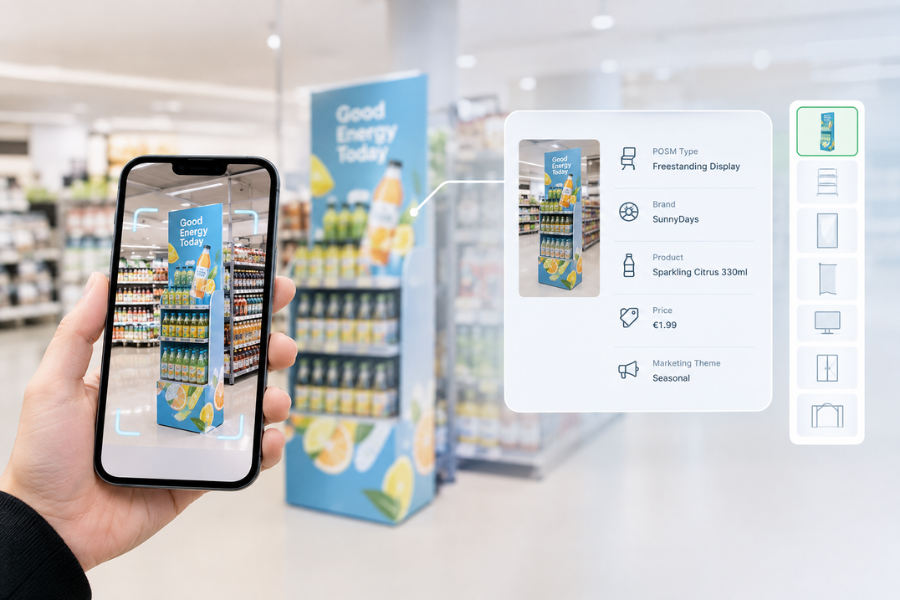
The operational workflow is designed to integrate into existing field execution processes rather than replace them. A field representative visits a store and takes a photograph of a display, shelf or window installation using a mobile application. The AI system analyses the image and returns structured data about what it detects.
The system can recognise POSM across eight distinct media types, including freestanding displays, shelf talkers, lightboxes, banners, digital screens, window installations and branded structures. It is designed to function even in cluttered, real-world store environments and can identify partially visible or damaged materials.
Beyond simply detecting presence, the system classifies each detected material by type, identifies the primary and associated brands, extracts featured product information and pricing and classifies the marketing theme, such as price/incentive, urgency, seasonal or product-focused. This transforms a single photograph into a structured record of not just whether a display was present, but what it communicated.
The capability supports multi-lingual and multi-currency operations, allowing it to be deployed across UK and European markets and internationally, without additional configuration or training. Data is delivered directly into existing field execution workflows, ensuring that field representatives, retail teams, supervisors and leaders all work from the same standardised information without changing their established processes.
Applications Across Retail Sectors
The technology is particularly relevant to sectors where in-store display compliance carries the highest business stakes.
In beer, wine and spirits, brands typically run large-scale seasonal activations across thousands of accounts, making verification at scale both critical and difficult. In quick service restaurants, limited-time offers require timely and accurate execution to capture demand. Grocery retailers use the technology to verify private label and own-brand promotional execution across their store networks. Snacks and confectionery and personal care brands often have contractually defined display compliance obligations tied to retailer agreements, obligations that must be demonstrably met.
For luxury fashion, fine jewellery, prestige beauty and premium department stores, the stakes are concentrated into the October–December holiday season, when the majority of annual revenue is generated. Flagship window installations, boutique displays and seasonal activations must be executed flawlessly and on schedule across every door. The technology allows retailers to verify that holiday campaigns are landing as intended across every market, rather than relying on self-reported photographs or delayed manual audits.
Implications for Trade Spend and ROI
A significant dimension of POSM recognition is its connection to trade spend accountability. Brands invest heavily in POSM production and retail execution, but without reliable verification data, measuring the return on that investment has been challenging.
By connecting execution data to trade spend, the technology provides proof-of-performance that organisations can use to optimise future investment decisions. It enables real-time campaign verification, faster identification of execution gaps and reduction of POSM waste by identifying materials that never reach the shelf. The data generated can support analysis of which display types, placements and creative approaches perform best, closing the loop between field execution and commercial outcomes.
Challenges and Limitations
While zero-shot POSM recognition represents a meaningful advance, several considerations warrant attention.
Accuracy benchmarks are not universally published. The capability is described as delivering zero-shot, same-day recognition, but launch materials for specific deployments have not consistently included accuracy, validation-sample or quantified ROI results. Recognition can prove execution conditions; it does not by itself prove detection accuracy or campaign ROI without independent validation.
Recognition is only one step in the execution chain. For the technology to create value, the output must reach the person who can correct a missing, damaged, or misplaced display. A useful result depends on handoffs, ownership and monitoring being designed around the recognition capability, technology alone does not close the execution loop.
Sources:

You may also like

Digital Twin Supermarkets Go Live
Stablecoin Payments Enter Physical Retail