Why Edge AI Is Becoming the Foundation of Intelligent Retail
For years, the conversation around artificial intelligence in retail has centred on what AI can do: smarter recommendations, personalised marketing, dynamic pricing. In 2026, the conversation has shifted to a more fundamental question: where does the intelligence actually live?
The answer, increasingly, is at the edge. Edge AI, the practice of processing data and running AI models locally on devices within the store rather than in distant cloud data centres, has become the critical infrastructure layer that enables intelligent stores to operate at scale. Without it, the sub-second responsiveness that modern retail applications demand is simply not possible.
The Latency Problem That Cloud Alone Cannot Solve
Retail-centric AI applications have a requirement that many other industries do not: they must respond in real time, often in fractions of a second. A customer at a self-checkout terminal cannot wait for a video stream to travel to the cloud, be processed and return with a result. A store associate checking inventory needs an answer immediately, not after a round trip to a remote data centre.
This is the fundamental limitation of cloud-only architectures for in-store AI. The network and processing latency between in-store data sources and the nearest cloud footprint becomes prohibitive for customer-facing interactive features. The bandwidth load from a store with high-resolution cameras, continuous RFID scans and beacon-based mobile location analytics can be substantial. Moving raw data from all these sources to the cloud instead of acting on it locally becomes expensive and inefficient.
Perhaps most critically, with more in-store digital services becoming integral to fundamental customer expectations, any downtime becomes a critical challenge. Relying on complex upstream infrastructure for basic services like self-checkout is simply not viable, stores cannot slow down just because the internet slows down.
As one industry analysis put it: “Modern retailers need instant and robust decisions and transactions in the store, something cloud-only solutions cannot provide”.
What Edge AI Means for Retail Stores
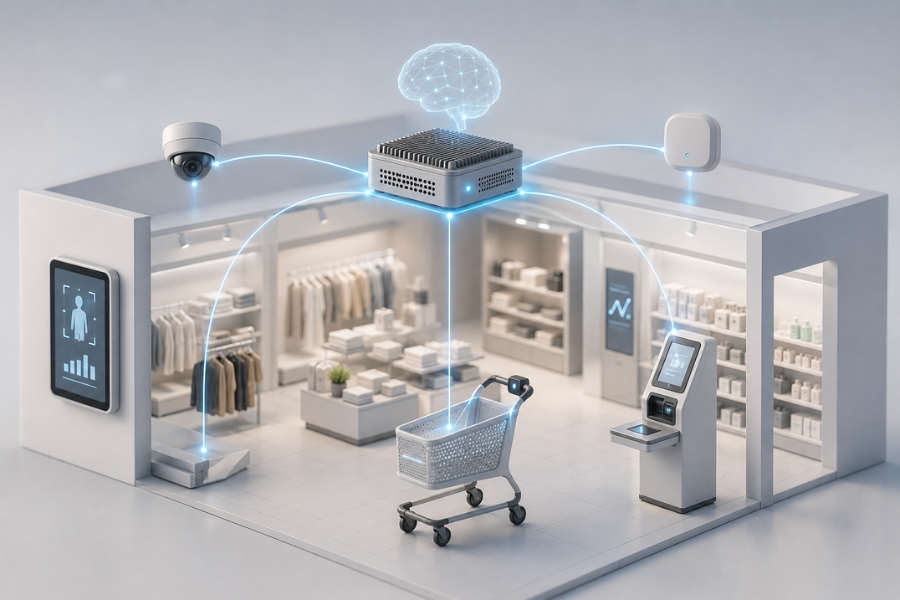
Edge computing in retail can be defined as placing general-purpose computers within store premises to host a wide variety of applications. By placing these computers physically close to sensors and IoT devices in the store, the time between capturing data in the physical environment through sensors and the time it is available to local applications is kept to an absolute minimum. It removes the need for the data to travel to a remote data centre and back.
By hosting applications on in-store edge computing infrastructure, retailers avoid the need to send data to the cloud and back and instead transact data faster and more reliably. This shift to hosting applications at the in-store edge is key to the future of retail stores because it provides intrinsic benefits above and beyond what can be done on traditional centralised IT infrastructure.
The benefits are not merely technical. Edge AI improves the performance of connected devices by enabling real-time data processing and decision-making directly at the device level, which reduces latency and boosts operational efficiency. This translates directly into business outcomes: faster service, improved customer satisfaction, and more efficient store operations.
Retail Remains Hardware-Heavy
Despite years of cloud evangelism, digital retail still relies heavily on on-premise hardware. Whether for video surveillance, point-of-sale systems or store infrastructure, PCs and servers remain deeply embedded in daily operations. Major grocery chains continue to run full rack units of local hardware in many stores, a reflection of retail’s inherently conservative IT philosophy.
Cloud adoption progresses far more slowly in retail than in most other industries, simply because latency, reliability and security cannot be compromised during peak hours at checkout or when handling sensitive store data.
Now, Edge AI is rapidly becoming a requirement for new in-store use cases. Video analytics for loss prevention, interactive applications for customers and employees and increasingly complex operational workflows all demand sub-second responsiveness. Cloud-based AI, with its longer latency, is too slow and too risky for business-critical in-store decisions.
Inventory management, logistics optimisation and operational analytics further strengthen the case for bringing AI closer to the shop floor. Retailers and enterprises are rediscovering the edge as a crucial middle layer between devices and the cloud, enabling resilience, lower latency, and local data processing.
What Edge AI Enables
The applications of edge AI in retail are already broad and growing. According to industry analysis, edge AI enables predictive restocking, autonomous decision-making and instant customer flow optimisation by processing data locally rather than waiting for centralised cloud systems. Modern retail locations are becoming intelligent environments where edge AI powers predictive restocking, customer flow optimisation and autonomous decision-making.
Embedded smart cameras and sensors identify when products are sold out or picked up and track customer traffic flow anonymously, enabling real-time inventory management and layout optimisation. This combination of multi-model sensors, video cameras, scales, RFID scanners, along with requirements around hyper-local access to data sources for rapid response times drives the need for hosting critical software components within the store.
The applications built on this data- and AI-centric foundation range from more traditional “stores that know what’s missing from inventory” to more forward-looking smart physical shopping carts that use on-cart cameras, weight sensors and deep learning models to track items going in and out of the cart and ensure accurate pricing.
Research presented in April 2026 demonstrated that Edge AI can transform retail networks by making smart and autonomous decisions at the edge level. A June 2026 paper proposed a new solution to improve real-time inventory management of retail networks with the help of Edge AI.
The Market Reality
The numbers tell a clear story. The edge artificial intelligence in the retail market has grown exponentially in recent years. It will grow from $21.84 billion in 2025 to $28.53 billion in 2026 at a compound annual growth rate of 30.6 per cent. By 2030, the market is expected to reach $81.71 billion.
The growth in the historic period can be attributed to growth of physical retail analytics, early adoption of POS systems, expansion of IoT sensors, demand for personalised shopping and operational efficiency needs. The growth in the forecast period can be attributed to edge deployment in smart stores, demand for real-time insights, growth of omnichannel retail, AI-driven dynamic pricing and investment in cashierless stores.
Major trends anticipated include real-time in-store analytics, personalised edge-based recommendations, autonomous inventory optimisation, computer vision-powered retail and low-latency customer engagement.
The growing number of connected devices is significantly boosting the edge AI in retail sector. The surge in connected devices, fuelled by the widespread adoption of IoT technologies, leads to enhanced efficiency, automation, and real-time data exchange. Notably, the average number of connected devices in US households rose from 21 in 2022 to 25 in 2023.
Edge AI at Industry Events
The prominence of edge AI in retail was unmistakable at major industry events in 2026. At EuroShop 2026, AI-on-the-edge emerged as a key theme reshaping in-store infrastructure. Many retailers are beginning to experiment with locally deployed AI models for analytics, automation and personalised services, a development that often requires upgrading the in-store network. While the technology is still in its early stages, its presence at EuroShop was unmistakable.
At the NRF Big Show 2026, the conversation around edge and cloud computing was central. Industry panels debated the balance between cloud and edge computing, noting critical points such as privacy, response time and dependence on connectivity. The most successful implementations, according to industry observers, will start with data architecture, empower store associates with real-time information, and prepare for AI-driven commerce.
At Computex 2026, the conversation had clearly shifted from talking about AI’s potential to discussing its practical deployment. When processing happens at the edge, retailers can reduce latency, improve responsiveness and deliver a better in-store experience for both customers and staff.
The Challenge of Deployment
Deploying at the edge presents unique challenges in comparison to the data centre. Retail environments are often harsh, space-constrained and require hardware that can withstand demanding point-of-sale and back-of-house conditions. Yet these challenges are being addressed through specialised hardware designed for maintenance-free operation over years of service.
Tariffs have also impacted the market by increasing costs for imported cameras, sensors and hardware, primarily affecting large-scale brick-and-mortar deployments. However, they have also encouraged software optimisation, aiding efficient scaling.
Looking Ahead
The shift toward edge AI in retail represents a fundamental architectural change. As stores become smarter and more automated, the ability to compute locally becomes a necessity. What was once seen as a technical preference is now understood as an operational requirement.
The next era of intelligent computing happens at the edge, on the devices and sensors used every day. Retail is one of the industries best positioned to benefit from this shift. Industry projections suggest that by 2035, approximately 80 per cent of AI workloads will run at the edge rather than in centralised clouds.
For retailers, the question is no longer whether to adopt edge AI, but how quickly they can deploy the infrastructure needed to support it. The retailers who succeed will be those who treat edge computing not as an IT project but as the foundational layer upon which intelligent, responsive stores are built.
Sources:

You may also like
AI Agents Step Into the Store Manager’s Office

Pay Later Moves From the Shopping Basket to the Shop Counter